








































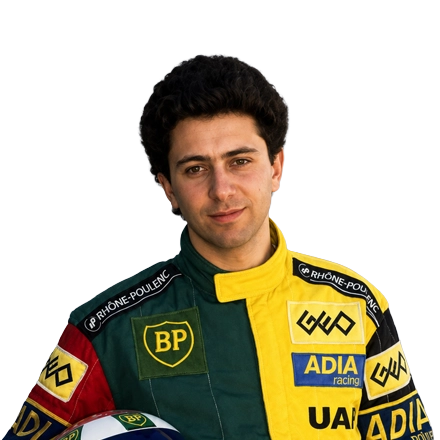
Born in Martigues, near Marseille, on 24 August 1964, Éric Bernard emerged as one of France’s most naturally gifted drivers of the late 1980s and early 1990s — a racer whose speed and technical ability earned him a place in Formula One and endurance racing. Although his Grand Prix career was repeatedly interrupted by injury, financial politics, and unstable teams, Bernard demonstrated flashes of exceptional talent against some of the strongest fields of his era.
Driver Bio
| Nationality | French |
| Birthplace | Martigues, France |
| Born | 24 August 1964 |
| First Grand Prix | 1989 French Grand Prix |
| Last Grand Prix | 1994 European Grand Prix |
| Years Active | 1989–1991, 1994 |
| Current/Last Team | Lotus |
Bernard’s motorsport journey began in karting in 1976, and over the next seven years, he established himself as one of France’s standout young prospects by winning four national karting titles. His performances earned him a place at the prestigious Winfield Racing School at Paul Ricard in 1983, where he competed in the famous Volant Elf talent competition. In a remarkable triumph, Bernard defeated future Formula One stars Jean Alesi and Bertrand Gachot to win the scholarship prize, securing a fully funded drive in Formula Renault for 1984.
His rise through the junior categories was swift. Bernard finished sixth in his debut Formula Renault campaign before dominating the championship the following year. From there, he graduated to French Formula Three in 1986, continuing his rapid progression by fighting at the front of the field and eventually finishing runner-up in the championship behind his long-time rival Alesi. By 1988, he had reached International Formula 3000, then considered the final stepping stone to Formula One.
Initially driving for the Ralt Team before switching to Bromley Motorsport and a Reynard chassis, Bernard impressed with his pace and consistency. A superb second-place finish at Dijon-Prenois helped him secure ninth in the championship. His breakthrough came in 1989 when he joined the highly regarded DAMS outfit, winning a race and finishing third overall in the Formula 3000 standings — performances that quickly attracted the attention of Formula One teams.
Formula One
Midway through 1989, Bernard received his Formula One opportunity when the French Larrousse team called him up for his home Grand Prix at Paul Ricard, replacing Yannick Dalmas. His debut immediately showcased his potential. In chaotic and fiercely competitive conditions, Bernard climbed as high as fifth place before running seventh late in the race, only for his Lamborghini V12 engine to fail near the finish. Coincidentally, the event also marked Jean Alesi’s own Formula One debut for Tyrrell, reviving a rivalry that had begun years earlier in the French junior ranks.
Bernard impressed enough to earn another appearance at the British Grand Prix before returning to complete his Formula 3000 season with DAMS. Larrousse then rewarded him with a full-time Formula One seat for 1990.
The 1990 season proved to be the strongest of Bernard’s Formula One career. Driving for the ambitious Larrousse-Lola team, he scored his first World Championship point with sixth place at Monaco before delivering a standout performance at Silverstone, where he finished an excellent fourth in the 1990 British Grand Prix. Bernard earned widespread praise for his driving style and ability to maximise the performance of underfunded machinery against more established teams.
He remained with Larrousse in 1991, but the season quickly became difficult. The team lost its Lamborghini engine deal, suffered financial problems, and had its 1990 championship points stripped by the FIA due to administrative irregularities. Despite the turmoil, Bernard still managed to score points with sixth place in the Mexican Grand Prix — the final points finish achieved by the Larrousse-Lola partnership.
As the season progressed, however, the team’s competitiveness collapsed. Bernard suffered the first failure to qualify of his Formula One career at the Portuguese Grand Prix during an emotionally difficult weekend following a personal bereavement. Worse still, tragedy struck later that year when he suffered a serious leg fracture during practice for the Japanese Grand Prix at Suzuka, abruptly ending his season and threatening his future in the sport.
Determined to return, Bernard spent 1992 recovering before securing a testing role with Ligier for 1993, helped by his long-time backers Elf. The patience paid off. Financial upheaval at Ligier ahead of the 1994 season opened a race seat alongside rookie Olivier Panis, giving Bernard a long-awaited return to Formula One.
The 1994 campaign was difficult but memorable. Ligier’s competitiveness was compromised by the team running an updated “B-spec” version of its previous year’s chassis — an increasingly outdated approach in modern Formula One. Nevertheless, Bernard delivered one of the best drives of his career at the German Grand Prix at Hockenheim. In a race filled with retirements and drama, he expertly guided his Ligier to third place, securing the only Formula One podium of his career.
Despite that success, Bernard’s Formula One future remained uncertain. By the European Grand Prix, he was replaced at Ligier by Johnny Herbert, only for Bernard to step directly into Herbert’s vacated Lotus seat for what would become his final Formula One appearance. Mika Salo subsequently took over the drive later in the season, and a planned return to Larrousse for 1995 disappeared when the team folded before the championship began.
Although his Formula One career ended earlier than many expected, Bernard successfully reinvented himself in endurance and GT racing. He became a highly respected sports car driver throughout the late 1990s, competing in GT championships and the American Le Mans Series. Driving for Panoz, he enjoyed major success and finished runner-up in the 1999 ALMS championship, proving his speed and adaptability long after leaving Formula One behind.
Éric Bernard’s career remains one of the sport’s great “what if” stories — a driver of immense natural talent whose progress was repeatedly disrupted by circumstance, injury, and unstable teams. Yet his determination, resilience, and flashes of brilliance ensured he remained one of the most respected French racers of his generation.
Grand Prix Stats
| Race Entries | 47 |
| Race Starts | 45 |
| Did Not Start | 2 |
| Best Race Start | 8th |
| Best Race Finish | 3rd |
| Retirements | 25 |
| First-Lap Retirements | 1 |
| Not Classified | 0 |
| Disqualified | 0 |
| Did Not Qualify | 2 |
Podiums
| Podiums | 1 |
| First Podium | 1994 German Grand Prix |
| Last Podium | 1994 German Grand Prix |
| 1st Place | 0 |
| 2nd Place | 0 |
| 3rd Place | 1 |
| Most Consecutive Podiums | 0 |
| Most Podiums in a Single Season | 1 (1994) |
| Seasons with Podiums | 1 |
Qualifying
| Qualifying Sessions | 47 |
| Reached Q3 | – |
| Q2 Eliminations | – |
| Q1 Eliminations | – |
| Did Not Qualify | 2 |
Points
| Points Scored | 10 |
| Points Finishes | 5 |
| Most Points in a Single Season | 5 (1990) |
| Seasons with Points | 3 |
Complete Formula One results
| Year | Entrant | Chassis | Engine | 1 | 2 | 3 | 4 | 5 | 6 | 7 | 8 | 9 | 10 | 11 | 12 | 13 | 14 | 15 | 16 | WDC | Points |
|---|---|---|---|---|---|---|---|---|---|---|---|---|---|---|---|---|---|---|---|---|---|
| 1989 | Equipe Larrousse | Lola LC89 | Lamborghini V12 | BRA | SMR | MON | MEX | USA | CAN | FRA 11 | GBR Ret | GER | HUN | BEL | ITA | POR | ESP | JPN | AUS | NC | 0 |
| 1990 | Espo Larrousse F1 | Lola LC89B | Lamborghini V12 | USA 8 | BRA Ret | 13th | 5 | ||||||||||||||
| Lola LC90 | SMR 13 | MON 6 | CAN 9 | MEX Ret | FRA 8 | GBR 4 | GER Ret | HUN 6 | BEL 9 | ITA Ret | POR Ret | ESP Ret | JPN Ret | AUS Ret | |||||||
| 1991 | Larrousse F1 | Larrousse Lola LC91 | Cosworth V8 | USA Ret | BRA Ret | SMR Ret | MON 9 | CAN Ret | MEX 6 | FRA Ret | GBR Ret | GER Ret | HUN Ret | BEL Ret | ITA Ret | POR DNQ | ESP Ret | JPN DNQ | AUS | 18th | 1 |
| 1994 | Ligier Gitanes Blondes | Ligier JS39B | Renault V10 | BRA Ret | PAC 10 | SMR 12 | MON Ret | ESP 8 | CAN 13 | FRA Ret | GBR 13 | GER 3 | HUN 10 | BEL 10 | ITA 7 | POR 10 | 18th | 4 | |||
| Team Lotus | Lotus 109 | Mugen Honda V10 | EUR 18 | JPN | AUS | ||||||||||||||||
Teammates & Qualifying Head-to-Head
| Teammate | Years | Races | Qualifying H2H |
|---|---|---|---|
| Philippe Alliot | 1989 | 2 | 0-2 |
| Aguri Suzuki | 1990, 1991 | 31 | 19-12 |
| Olivier Panis | 1994 | 13 | 3-10 |
| Alex Zanardi | 1994 | 1 | 0-1 |