




































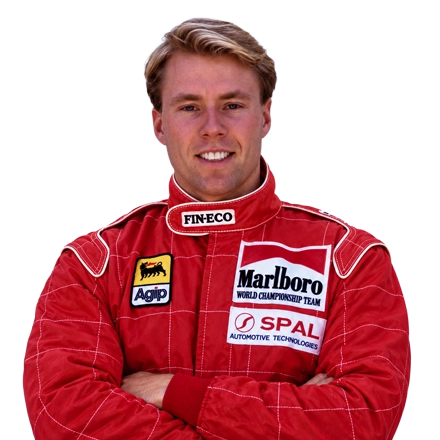
JJ Lehto’s career carried him from championship success in British Formula Three to a Formula One podium, then to two victories at the Le Mans 24 Hours. The Finnish driver could be exceptionally effective in difficult conditions, and endurance racing eventually gave him the sustained opportunities that an interrupted F1 career had not.
Driver Bio
| Nationality | Finnish |
| Birthplace | Espoo, Finland |
| Born | 31 January 1966 |
| First Grand Prix | 1989 Portuguese Grand Prix |
| Last Grand Prix | 1994 Australian Grand Prix |
| Years Active | 1989–1994 |
| Current/Last Team | Sauber |
Born Jyrki Juhani Järvilehto in Espoo on 31 January 1966, he started karting at eight and moved into Formula Ford at 15. Keke Rosberg became an important mentor and encouraged him to adopt the shorter racing name by which he became internationally known. The results soon made that name worth remembering.
Rosberg had won the 1982 World Drivers’ Championship, giving the young Finn access to advice from someone who had already navigated the route from junior racing to an F1 title. The mentorship continued beyond the choice of a shorter name: Rosberg later helped direct Lehto towards the DTM when the Grand Prix opportunities had run out.
After success in Scandinavian competition, Lehto won the British and European Formula Ford 2000 titles in 1987. The following season he became British Formula Three champion with Pacific Racing. Those consecutive steps suggested a straightforward progression towards the top, but International Formula 3000 in 1989 proved far less productive. He managed no podiums and missed the final round at Dijon.
Nevertheless, a Ferrari testing role demonstrated that F1 teams were paying attention. A race opportunity arrived later in 1989 with Onyx, where he replaced Bertrand Gachot. He failed to pre-qualify in Portugal, then made his first start at the following Spanish Grand Prix. In the rain-hit Australian finale he ran as high as fifth before electrical trouble ended the race, an encouraging performance hidden by the retirement column.
He remained with Onyx in 1990, but the team’s circumstances deteriorated as ownership changed and Peter Monteverdi became involved. Gregor Foitek joined him in the line-up, resources were limited and Lehto failed to qualify five times. The operation disappeared after the Hungarian Grand Prix. A promising driver’s first full season had offered little stability.
The distinction between appearing at a meeting and starting its race is important in this part of his record. Pre-qualifying could end a weekend before the main field began its qualifying sessions. Lehto accumulated seventy World Championship entries across his F1 career, but that figure includes unsuccessful attempts and should not be read as seventy race starts.
A move to BMS Scuderia Italia for 1991 brought a Dallara chassis, Judd V10 power and Emanuele Pirro as team-mate. The team still had to negotiate pre-qualifying, but at the wet San Marino Grand Prix Lehto emerged from an attritional race in third place.
Beppe Lucchini’s backing supported the Scuderia Italia operation, while Dallara supplied the car rather than entering it as an independent works team. The poor results of the previous season had left the new line-up facing the extra preliminary session, making the eventual podium a particularly substantial improvement in the team’s fortunes. It was his first points finish and would remain his only Formula One podium.
Reliability prevented that result from becoming the start of a regular run near the front. He finished only four other races that year. For 1992, Pierluigi Martini became his team-mate and Ferrari V12 engines powered the Dallara B192, but the car’s handling gave the drivers a difficult season. Seventh at Spa was Lehto’s best finish; at Hungary he failed to qualify. Another change was needed.
Sauber‘s arrival in F1 provided it. Lehto joined Karl Wendlinger for the Swiss team’s 1993 debut season, using Ilmor engines, and finished fifth at Kyalami on the team’s first appearance. Fourth at Imola followed despite a late engine problem. The early points suggested a strong foundation for both driver and team.
The remainder of the year was less rewarding. A collision with Wendlinger in Monaco complicated relations, and Lehto added no more points. Even so, his performances were sufficient to attract Benetton, which selected him to partner Michael Schumacher for 1994 after considering drivers including Michele Alboreto and Luca Badoer. It was the most competitive F1 seat of his career.
A neck injury in pre-season testing changed everything. Jos Verstappen contested the opening two rounds while Lehto recovered. The Finn returned at the San Marino Grand Prix and qualified fifth, but stalled on the grid; Pedro Lamy struck his stationary car at the start. On a weekend dominated by fatal accidents elsewhere, Lehto’s own comeback had begun with another frightening incident.
There were glimpses of speed afterwards. He ran third in Spain before the engine failed and was awarded sixth in Canada after Christian Fittipaldi‘s disqualification. Yet the injury had not fully healed, and the demands of racing made it difficult to regain his form. Verstappen replaced him again from the French Grand Prix.
Lehto returned for Italy and Portugal while Schumacher served a suspension, but Johnny Herbert then took over the Benetton seat. The final two races of Lehto’s F1 career came with Sauber, which still needed cover for Wendlinger and could not use Andrea de Cesaris. A year that had begun with the prospect of a front-running car ended with his Grand Prix future exhausted.
Touring cars offered a new direction in 1995 and 1996 through the DTM and its international counterpart, although no victories followed. Sports cars proved a better fit. In 1995 he made his third Le Mans appearance, sharing a McLaren F1 GTR with Yannick Dalmas and Masanori Sekiya. Their victory in rain-soaked conditions became one of the defining performances of his career, with Lehto’s night-time pace a major part of the success.
During those wet night stints he helped put the car into the lead, with contemporary accounts describing lap-time advantages reaching around thirty seconds over other runners. The performance stood out because conditions rewarded confidence and control as much as the car’s underlying speed. Lehto had joined the entry late, but became central to its race-winning effort.
Further McLaren sports-car outings followed in 1996, including another win. In 1997 he teamed with Steve Soper in BMW’s McLaren programme for the FIA GT Championship. Early results made them serious contenders, and the Thunder in Helsinki event gave Lehto a particularly memorable home-country success. Later in the season, however, Mercedes gained the upper hand and Bernd Schneider won the drivers’ title.
A move to CART in 1998 took Lehto to Hogan Racing with Mercedes power. The American campaign failed to produce the results he wanted, and he returned to sports cars the following year. That decision brought him into BMW’s V12 LMR programme just as the American Le Mans Series was establishing itself.
Lehto won four ALMS races in 1999, including Sebring. An American licence issue meant he did not receive championship points for that opening victory, a costly complication in the title contest. In 2000, the arrival of Audi’s R8 made life harder for BMW’s prototype team, but Lehto remained a major presence in endurance competition.
BMW then moved its emphasis to the M3 GTR. Lehto contested the ALMS GT class in 2001 and finished level on points with team-mate Jörg Müller, losing the championship on the tie-break procedure involving race statistics. It was another season in which the final standings did not fully convey how closely he had contested the title.
The tie-break favoured Müller through his greater number of fastest laps and laps led. For two drivers sharing the same car, those individual statistics could still separate their championship outcomes. It was a different frustration from the lost Sebring points in 1999, but again the decisive factor extended beyond the number of races the pairing had won.
He declined a BMW 320i European Touring Car Championship offer for 2002 and joined Cadillac’s Northstar programme instead. The team competed at Le Mans and in the ALMS, finding podium form late in the season, only for General Motors to close the project. Once more, Lehto needed a new home just as progress was becoming visible.
Champion Racing supplied one in 2003. Driving its Audi, he won four ALMS races, including Petit Le Mans. In 2004, with Audi’s works squad no longer contesting the full championship, Champion became the leading force and Lehto secured six wins and the title. It was his first championship since British F3 in 1988, a long wait answered with a thoroughly convincing season across the American series and its demanding endurance events.
His final full-time campaign in 2005 brought victories at both Sebring and Le Mans. The second Le Mans success arrived ten years after the first and with very different machinery, reinforcing his standing as an endurance specialist. The ALMS championship escaped him that season, but the major race wins ensured it remained an outstanding year.
Plans to race a Porsche RS Spyder for the proposed Solaroli operation, alongside Herbert, were discussed during 2006 and confirmed publicly in 2007, but the programme never reached competition. Lehto did appear at the 2007 Daytona 24 Hours with Krohn Racing, sharing a Pontiac-powered Riley with Colin Braun and Max Papis. Misfiring problems contributed to a 17th-place finish.
A further guest appearance came in Malaysia’s Speedcar event in 2008, when he replaced Narain Karthikeyan in the number 90 car. Such outings were increasingly occasional rather than the centre of his working life. He had also become familiar to Finnish television viewers through F1 commentary for MTV3 from 2001 to 2010, including the broadcaster’s MAX service and work alongside Oskari Saari. In 2011 he covered the DTM for URHOtv.
A separate and tragic episode occurred on 17 June 2010, when a boat struck a bridge at Jomalvik near Ekenäs in Finland. Lehto was injured and his friend died. A district court convicted Lehto on 14 December 2011 of offences including negligent homicide and boating while intoxicated, imposing a 28-month sentence. He appealed the decision.
On 30 November 2012, the Turku Court of Appeal acquitted him of all charges. The court found that the evidence did not establish who had been driving the boat. That acquittal is essential to an accurate account of the case: the earlier conviction was overturned, and should not be presented as the final legal outcome.
Lehto’s sporting record spans sharply different phases. The junior titles established his potential, the San Marino podium showed what he could achieve in F1, and injury disrupted his best Grand Prix opportunity. In endurance racing he found the setting for his greatest results, combining victories in the leading American series with two wins at the sport’s most famous 24-hour race.
Grand Prix Stats
| Race Entries | 70 |
| Race Starts | 62 |
| Did Not Start | 0 |
| Best Race Start | 4th |
| Best Race Finish | 3rd |
| Retirements | 36 |
| First-Lap Retirements | 3 |
| Not Classified | 1 |
| Disqualified | 0 |
| Did Not Qualify | 6 |
Podiums
| Podiums | 1 |
| First Podium | 1991 San Marino Grand Prix |
| Last Podium | 1991 San Marino Grand Prix |
| 1st Place | 0 |
| 2nd Place | 0 |
| 3rd Place | 1 |
| Most Consecutive Podiums | 0 |
| Most Podiums in a Single Season | 1 (1991) |
| Seasons with Podiums | 1 |
Qualifying
| Qualifying Sessions | 68 |
| Reached Q3 | – |
| Q2 Eliminations | – |
| Q1 Eliminations | – |
| Did Not Qualify | 6 |
Points
| Points Scored | 10 |
| Points Finishes | 4 |
| Most Points in a Single Season | 5 (1993) |
| Seasons with Points | 3 |
Stats by Season
| Year | Constructor | Entries | Starts | Wins | Podiums | Poles | Fastest Laps | Front Rows | DNF | Best Start | Best Result | Pts Finishes | Points | Championship |
|---|---|---|---|---|---|---|---|---|---|---|---|---|---|---|
| 1989 | Onyx | 4 | 2 | 0 | 0 | 0 | 0 | 0 | 2 | 17 | 12 | 0 | 0 | NC |
| 1990 | Onyx | 10 | 5 | 0 | 0 | 0 | 0 | 0 | 3 | 20 | 12 | 0 | 0 | NC |
| 1991 | Scuderia Italia SpA (Dallara) | 16 | 16 | 0 | 1 | 0 | 0 | 0 | 11 | 10 | 3 | 1 | 4 | 12th |
| 1992 | Scuderia Italia SpA (Dallara) | 16 | 15 | 0 | 0 | 0 | 0 | 0 | 6 | 7 | 7 | 0 | 0 | NC |
| 1993 | Sauber | 16 | 16 | 0 | 0 | 0 | 0 | 0 | 10 | 6 | 4 | 2 | 5 | 13th |
| 1994 | Benetton/Sauber | 8 | 8 | 0 | 0 | 0 | 0 | 0 | 4 | 8 | 6 | 1 | 1 | 25th |
Teammates & Qualifying Head-to-Head
| Teammate | Years | Races | Qualifying H2H |
|---|---|---|---|
| Stefan Johansson | 1989, 1990 | 6 | 2-4 |
| Gregor Foitek | 1990 | 8 | 3-5 |
| Emanuele Pirro | 1991 | 16 | 7-9 |
| Pierluigi Martini | 1992 | 16 | 8-8 |
| Karl Wendlinger | 1993 | 16 | 8-8 |
| Michael Schumacher | 1994 | 4 | 0-4 |
| Jos Verstappen | 1994 | 2 | 0-2 |
| Heinz-Harald Frentzen | 1994 | 2 | 0-2 |