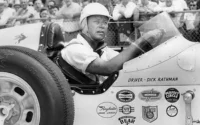



























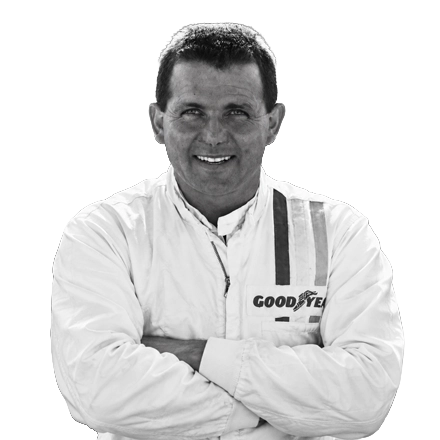
Jim Hurtubise’s racing life combined serious speed, remarkable resilience and a stubborn attachment to the front-engined Indianapolis car. Born in North Tonawanda, New York, on 5 December 1932, he became a winner in championship cars and NASCAR, an Indianapolis rookie sensation and one of American racing’s most distinctive characters.
Driver Bio
| Nationality | American |
| Birthplace | North Tonawanda, New York, USA |
| Born | 5 December 1932 |
| Died | 6 January 1989 |
| First Grand Prix | 1960 Indianapolis 500 |
| Last Grand Prix | 1960 Indianapolis 500 |
| Years Active | 1960 |
| Current/Last Team | Christensen |
His early competition involved a number 56 coupe prepared with his brother Pete, racing on short tracks in western New York and south-eastern Canada. Venues included Merrittville and Cuba Lake. After moving to California in the mid-1950s, he built his reputation in modifieds and sprint cars, progressing through IMCA and California Racing Association competition before reaching the national championship scene.
Hurtubise’s USAC Championship Car record covered 97 starts across 1959–68 and 1970–74. He finished in the top ten 38 times and won four races: Sacramento in 1959, Langhorne in 1960 and Springfield in both 1961 and 1962. His ability on dirt was an important part of that record, although Indianapolis brought him to a much wider audience.
At the 1960 500, his qualifying speed was the fastest of the meeting, approaching 150mph and exceeding Eddie Sachs‘s pole-winning pace by roughly 3mph. Qualifying later in the schedule meant that speed did not deliver pole position, but it helped earn Hurtubise Rookie of the Year honours. He finished 18th. Because Indianapolis still counted towards the World Drivers’ Championship, that race also constitutes his sole championship appearance; he scored no points and never started a conventional Formula One Grand Prix.
Across ten Indianapolis starts between 1960 and 1974, his best finish was 13th in 1962. Results alone, though, hardly explain his reputation. In the 1964 Rex Mays race at Milwaukee, he suffered severe burns to his hands. During treatment, he wanted them shaped so that he could still hold a steering wheel. His subsequent return to competition earned the Ralph DePalma Award and gave practical meaning to his reputation for determination.
Indianapolis machinery was changing rapidly. Hurtubise drove a Novi in 1965, only for its engine to fail on the opening lap in the type’s final appearance in the race. A rear-engined car brought 17th in 1966, followed by failure to qualify in 1967. He then returned with a project of his own.
Built with Pete, the Mallard was a front-engined car intended to challenge the increasingly universal rear-engined layout. Hurtubise argued for its relative lightness and familiar handling. In 1968 it became the last front-engined car to start the Indianapolis 500, securing a place in Speedway history even as the design direction of the sport moved elsewhere.
Further Mallard qualification attempts in 1969, 1970 and 1971 failed. In 1972, Hurtubise qualified a rear-engined car and finished 13th, but the Mallard still made an unforgettable appearance on bump day. With no engine installed, its engine compartment instead held five cases of chilled Miller beer. When qualifying ended, the contents were shared. The car had found a new way to attract a crowd.
A failed qualification in 1973 preceded his final Indianapolis start in 1974. He qualified 28th and was classified in the same position after an engine failure on lap 31. He failed to make the field in 1975, and the Mallard’s later attempts in 1976 and 1977 were no more successful.
The 1978 meeting brought a less light-hearted confrontation. Chief steward Tom Binford would not permit another attempt at what he considered an unsafe speed. Hurtubise then sat in Bob Harkey’s car for around ten minutes before running onto the track, where police intervened. The Mallard’s final Indianapolis qualifying attempt came in 1981, long after its underlying layout had disappeared from the race.
Outside Indianapolis, the car also appeared at Pocono in 1971, starting 33rd and finishing 30th. At Michigan in 1972, Hurtubise qualified 26th and finished 23rd in what became the final appearance of a front-engined car in a USAC Championship race. His loyalty to the concept was therefore written into more than one set of record books.
Stock cars supplied another major achievement. Between 1957 and 1977, Hurtubise made 36 starts in NASCAR’s top division, recording eleven top-ten finishes. His single victory came in the 1966 Atlanta 500, a substantial prize in a career spread across several forms of American racing. Winning on dirt, on paved championship circuits and in NASCAR underlined a versatility sometimes overshadowed by the Mallard stories.
Hurtubise died following a heart attack in Port Arthur, Texas, on 6 January 1989, aged 56, and was buried at Crown Hill Cemetery in Indianapolis. Recognition of his career continued after his death. He had been an inaugural inductee into the FOAR SCORE Hall of Fame in 1985, and was subsequently honoured by the National Sprint Car Hall of Fame in 1993, the Northeast Dirt Modified Hall of Fame in 1998 and the Greater Buffalo Sports Hall of Fame in 2004.
For all the mechanical experiments and famous anecdotes, the foundations of his reputation were straightforward: he was quick, he won important races and he returned from injuries that threatened the use of his hands. The entertaining stories belong in the record, but so does the formidable driver behind them.
The contrast between the 1960 qualifying sensation and the later Mallard campaigns is particularly striking. Hurtubise first impressed Indianapolis by being faster than the established field; years later, he was still trying to qualify a type of car the field had abandoned. Both episodes required a willingness to pursue his own approach, although their competitive outcomes were very different.
Grand Prix Stats
| Race Entries | 1 |
| Race Starts | 1 |
| Did Not Start | 0 |
| Best Race Start | 23rd |
| Best Race Finish | – |
| Retirements | 1 |
| First-Lap Retirements | 0 |
| Not Classified | 0 |
| Disqualified | 0 |
| Did Not Qualify | 0 |
Qualifying
| Qualifying Sessions | 1 |
| Reached Q3 | – |
| Q2 Eliminations | – |
| Q1 Eliminations | – |
| Did Not Qualify | 0 |
Stats by Season
| Year | Constructor | Entries | Starts | Wins | Podiums | Poles | Fastest Laps | Front Rows | DNF | Best Start | Best Result | Pts Finishes | Points | Championship |
|---|---|---|---|---|---|---|---|---|---|---|---|---|---|---|
| 1960 | Christensen | 1 | 1 | 0 | 0 | 0 | 0 | 0 | 1 | 23rd | n/a | 0 | 0 | NC |