



























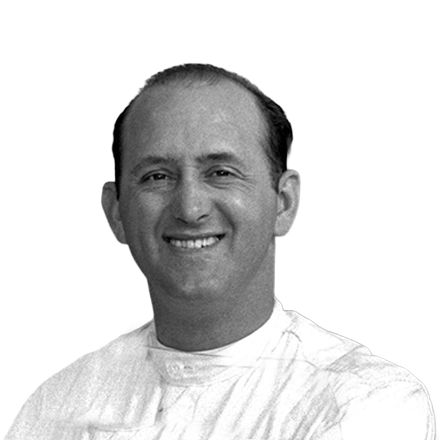
Edward Julius Sachs Jr. was one of the most charismatic and fearless figures ever to emerge from American auto racing. A star of the United States Auto Club circuit, Sachs built a reputation not only for raw speed and daring behind the wheel, but also for his larger-than-life personality, sharp wit, and unforgettable showmanship. To fans across the country, he became known as the “Clown Prince of Auto Racing,” a driver who could light up a racetrack with equal parts courage and charisma.
Driver Bio
| Nationality | American |
| Birthplace | Allentown, Pennsylvania, USA |
| Born | 28 May 1927 |
| Died | 30 May 1964 |
| First Grand Prix | 1957 Indianapolis 500 |
| Last Grand Prix | 1960 Indianapolis 500 |
| Years Active | 1953–1954, 1956–1960 |
| Current/Last Team | Ewing |
Born in Allentown, Pennsylvania, on May 28, 1927, Sachs grew up during the Great Depression and later served in the United States Navy during World War II. Like many racers of his era, he came from a blue-collar background and earned his way into the sport through grit, mechanical instinct, and relentless determination.
Rising Through the Racing Ranks
Sachs rose through the ranks of American open-wheel racing during the 1950s, becoming one of the standout competitors on the USAC Championship Trail. Across his career, he collected eight Championship Trail victories and scored 25 top-five finishes in 65 AAA and USAC starts. In 1958, he captured the USAC Midwest Sprint Car Championship, cementing his reputation as one of the toughest and most versatile drivers in the country.
Even in an era filled with fearless competitors, Sachs stood apart. He wasn’t just quick — he was entertaining. Fans packed grandstands to watch him race because they never quite knew what he might do next. He embraced the spotlight, joked constantly with reporters and competitors, and brought personality to a sport often dominated by stoic drivers.
Indianapolis 500 Stardom
The Indianapolis 500 became the stage where Sachs made his biggest impact. Between 1957 and 1964, he started the race eight consecutive times and developed a special connection with the Speedway crowd. He won pole position in both 1960 and 1961, proving he was among the fastest men in racing during one of the sport’s most dangerous eras.
His finest Indianapolis performance came in 1961. Sachs appeared destined for victory and was leading the race with only three laps remaining when his right rear tyre began to delaminate. In a split second, he had to decide whether to gamble on survival or pit for safety. Sachs chose caution, surrendering the lead — and ultimately the win — to A. J. Foyt.
He finished second, but never regretted the decision. Reflecting on the moment later, he famously said, “I’d sooner finish second than be dead.” The quote became one of the defining lines of his career and perfectly captured the razor-thin line drivers walked during that era of racing.
“If You Can’t Win, Be Spectacular”
Sachs became one of the most beloved personalities in motorsport thanks to his humour, honesty, and flair for drama. He coined the famous phrase, “If you can’t win, be spectacular,” a line that perfectly summed up both his approach to racing and his larger-than-life personality.
Nicknamed the “Clown Prince of Auto Racing,” Sachs understood something many drivers did not: racing was entertainment as much as competition. He played to the crowd, signed autographs endlessly, and became one of the first truly colourful personalities in American open-wheel racing.
But beneath the jokes and showmanship was a deeply respected competitor. Fellow drivers knew Sachs was fearless, mechanically sharp, and incredibly quick. His reputation inside the paddock matched the one he carried with fans in the grandstands.
The Tragedy of the 1964 Indianapolis 500
Tragically, Sachs’ life and career came to an end during the 1964 Indianapolis 500, one of the darkest days in the event’s history.
On the second lap of the race, rookie driver Dave MacDonald lost control of his Mickey Thompson-designed car while exiting Turn Four. The car slammed into the inside wall and exploded when its massive 45-gallon fuel load ignited, sending flames and smoke across the track.
As the burning car slid back toward the racing line, Sachs — following close behind — aimed for a narrowing gap near the outside wall. The opening disappeared almost instantly. Bob Veith narrowly squeezed through, but Sachs collided broadside with MacDonald’s car, triggering a second explosion that engulfed the Speedway in fire.
Behind them, Johnny Rutherford drove directly into the inferno with nowhere else to go, powering his way through the wreckage at full throttle. Several more drivers became involved as debris scattered and fuel tanks ruptured. Ronnie Duman suffered serious burns after another collision, while Bobby Unser and Rutherford escaped with comparatively minor injuries.
MacDonald, critically burned and suffering severe lung damage from inhaling flames, died later that day. Sachs was trapped in his car during the crash. Although his driver’s suit was only scorched, he sustained catastrophic injuries. Witnesses later stated they saw him attempting to escape the wreckage after impact. The exact cause of death was never conclusively determined, with possibilities including burns, asphyxiation, or blunt-force trauma.
One haunting detail survived the crash: a lemon Sachs had worn around his neck on a string for luck was later discovered inside Johnny Rutherford’s engine compartment.
A Crash That Changed Indy Forever
The horrifying accident was captured on film and broadcast around the world. For the first time in Indianapolis 500 history, the race was stopped because of an accident.
The public reaction was immediate and intense, forcing major changes to the sport. In the aftermath, USAC introduced fuel restrictions and mandatory pit stops, effectively ending the era of gasoline-powered Indy cars. From 1965 onward, the Indianapolis 500 transitioned to methanol and later ethanol-based fuels — a direct legacy of the tragedy that claimed the lives of Sachs and MacDonald.
The crash remains one of the most significant turning points in Indianapolis Motor Speedway history and permanently changed the conversation around safety in American motorsport.
World Championship Appearances
During the years when the Indianapolis 500 counted toward the Formula One World Championship, from 1950 through 1960, Sachs also appeared in FIA World Championship competition. He competed in four World Championship races during that period and started from pole position once, although he never scored championship points.
Personal Life
Away from the racetrack, Sachs married Nance McGarrity of Coopersburg, Pennsylvania, on June 3, 1959, in Indianapolis. The couple had one son, Edward Julius Sachs III, born in 1962.
Decades after Eddie’s death, Nance was laid to rest beside him at Holy Saviour Cemetery in Bethlehem, Pennsylvania. She was survived by their son and grandchildren, Edward IV and Meagan Sachs.
Their son followed the family passion into motorsport, racing dirt tracks throughout the Midwest under the name Eddie Sachs Jr. Although he never competed in the Indianapolis 500 like his father, he remained deeply involved in racing and later became both a businessman and part-time team owner in USAC competition.
Legacy
In 1999, Eddie Sachs was inducted into the National Sprint Car Hall of Fame, a fitting tribute to a driver remembered not only for his speed, but for his spirit.
More than sixty years after his death, Sachs remains one of the most iconic personalities in Indianapolis 500 history — a racer who embodied both the glamour and danger of America’s golden age of motorsport. Fast, fearless, funny, and unforgettable, Eddie Sachs left behind far more than statistics. He became a symbol of an era when drivers risked everything every time they climbed into the cockpit.
Grand Prix Stats
| Race Entries | 7 |
| Race Starts | 4 |
| Did Not Start | 0 |
| Best Race Start | 1st |
| Best Race Finish | – |
| Retirements | 4 |
| First-Lap Retirements | 0 |
| Not Classified | 0 |
| Disqualified | 0 |
| Did Not Qualify | 3 |
Pole Positions
| Pole Positions | 1 |
| First Pole | 1960 Indianapolis 500 |
| Last Pole | 1960 Indianapolis 500 |
| Most Consecutive Poles | 0 |
| Most Poles in a Single Season | 1 (1960) |
| Seasons with Poles | 1 |
Qualifying
| Qualifying Sessions | 7 (4 starts + 3 DNQ) |
| Reached Q3 | – |
| Q2 Eliminations | – |
| Q1 Eliminations | – |
| Did Not Qualify | 3 |
Front Row Starts
| Front Row Starts | 3 |
| Poles | 1 |
| 2nd on Grid | 2 |
| Most Front Row Starts in a Season | 1 (1957, 1959, 1960) |
| Seasons with Front Row Starts | 3 |
Stats by Season
| Year | Constructor | Entries | Starts | Wins | Podiums | Poles | Fastest Laps | Front Rows | DNF | Best Start | Best Result | Pts Finishes | Points | Championship |
|---|---|---|---|---|---|---|---|---|---|---|---|---|---|---|
| 1957 | Kuzma | 1 | 1 | 0 | 0 | 0 | 0 | 1 | 1 | 2nd | DNF | 0 | 0 | NC |
| 1958 | Kuzma | 1 | 1 | 0 | 0 | 0 | 0 | 0 | 1 | n/a | DNF | 0 | 0 | NC |
| 1959 | Kuzma | 1 | 1 | 0 | 0 | 0 | 0 | 1 | 1 | 2nd | DNF | 0 | 0 | NC |
| 1960 | Ewing | 1 | 1 | 0 | 0 | 1 | 0 | 1 | 1 | 1st | DNF | 0 | 0 | NC |