


























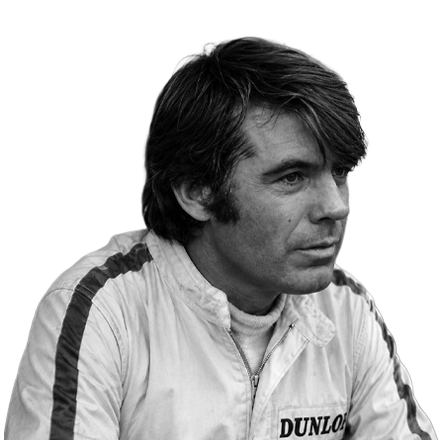
John Cannon was a fiercely versatile racing driver whose career spanned sports cars, Can-Am, Formula 5000, Formula Two, Indy cars, and Formula One. Though born in London, England, Cannon raced under the Canadian flag and became one of Canada’s most loved and accomplished international drivers of the 1960s and 1970s.
Driver Bio
| Nationality | Canadian |
| Birthplace | Hammersmith, England, UK |
| Born | 21 June 1937 |
| Died | 18 October 1999 |
| First Grand Prix | 1971 United States Grand Prix |
| Last Grand Prix | 1971 United States Grand Prix |
| Years Active | 1971 |
| Current/Last Team | BRM |
Known for his adaptability, Cannon built a reputation as a driver capable of succeeding in almost any type of machinery. Whether competing in thunderous Can-Am monsters, nimble Formula Two cars, or brutal Formula 5000 single-seaters, he proved himself against some of the strongest fields in world motorsport.
Cannon first established himself in North American sports car racing, competing in the fiercely competitive United States Road Racing Championship (USRRC). Driving for Nickey Chevrolet, he raced a Genie/Vinegaroon sports car sponsored by actor Dan Blocker, famous worldwide for playing Hoss Cartwright in the television series Bonanza. The combination of booming V8 power and Cannon’s aggressive but controlled driving style made him a natural fit for the fast-growing North American road racing scene.
When the legendary Can-Am Series launched in 1966, Cannon quickly emerged as one of Canada’s leading drivers. In the inaugural season, he became the top-finishing Canadian competitor thanks largely to an outstanding fourth-place finish at the opening race at Circuit Mont-Tremblant in Quebec — effectively his home event.
Two years later, Cannon delivered one of the most memorable performances of his career. At Laguna Seca in 1968, driving in treacherously wet conditions, he scored a famous victory against the all-conquering McLaren team, whose dominance of Can-Am had seemed almost untouchable. Beating McLaren during that era was considered a major achievement, and Cannon’s wet-weather triumph became one of the defining moments of his racing life. He would again finish as the top Canadian in the Can-Am standings in 1973.
Alongside his sports car success, Cannon also became a major force in Formula 5000, then one of the fastest and most spectacular single-seater categories in the world.
In 1969, competing in the Continental Series, Cannon drove a Malcolm Starr-entered Eagle prepared by Tom Jobe and Bob Skinner. That season he claimed victories at Riverside, Sears Point, and Mosport, finishing fourth overall in the championship standings.
The following year proved even better.
Driving the Hogan-Starr Racing McLaren M10B for Malcolm Starr and St. Louis trucking magnate Carl Hogan, Cannon captured the 1970 Formula 5000 championship with victories at Riverside, Kent, and Elkhart Lake. The title established him as one of the top open-wheel racers in North America and demonstrated his ability to combine outright speed with consistency across a full championship campaign.
His success also earned him opportunities overseas. In 1971, Cannon competed in the Tasman Series for Hogan Racing, finishing tied for ninth in the standings against many of the world’s leading drivers. That same year, he impressed observers in several rounds of the European Formula Two Championship, where his performances against future Formula One stars strengthened his international reputation.
Formula One
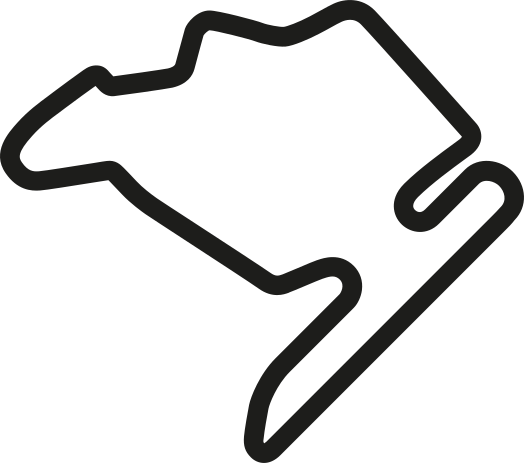
Cannon’s Formula One World Championship career officially consisted of a single Grand Prix appearance. He entered the 1971 United States Grand Prix at Watkins Glen and finished 14th, although he did not score championship points. He also competed in the non-championship Questor Grand Prix, finishing 12th.
USAC
In addition to road racing and Formula racing, Cannon also competed in the USAC Championship Car series — the world of Indy car racing — making 15 starts between 1968 and 1974 while competing part-time. His best result came with a second-place finish at Circuit Mont-Tremblant in 1968, the same year he achieved a career-best 27th in the USAC standings. He twice attempted to qualify for the Indianapolis 500, in 1970 and 1974, but failed to make the starting field on both occasions.
Even after the peak of his Formula 5000 success, Cannon continued racing internationally. In 1975 and 1976, he returned to the US Formula 5000 series driving a modified March 741, competing strongly despite increasingly fierce competition and limited financial resources. His best results during that period included fourth place at Riverside in 1975 and sixth place at the same circuit in 1976 during the final years of the original US F5000 era.
At the time, Cannon was associated with Hollywood Sports Cars, the Los Angeles Ferrari dealership operation where he worked, although financial pressures and escalating engine costs often limited his competitiveness against factory-backed rivals.
Even so, his talent remained clear whenever conditions suited him. During 1976, he travelled internationally once again, contesting rounds of the British Shellsport F5000/F1/Libre series and proving competitive against European opposition. Earlier that same year, he competed in Australia’s Rothmans Formula 5000 series and won the Sandown Park round — another major international victory in an already remarkably diverse career.
Cannon’s final serious racing appearances came two years later in the Australian Rothmans series. At 45 years old, long after many rivals had retired, he still managed to secure a podium finish through experience, reliability, and racecraft.
Hall Of Fame
In recognition of his achievements, John Cannon was inducted into the Canadian Motorsport Hall of Fame in 1993, cementing his place among Canada’s most important racing figures.
Motorsport also remained part of the family legacy. His son, Michael Cannon, built a successful career as a race engineer and later worked in the Champ Car World Series, including serving as race engineer for A. J. Allmendinger at Forsythe Racing during the 2006 season.
Death
John Cannon died on 18 October 1999 after the kit aircraft he was piloting crashed near Quemado, New Mexico.
Grand Prix Stats
| Race Entries | 1 |
| Race Starts | 1 |
| Did Not Start | 0 |
| Best Race Start | 24th |
| Best Race Finish | 14th |
| Retirements | 0 |
| First-Lap Retirements | 0 |
| Not Classified | 0 |
| Disqualified | 0 |
| Did Not Qualify | 0 |
Qualifying
| Qualifying Sessions | 1 |
| Reached Q3 | 0 |
| Q2 Eliminations | 0 |
| Q1 Eliminations | 0 |
| Did Not Qualify | 0 |
Stats by Season
| Year | Constructor | Entries | Starts | Wins | Podiums | Poles | Fastest Laps | Front Rows | DNF | Best Start | Best Result | Pts Finishes | Points | Championship |
|---|---|---|---|---|---|---|---|---|---|---|---|---|---|---|
| 1971 | BRM | 1 | 1 | 0 | 0 | 0 | 0 | 0 | 0 | 24 | 14 | 0 | 0 | NC |
Stats by Constructor
| Constructor | Years | Entries | Starts | Wins | Podiums | Poles | Fastest Laps | Front Rows | DNF | Best Start | Best Result | Pts Finishes | Points |
|---|---|---|---|---|---|---|---|---|---|---|---|---|---|
| BRM | 1971 | 1 | 1 | 0 | 0 | 0 | 0 | 0 | 0 | 24 | 14 | 0 | 0 |
Teammates & Qualifying Head-to-Head
| Teammate | Years | Races | Qualifying H2H |
|---|---|---|---|
| Helmut Marko | 1971 | 1 | – |
| Howden Ganley | 1971 | 1 | – |
| Peter Gethin | 1971 | 1 | – |
| Jo Siffert | 1971 | 1 | – |