























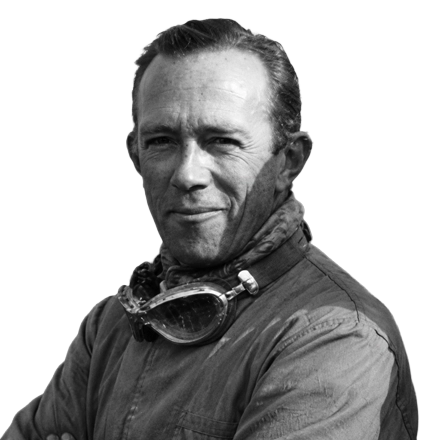
Juan Jover Sañes was one of the pioneering figures of Spanish motorsport — a versatile racer who competed across Grand Prix racing, endurance events and hillclimbs during the dangerous and fast-evolving post-war era of European motorsport.
Driver Bio
| Nationality | Spanish |
| Birthplace | Barcelona, Spain |
| Born | 23 November 1903 |
| Died | 28 June 1960 |
| First Grand Prix | 1951 Spanish Grand Prix |
| Last Grand Prix | 1951 Spanish Grand Prix |
| Years Active | 1951 |
| Current/Last Team | Scuderia Milano |
Born in Barcelona, Jover became one of the first Spanish drivers to break onto the international racing scene at a time when the country had little representation in top-level competition. Alongside Paco Godia, he earned his place in F1 history as one of the first Spaniards ever to compete in Formula One.
Jover first built his reputation in Grand Prix racing during the late 1940s. Driving for Scuderia Milano-Maserati, he competed in the 1947 Bari Grand Prix, finishing sixth against a strong European field. A year later, he continued his rise with another solid performance at the 1948 Albi Grand Prix, where he finished seventh.
His versatility behind the wheel soon became clear. While many drivers specialised in a single discipline, Jover proved equally capable in endurance racing. In 1949, he achieved one of the standout results of his career by finishing second in the legendary 24 Hours of Le Mans alongside French driver Henri Louveau — a remarkable accomplishment in one of motorsport’s toughest and most prestigious events.
In 1951, Jover stepped onto the Formula One stage at the 1951 Spanish Grand Prix. Driving a Maserati, again for Scuderia Milano, he qualified 18th for the race, officially becoming one of Spain’s Formula One pioneers. However, his Grand Prix hopes ended before the start after engine failure forced him out prior to the race itself.
Following his Formula One appearance, Jover increasingly focused on hillclimbing and endurance competition, including races with the ambitious Spanish manufacturer Pegaso. But motorsport in the 1950s carried enormous risks, and in 1953 he suffered a major setback while testing a Pegaso Z-102 ahead of the 24 Hours of Le Mans. A serious crash left him with significant injuries to his left leg.
True to the resilience shown by so many drivers of his era, Jover fought his way back to competition and returned to hillclimbing in June 1954.
His later years in racing brought renewed success. In 1957, he won the Gran Premio de Barajas driving a Maserati 200S, proving he remained fiercely competitive despite his earlier injuries. The following year, he added another notable victory by winning the famous La Rabassada hillclimb in a Mercedes-Benz 300SL.
Tragically, Jover’s life ended in 1960 in a road accident near Sitges in Catalonia. His convertible reportedly left the road and plunged off a cliff, bringing an end to the life of one of Spain’s earliest international racing stars.
Grand Prix Stats
| Race Entries | 1 |
| Race Starts | 0 |
| Did Not Start | 1 |
| Best Race Start | – |
| Best Race Finish | – |
| Retirements | 0 |
| First-Lap Retirements | 0 |
| Not Classified | 0 |
| Disqualified | 0 |
| Did Not Qualify | 0 |
Qualifying
| Qualifying Sessions | 0 |
| Reached Q3 | 0 |
| Q2 Eliminations | 0 |
| Q1 Eliminations | 0 |
| Did Not Qualify | 0 |
Stats by Season
| Year | Constructor | Entries | Starts | Wins | Podiums | Poles | Fastest Laps | Front Rows | DNF | Best Start | Best Result | Pts Finishes | Points | Championship |
|---|---|---|---|---|---|---|---|---|---|---|---|---|---|---|
| 1951 | Scuderia Milano | 1 | 0 | 0 | 0 | 0 | 0 | 0 | 0 | – | DNS | 0 | 0 | Never classified |
Stats by Constructor
| Constructor | Years | Entries | Starts | Wins | Podiums | Poles | Fastest Laps | Front Rows | DNF | Best Start | Best Result | Pts Finishes | Points |
|---|---|---|---|---|---|---|---|---|---|---|---|---|---|
| Scuderia Milano | 1951 | 1 | 0 | 0 | 0 | 0 | 0 | 0 | 0 | – | DNS | 0 | 0 |
Teammates & Qualifying Head-to-Head
| Teammate | Years | Races | Qualifying H2H |
|---|---|---|---|
| Francisco Godia | 1951 | 1 | – |