






















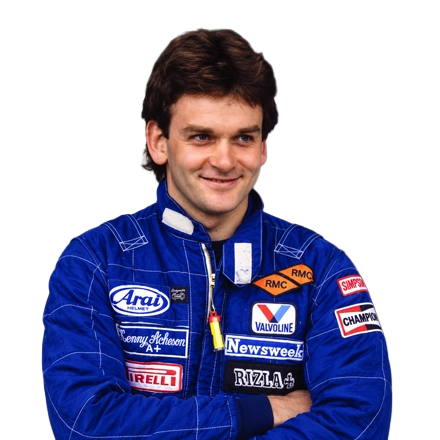
Kenneth Henry “Kenny” Acheson (born 27 November 1957) is a British former racing driver from Northern Ireland whose career encompassed Formula One, Japanese single-seaters and international sports cars.
Driver Bio
| Nationality | British |
| Birthplace | Cookstown, Northern Ireland, UK |
| Born | 27 November 1957 |
| First Grand Prix | 1983 British Grand Prix |
| Last Grand Prix | 1985 Italian Grand Prix |
| Years Active | 1983, 1985 |
| Current/Last Team | RAM |
Acheson competed for RAM in the 1983 and 1985 Formula One seasons. He made three Grand Prix starts, reaching the finish only once: 12th at the 1983 South African Grand Prix. His greatest successes came later, including the 1987 Japanese Sports-Prototype Championship and three podium finishes at the 24 Hours of Le Mans.
Career
Early years
Born in Cookstown, Acheson was the youngest of three children. His father owned an Ulster brickworks and was himself a competitor, racing motorcycles and Formula Fords during the 1970s.
Kenny’s first serious test came at Kirkistown in 1976, driving his father’s old Crosslé Formula Ford 1600. Despite his inexperience, he was soon circulating within three seconds of the lap record.
He entered his first race at the same circuit later that year and performed well enough for his father to offer him a deal: give up smoking, and a new Crosslé would follow for 1977.
Acheson accepted the terms—and promptly won the Northern Ireland Formula Ford 1600 Championship.
Formula Ford and Formula Three
He moved to England in 1978 and entered three Formula Ford championships in one of Alan Cornock’s RMC-backed Royales. Acheson dominated the season, winning 29 races and capturing all three titles. His performances also earned him a Grovewood Award.
Formula Three followed in 1979. Acheson began with a second-hand Ralt before ordering a new March 793 in pursuit of greater competitiveness. He did not win a championship round, although he set fastest lap in the Formula Three support race at the British Grand Prix and collected three victories in non-championship events.
For 1980, Acheson joined Murray Taylor Racing in the Vandervell British Formula Three Championship. He led the standings at mid-season, ahead of Project Four driver Stefan Johansson.
The contest swung after Johansson received a new Ralt RT3 and began closing the gap. A small mistake by Acheson at the final round allowed the Swede to take the title.
Formula Two accident and comeback
Acheson graduated to European Formula Two in 1981 with Docking Spitzley Racing, driving a Toleman TG280.
His season ended violently on the streets of Pau. While fighting Michele Alboreto for the lead, the pair ran side by side until Acheson was left with nowhere to go. His car crashed heavily and came to rest in a tree.
Both of Acheson’s legs were badly broken, and he was fortunate to survive. Nevertheless, he recovered in time to return for 1982 with the Ralt-Honda team, finishing seventh in the European Championship.
Maurer Motorsport gave him a factory Formula Two drive for 1983. Later that year, RMC backing helped him secure a Formula One opportunity with John Macdonald’s RAM operation.
Formula One
RAM’s bulky March offered little chance of success. Acheson entered seven Grands Prix without qualifying before finally earning a place on the grid at the season-ending South African Grand Prix. He finished 12th, four laps behind the winner.
Without a drive in 1984, Acheson returned to RAM during the 1985 season following the death of Manfred Winkelhock in a sports-car accident at Mosport.
The Hart-powered RAM 03 was more competitive than its predecessor, allowing Acheson to qualify in Austria and Italy. He retired from both races, however, and the drive disappeared when his funding ran out. His Formula One career ended with three starts and no championship points.
CART
Acheson also made a brief attempt to establish himself in American Indy-car racing.
He was entered at Indianapolis in a Lola T800-Cosworth but did not drive. At the Meadowlands, he crashed a March 83C, then failed to qualify at Elkhart Lake. Another practice accident followed at Laguna Seca in the Skoal Bandit Lola.
The American experiment produced no race starts, prompting Acheson to seek opportunities elsewhere.
Japan and sports cars
Acheson rebuilt his career in Japan, racing for Kunimitsu Takahashi’s Advan-backed Alpha team in Formula 3000 and sports-car competition.
The move paid off in 1987 when he won the Japanese Sports-Prototype Championship. That title brought him back to Europe with Sauber-Mercedes for 1988. He was due to race at Le Mans, but the team withdrew its cars during practice because of tyre concerns.
Acheson contested a complete season with Sauber-Mercedes in 1989. Sharing a C9 with Mauro Baldi and Gianfranco Brancatelli, he finished second at Le Mans. Further victories followed at Brands Hatch and Spa.
Despite those performances, Sauber released him at the end of the year. Acheson joined Nissan for the 1990 World Sportscar Championship and returned to Le Mans in the fearsome R90CK. The race ended before it began when gearbox failure struck on the warm-up lap.
Silk Cut Jaguar recruited him for 1991. Driving an XJR-12, Acheson finished third at Le Mans to earn his second podium at the event.
Toyota supplied another opportunity in 1992. Sharing the Tony Southgate-designed TS010, he finished second and collected a third Le Mans podium in four years. A return with Toyota in 1993 ended in retirement.
When the World Sportscar Championship disappeared, Acheson moved into Japanese GT racing with SARD. That relationship led to his final Le Mans appearance in 1995, driving the ambitious SARD MC8-R. Complete brake failure forced the car out after only 14 laps.
Retirement
Acheson joined Lister for the 1996 24 Hours of Daytona, driving a Newcastle United-liveried Storm with Geoff Lees and Tiff Needell.
In the closing stages, a slower car struck the Lister and triggered a violent accident that destroyed it. Acheson escaped without serious injury but decided he had pushed his luck far enough.
He walked away from the wreck—and from professional racing.
Grand Prix Stats
| Race Entries | 10 |
| Race Starts | 3 |
| Did Not Start | 0 |
| Best Race Start | 23rd |
| Best Race Finish | 12th |
| Retirements | 2 |
| First-Lap Retirements | 0 |
| Not Classified | 0 |
| Disqualified | 0 |
| Did Not Qualify | 7 |
Qualifying
| Qualifying Sessions | 10 |
| Reached Q3 | 0 |
| Q2 Eliminations | 0 |
| Q1 Eliminations | 0 |
| Did Not Qualify | 7 |
Stats by Season
| Year | Constructor | Entries | Starts | Wins | Podiums | Poles | Fastest Laps | Front Rows | DNF | Best Start | Best Result | Pts Finishes | Points | Championship |
|---|---|---|---|---|---|---|---|---|---|---|---|---|---|---|
| 1983 | RAM | 7 | 1 | 0 | 0 | 0 | 0 | 0 | 0 | 24 | 12 | 0 | 0 | NC |
| 1985 | RAM | 3 | 2 | 0 | 0 | 0 | 0 | 0 | 2 | 23 | – | 0 | 0 | NC |
Teammates & Qualifying Head-to-Head
| Teammate | Years | Races | Qualifying H2H |
|---|---|---|---|
| Philippe Alliot | 1985 | 3 | 1-2 |