
































Lee Wallard was an American racing driver whose career reads like a Hollywood script—slow-burning, hard-fought, and culminating in one of the most stirring underdog triumphs in Indianapolis history. Long overlooked in the upper ranks of the sport, Wallard delivered a masterclass at the 1951 Indianapolis 500, dominating the field in a performance for the ages. Within days, however, fate intervened: a fiery crash during a promotional appearance inflicted devastating burns that abruptly ended his racing career.
| Nationality | American |
|---|---|
| Born | Leland Wallard 7 September 1910 Schenectady, New York, U.S. |
| Died | 29 November 1963 (aged 53) St. Petersburg, Florida, U.S. |
Born in Schenectady, New York, Wallard was not a prodigy groomed for greatness. He was a grinder—someone who built his craft lap by lap. He began racing in 1935 on dirt tracks and at local fairgrounds, venues that rewarded bravery. Progress came slowly. Early on, he suffered a serious accident that left him with a broken pelvis—an injury that would have persuaded many drivers to walk away.
In 1941, he made his first appearance in a Championship Car event at the Syracuse 100, stepping onto a bigger stage just as the world was shifting toward war.
When the United States entered World War II, Wallard enlisted in the U.S. Navy and served with the Navy Seabees. Stationed in Alaska for part of the conflict, he operated bulldozers and helped construct critical airfields. The war years interrupted his racing ambitions, but they also forged the discipline that would later define his greatest hour.
Post-War Resurgence
After the war, Wallard returned to competition with renewed purpose, increasingly racing at the AAA Championship level. In the unusual, transitional 1946 season, he captured his first “big car” victory. Two years later, in 1948, he secured his second major triumph at DuQuoin—this time a standard Championship Car event. By then, Wallard was no overnight sensation. He was a veteran.
A Cinderella Story at the 1951 Indianapolis 500
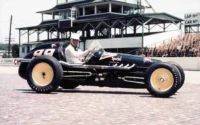
The defining moment of Wallard’s career came at the 1951 Indianapolis 500. At 40 years old—an age when many drivers were considered past their peak—Wallard climbed into the No. 99 Belanger Special. The ride had been passed over by Tony Bettenhausen, who opted instead for a newer front-wheel-drive machine. That decision opened the door for Wallard.
Starting from the front row, Wallard dictated the pace. Competitors struggled to keep up, and in many cases, their equipment simply couldn’t withstand the relentless tempo he set. Over 200 laps, he led 159 of them—an extraordinary display of control and endurance. When the checkered flag fell, he had become the first driver in history to complete the Indianapolis 500 in under four hours.
A Career Cut Short
Triumph turned to tragedy with cruel speed.
Just one week after his Indianapolis victory, Wallard was competing in a race in Reading, Pennsylvania, when his car erupted in flames on the home stretch. He suffered severe burns and endured 27 skin graft operations in the aftermath. The injuries were catastrophic.
In 1954, demonstrating characteristic resolve, Wallard attempted a comeback at Indianapolis. But during preparations he discovered that the muscle tissue he had lost in the fire made it impossible to control the car at competitive speeds. Reluctantly, he withdrew before qualifications. His driving career was over.
World Drivers’ Championship Record
From 1950 through 1960, the Indianapolis 500 counted toward the FIA World Drivers’ Championship. As a result, drivers at Indianapolis during those years earned World Championship participation and could score points alongside their AAA/USAC standings.
Wallard competed in two World Drivers’ Championship events at Indianapolis. He claimed one victory, the 1951 Indianapolis 500, recorded one fastest leader lap, and accumulated nine World Championship points—a compact but distinguished record on the global stage.
Later Years & Death
In retirement, Wallard relocated to Florida. The physical toll of his injuries, however, never fully left him. On 29 November 1963, he died of a heart attack related to complications stemming from the burns he suffered in 1951.
Wallard was inducted into the Auto Racing Hall of Fame in 1955, a fitting recognition of his historic Indianapolis triumph. Decades later, in 2013, he was also honored by the Schenectady City School District Athletic Hall of Fame, bringing his story full circle to the community where it began.
Lee Wallard Formula One World Championship career
| F1 Career | 1950 – 1951, 1954 |
|---|---|
| Teams | Moore, Kurtis Kraft |
| Entries | 3 (2 starts) |
| Championships | 0 |
| Wins | 1 |
| Podiums | 1 |
| Career points | 9 |
| Pole positions | 0 |
| Fastest laps | 1 |
| First entry | 1950 Indianapolis 500 |
| First win | 1951 Indianapolis 500 |
| Last win | 1951 Indianapolis 500 |
| Last entry | 1954 Indianapolis 500 |
Lee Wallard Wins
| Win No. | Grand Prix |
|---|---|
| 1 | 1951 Indianapolis 500 |
Lee Wallard Teammates
| 4 drivers | Involvement | First Year | Last Year |
|---|---|---|---|
| George Connor | 1 | 1950 | |
| Bill Holland | 1 | 1950 | |
| Tony Bettenhausen | 1 | 1950 | |
| Walt Faulkner | 1 | 1954 |
Lee Wallard Complete Formula One Results
| Year | Entrant | Chassis | Engine | 1 | 2 | 3 | 4 | 5 | 6 | 7 | 8 | 9 | WDC | Pts |
|---|---|---|---|---|---|---|---|---|---|---|---|---|---|---|
| 1950 | Blue Crown Spark Plug | Moore | Offenhauser L4 | GBR | MON | 500 6 | SUI | BEL | FRA | ITA | NC | 0 | ||
| 1951 | Belanger Motors | Kurtis Kraft | Offenhauser L4 | SUI | 500 1 | BEL | FRA | GBR | GER | ITA | ESP | 7th | 9 | |
| 1954 | Belanger Motors | Kurtis Kraft D | Offenhauser L4 | ARG | 500 DNQ | BEL | FRA | GBR | GER | SUI | ITA | ESP | NC | 0 |