




























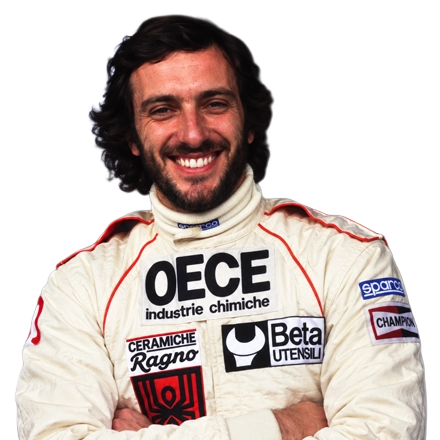
Siegfried Stohr (born 10 October 1952) is an Italian former racing driver who reached Formula One with Arrows in 1981 after a successful climb through Formula Italia, Formula Three and Formula Two. He entered 13 Formula One World Championship Grands Prix, scoring no championship points, before stepping away from racing and later becoming closely involved in driver training and road safety.
Driver Bio
| Nationality | Italian |
| Birthplace | Rimini, Italy |
| Born | 10 October 1952 |
| First Grand Prix | 1981 United States Grand Prix West |
| Last Grand Prix | 1981 Italian Grand Prix |
| Years Active | 1981 |
| Current/Last Team | Arrows |
Early career
Stohr began his car-racing career in Formula Italia in 1976 and immediately showed promise, finishing second in the championship.
A year later he went one better, winning the 1977 Formula Italia title.
His progress continued in 1978 when he moved into Italian Formula Three. Driving a Chevron, Stohr won the Italian Formula Three Championship, giving him a second consecutive title and establishing himself as one of Italy’s most promising single-seater drivers.
Formula Two followed in 1979.
Stohr initially remained with Chevron machinery and produced strong performances at both Vallelunga and Pau, finishing second at each. He later switched to a March, although the change brought considerably less success.
For 1980, Stohr joined Alan Docking Racing and moved into a Toleman.
It proved to be another important season. He won at Enna and finished fourth in the European Formula Two Championship, doing enough to earn an opportunity at the highest level.
Formula One
Stohr joined Arrows for the 1981 Formula One season, partnering fellow Italian Riccardo Patrese.
It was a difficult step up.
Patrese immediately proved considerably quicker, while Stohr struggled to find his feet during the opening races of his rookie season. His performances were beginning to improve when his campaign was overshadowed by a frightening accident at the Belgian Grand Prix at Zolder.
Patrese’s Arrows stalled on the starting grid. Mechanic Dave Luckett ran onto the circuit in an attempt to restart the car, but the race-start procedure continued.
As the field accelerated away, Stohr was unable to avoid his stationary teammate and crashed into the rear of Patrese’s car. Luckett, who was still working on the Arrows, was struck and seriously injured.
The incident had a profound effect on Stohr.
His confidence suffered badly afterwards, and his performances declined during the remainder of the season. Arrows itself was also slipping backwards relative to its rivals, making an already difficult campaign even tougher.
Stohr’s Formula One career effectively came to an end at the Italian Grand Prix, where he crashed during qualifying.
He retired before the season had finished.
His World Championship record ultimately stood at 13 Grand Prix appearances and no points – a brief Formula One career that came after an impressive junior record but was heavily shaped by the traumatic events at Zolder.
Return to racing
Stohr remained away from serious competition for several years before making a short-lived comeback in 1989.
He entered the Italian Superturismo Championship driving a BMW M3, although the return proved brief and did not lead to another extended racing programme.
By then, his attention had increasingly shifted towards a very different side of motoring.
Life after Formula One
Stohr’s interests always extended beyond simply driving a racing car.
A psychology graduate from the University of Padua, he combined his academic background with his experience as a professional driver to concentrate on driving education and safety.
In 1982, shortly after leaving Formula One, Stohr established a racing school and safe-driving academy at the Misano circuit.
It became the foundation of his post-racing career, allowing him to apply lessons learned in competition to both performance driving and improving safety behind the wheel.
During the 1990s, Stohr also became a regular columnist for Italian motorsport weekly Autosprint. In addition to writing about racing, he contributed columns on driving safety to several other publications.
Stohr’s Formula One adventure lasted only a single season, but it was just one part of a broader career. Before reaching Grand Prix racing he had been a Formula Italia and Italian Formula Three champion, a Formula Two race winner and a genuine prospect on the European single-seater ladder.
Afterwards, rather than leaving driving behind entirely, he turned his experience towards teaching others – making racing technique, psychology and road safety the focus of a long second career.
Grand Prix Stats
| Race Entries | 13 |
| Race Starts | 9 |
| Did Not Start | 0 |
| Best Race Start | 13th |
| Best Race Finish | 7th |
| Retirements | 6 |
| First-Lap Retirements | 2 |
| Not Classified | 0 |
| Disqualified | 0 |
| Did Not Qualify | 4 |
Qualifying
| Qualifying Sessions | 13 |
| Reached Q3 | 0 |
| Q2 Eliminations | 0 |
| Q1 Eliminations | 0 |
| Did Not Qualify | 4 |
Stats by Season
| Year | Constructor | Entries | Starts | Wins | Podiums | Poles | Fastest Laps | Front Rows | DNF | Best Start | Best Result | Pts Finishes | Points | Championship |
|---|---|---|---|---|---|---|---|---|---|---|---|---|---|---|
| 1981 | Arrows | 13 | 9 | 0 | 0 | 0 | 0 | 0 | 6 | 13 | 7 | 0 | 0 | NC |
Stats by Constructor
| Constructor | Years | Entries | Starts | Wins | Podiums | Poles | Fastest Laps | Front Rows | DNF | Best Start | Best Result | Pts Finishes | Points |
|---|---|---|---|---|---|---|---|---|---|---|---|---|---|
| Arrows | 1981 | 13 | 9 | 0 | 0 | 0 | 0 | 0 | 6 | 13 | 7 | 0 | 0 |
Teammates & Qualifying Head-to-Head
| Teammate | Years | Races | Qualifying H2H |
|---|---|---|---|
| Riccardo Patrese | 1981 | 13 | 0-13 |