
































Formula 1 is preparing multiple versions of its 2027 season calendar as the sport continues to navigate uncertainty caused by the conflict in the Middle East.
What to know
- F1 is still targeting 24 races in 2027: Stefano Domenicali says alternative calendar plans are already prepared if the Middle East conflict remains unresolved.
- The 2027 F1 calendar will be announced later than usual: Formula 1 is currently planning to reveal the schedule in autumn 2026, retaining time to make further adjustments.
- Middle East disruption has already changed the 2026 season: Bahrain and Saudi Arabia were cancelled, Malaysia was added to the schedule, and Europe could host the season finale if Qatar and Abu Dhabi cannot take place.
- Future expansion is separate from the 2027 contingency plans: F1 is talking with potential hosts including Rwanda, South Africa, Thailand and Argentina, while Hockenheim has also approached F1, but new events would not arrive before 2028.
The 2027 F1 schedule has yet to be announced, with Formula 1 president Stefano Domenicali confirming that contingency plans are already in place should the situation in the region continue into next year.
Unlike recent seasons, when the following year’s calendar had already been published by this stage, Formula 1 is waiting until the autumn to reveal its plans for 2027.
The intention remains to announce what Domenicali described as a “normal plan”. Behind it, however, F1 has alternative schedules ready.
“In case the situation in the Middle East is not solved, we have options, different plans [for 2027],” Domenicali said.
“But the trigger for that, of course, is at the end of the year, so we have still a lot of time to adjust.”
The important number for fans is 24. Whatever configuration is eventually required, Formula 1 is still targeting a 24-race World Championship in 2027.
Domenicali confirmed that F1 has “different plans with different options already in place” designed to preserve that 24-race target.
2026 has already demonstrated F1’s contingency planning
The preparations for 2027 are not simply theoretical.
The Middle East conflict has already had a direct effect on the 2026 Formula 1 season, with the Bahrain and Saudi Arabian Grands Prix cancelled.
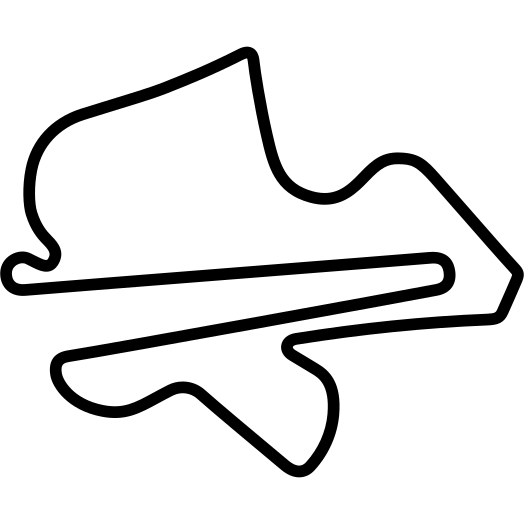
Malaysia has subsequently been added to the 2026 schedule to host the postponed Bahrain Grand Prix, illustrating the kind of flexibility Formula 1 can deploy when its original calendar becomes impossible to complete as planned.
There is also uncertainty surrounding the end of the current season. Should the Qatar and Abu Dhabi Grands Prix be unable to go ahead, the 2026 championship is set to conclude in Europe instead.
That makes the delayed publication of the 2027 calendar significant. Rather than committing early to a schedule that may subsequently require major alterations, F1 has given itself additional time to assess the geopolitical situation.
Domenicali also put the sporting implications firmly into perspective, stressing that Formula 1 would be a relatively minor concern if the conflict remained unresolved into 2027.
For F1 itself, however, the practical challenge is clear: construct a global 24-race championship capable of adapting if key territories remain unavailable.
Why modern F1 calendars need a Plan B
Calendar disruption is nothing new in Formula 1 history. Races have disappeared, moved or been replaced for reasons ranging from politics and financial problems to safety concerns and global crises.
What has changed is the scale and complexity of the modern championship.
A contemporary 24-race F1 season is a huge international operation involving eleven teams, thousands of personnel, freight movements, broadcasters, commercial partners and tightly packed sequences of races across several continents.
Replacing a Grand Prix is therefore more complicated than simply finding an available circuit.
F1 must consider whether a venue can host a modern Grand Prix, where it fits geographically, whether the necessary infrastructure and organisation can be put in place, and how a change affects the rest of the calendar.
The 2026 situation has consequently become an important demonstration of how modern Formula 1 approaches disruption: build alternatives before they are required.
Turkey and Portugal are already returning
There will be changes to the Formula 1 map regardless of what happens in the Middle East.
Turkey and Portugal have already been announced as returning to the championship, replacing Zandvoort and Barcelona.
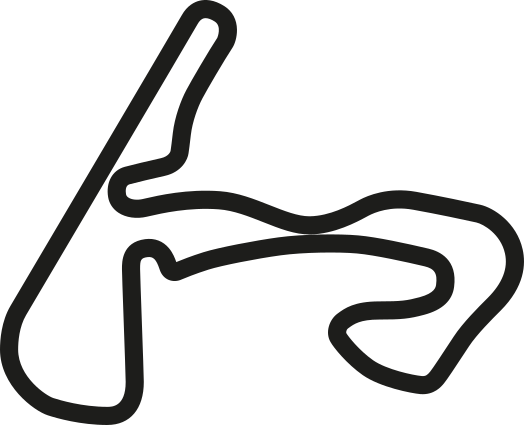
Zandvoort will stage its final Dutch Grand Prix on August 21-23, 2026, immediately after the summer break.
Those changes should not be confused with F1’s longer-term discussions about adding entirely new events. According to Domenicali, any additional races emerging from the current round of negotiations would not join the championship before 2028.
That distinction matters when considering possible contingency options for 2027. F1 is simultaneously managing an immediate scheduling problem and deciding what its longer-term global footprint should look like.
Africa, Asia and South America remain part of F1’s future plans
Formula 1’s calendar could evolve considerably beyond 2027.
Discussions are taking place with Rwanda, South Africa, Thailand and Argentina over potential future Grands Prix.
Argentina has acquired particular momentum as interest in Formula 1 has grown following Franco Colapinto‘s arrival on the grid.
Domenicali said negotiations in Africa were progressing “very well”, while talks were also taking place in South America and the Far East.
China and Japan are generating further interest, although F1 currently intends to maintain a single Chinese Grand Prix while it works on consolidating the market.
This creates an interesting contrast for Formula 1’s calendar planners. The sport has no shortage of prospective hosts, yet increasing demand does not necessarily provide an immediate solution when an existing race has to be replaced.
New Grands Prix require long-term commercial agreements, infrastructure, investment and logistical preparation. That is why discussions taking place today are primarily relevant to 2028 and beyond rather than providing instant replacements for 2027.
Could Hockenheim bring Formula 1 back to Germany?
Another familiar circuit has also entered the conversation.
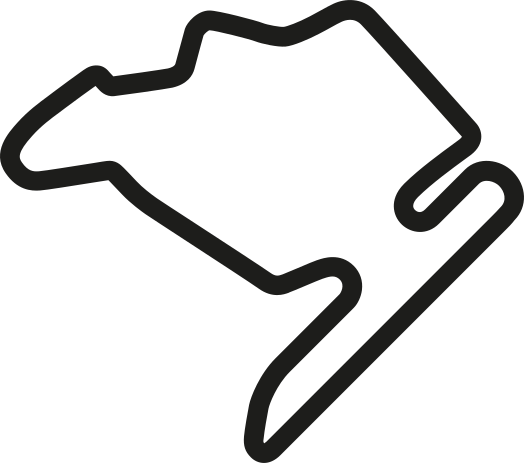
Hockenheim has approached Formula 1 about the possibility of bringing the German Grand Prix back to the championship.
The circuit last hosted F1 in 2019 before dropping from the calendar, with a lack of government investment contributing to its disappearance.
The venue now operates under a different ownership and investment model and is developing its wider motorsport park.
Domenicali confirmed that Hockenheim had made contact and that discussions had taken place, although he stressed that staging Formula 1 would require a different level of investment.
A German comeback would carry obvious historical significance. Germany has been one of Formula 1’s major European markets across multiple eras, while Hockenheim itself has a Grand Prix history stretching back decades.
There is no confirmation that the circuit will return, however, and it should currently be viewed as a possible future venue rather than a confirmed component of the 2027 contingency plan.
F1’s European market is strengthening again
Hockenheim’s interest also reflects another development in Formula 1’s changing geography.
Domenicali says F1 is watching renewed growth in Europe, describing the continent as an increasingly important market again as audience numbers strengthen.
That could become particularly relevant when Formula 1 considers how to protect future calendars against disruption.
The championship has expanded aggressively beyond its traditional European heartland during the modern era, creating a genuinely global schedule. At the same time, established European circuits can offer something especially valuable during uncertain periods: proven Grand Prix infrastructure and extensive motorsport experience.
The possibility of the 2026 championship ending in Europe if Qatar and Abu Dhabi cannot be staged illustrates that strategic value.
It does not mean F1 is retreating from its global ambitions. Negotiations across Africa, South America and Asia demonstrate precisely the opposite. Instead, the modern calendar increasingly needs both global reach and enough flexibility to respond when circumstances change.
When will the 2027 F1 calendar be announced?
Formula 1 plans to announce its 2027 calendar in the autumn of 2026.
Even then, the situation may continue to evolve.
Domenicali indicated that the decisive point for activating alternative plans would come towards the end of the year, giving Formula 1 additional time to determine whether its preferred schedule remains viable.
For now, the clearest commitment is not to a particular collection of circuits but to the size of the championship: F1 intends to stage 24 races in 2027.
Exactly where all 24 will take place could depend on events far beyond Formula 1’s control.
Seen in: