



































Formula 1 teams have unanimously backed a plan to shorten Grand Prix distances from 305km to around 290km for the 2027 season. If the proposal completes the required approval process, most F1 races will become roughly 15km shorter, equivalent to around two or three laps at many circuits.
The proposed change is not an attempt to create shorter TV broadcasts or more frantic racing. It has emerged from a much more technical problem involving Formula 1’s new-generation power units, higher fuel-flow rates and the fuel capacity of cars designed around the 2026 regulations.
For a championship that has used a 305km race distance benchmark for decades, even a temporary move to 290km would be a notable change to the structure of a Formula 1 Grand Prix.
What To Know?
- F1 teams have unanimously backed a 290km Grand Prix distance for 2027, reducing the current standard by around 15km.
- Most races could lose roughly two or three laps, although the exact reduction depends on each circuit’s lap length.
- The change is driven by fuel and power-unit rules, with higher fuel-flow rates increasing the amount of fuel cars need to complete a race.
- The rule is not final yet: it still requires approval by the F1 Commission and ratification by the FIA World Motor Sport Council.
F1’s proposed 2027 race-distance changes at a glance
| Rule or proposal | 2026 | Proposed for 2027 |
|---|---|---|
| Standard Grand Prix distance | At least 305km | Around 290km |
| Typical change | Current distance | Roughly 15km shorter |
| Likely lap reduction | – | Around 2-3 laps at many circuits |
| Monaco | 260km exception | Expected to remain an exception |
| Team support | Current regulations | Unanimous support for the plan |
| Final regulatory approval | Already in force | Still required |
| Initial duration of change | – | Currently intended for 2027 |
Why does Formula 1 want to shorten races in 2027?
The proposed reduction is a consequence of changes being made to Formula 1’s new power-unit regulations.
F1’s latest generation of machinery arrived with a much greater emphasis on electrical energy. However, work has continued on the rules in an effort to prevent cars becoming excessively energy-limited during races.
As part of that process, fuel-flow rates are being increased for 2027. Allowing engines to use more fuel can help address some of the performance concerns, but it creates another problem: if a car burns fuel at a greater rate, it needs enough fuel capacity to complete the full Grand Prix distance.
That matters because teams designed their cars and fuel systems around the existing requirements. Requiring substantially more fuel could force expensive modifications, particularly for teams hoping to carry over significant parts of their 2026 chassis into the following season.
Rather than forcing every team towards a major redesign solely to accommodate additional fuel, one solution emerged: reduce the distance the cars need to cover.
How much shorter will an F1 race be in 2027?
Under the proposal backed by teams, the normal Grand Prix benchmark would fall from 305km to approximately 290km.
That is a reduction of around 15km, or just under 5% of the traditional race distance.
There would still be no universal number of laps. As with the existing rules, the scheduled lap count would be calculated from the length of each circuit.
A Grand Prix would therefore still contain a different number of laps at Monza, Silverstone, Suzuka or Interlagos. The underlying target distance would simply be shorter.
At many circuits, the difference is expected to amount to roughly three fewer racing laps, although the precise reduction would vary with track length.
On a circuit where one lap is approximately 5km, cutting 15km from the required distance naturally removes about three laps. At longer circuits, the difference may be closer to two.
F1 2026 v 2027 race distances
| Circuit | Lap length (km) | 2026 laps | 2026 race distance (km) | 2027 laps | 2027 race distance (km) |
|---|---|---|---|---|---|
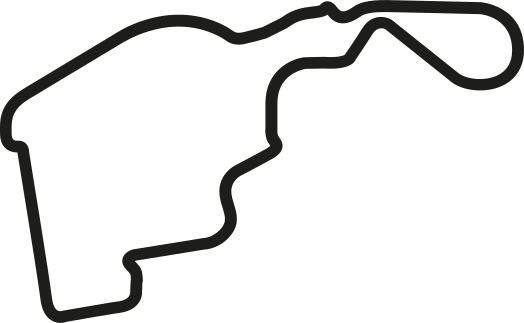
| Australia | 5.278 | 58 | 306.124 | 55 | 290.290 |
| China | 5.451 | 56 | 305.066 | 54 | 294.164 |
| Japan | 5.807 | 53 | 307.471 | 50 | 290.050 |
| Bahrain | 5.412 | 57 | 308.238 | 54 | 292.002 |
| Saudi Arabia | 6.174 | 50 | 308.450 | 48 | 296.102 |
| Miami | 5.412 | 57 | 308.326 | 54 | 292.090 |
| Canada | 4.361 | 70 | 305.270 | 67 | 292.187 |
| Monaco | 3.337 | 78 | 260.286 | 78 | 260.286 |
| Barcelona | 4.657 | 66 | 307.236 | 63 | 293.265 |
| Austria | 4.326 | 71 | 307.018 | 68 | 294.040 |
| Great Britain | 5.891 | 52 | 306.198 | 50 | 294.416 |
| Belgium | 7.004 | 44 | 308.052 | 42 | 294.044 |
| Hungary | 4.381 | 70 | 306.630 | 67 | 293.487 |
| Netherlands | 4.259 | 72 | 306.587 | 69 | 293.810 |
| Italy | 5.793 | 53 | 306.720 | 51 | 295.134 |
| Madrid | 5.416 | 57 | 308.524 | 54 | 292.276 |
| Azerbaijan | 6.003 | 51 | 306.049 | 49 | 294.043 |
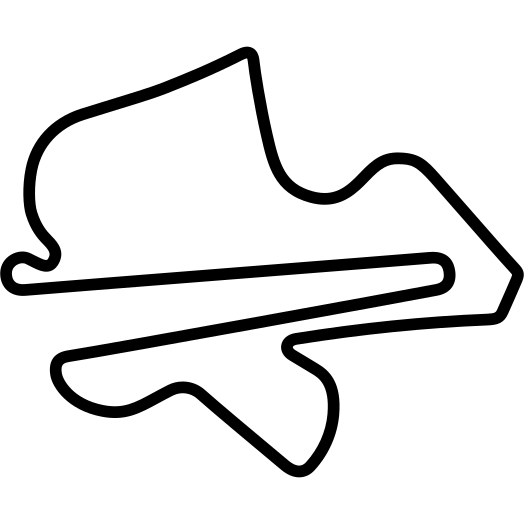
| Malaysia | 5.543 | 56 | 310.408 | 53 | 293.779 |
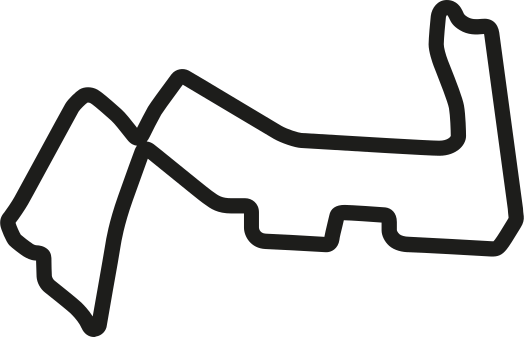
| Singapore | 4.927 | 62 | 305.337 | 59 | 290.556 |
| Austin | 5.513 | 56 | 308.405 | 53 | 291.866 |
| Mexico | 4.304 | 71 | 305.354 | 68 | 292.442 |
| Brazil | 4.309 | 71 | 305.879 | 68 | 292.952 |
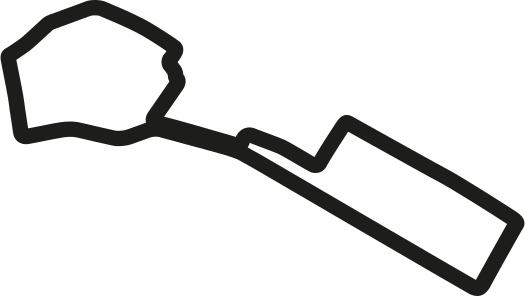
| Las Vegas | 6.201 | 50 | 309.958 | 47 | 291.355 |
| Qatar | 5.419 | 57 | 308.611 | 54 | 292.354 |
| Abu Dhabi | 5.281 | 58 | 306.183 | 55 | 290.340 |
Why not shorten only some F1 races?
One of the more interesting parts of the discussion was that Formula 1 initially considered a less universal solution.
With fuel consumption being the central concern, there were talks about reducing selected Grands Prix by a couple of laps rather than changing the basic distance rule for the championship as a whole.
That may sound like a more targeted approach, but it risked creating another strategic problem.
If some races retained a longer distance while others became shorter, teams could face substantially different fuel requirements from event to event. At circuits where the distance remained comparatively demanding, drivers might have been forced into more pronounced fuel saving.
In other words, trying to preserve the traditional distance at certain venues could have resulted in cars spending more of the race managing fuel rather than racing at their potential.
Following discussions between the FIA and the teams, a common Grand Prix distance was considered the cleaner solution. That preserves one of the basic principles of the current championship: most races are built around the same distance target, regardless of how many laps that produces.
Why is fuel capacity such an important issue?
Fuel tanks are not components that teams can treat in isolation.
The size, shape and position of the fuel cell affect the packaging of an F1 car, including the chassis and surrounding systems. A requirement to carry significantly more fuel can therefore have consequences beyond simply installing a larger container.
That is particularly awkward when regulations change late enough that teams have already committed to important parts of a car’s architecture.
Additional allowance has been made within Formula 1’s cost-cap framework for teams that need to modify cars that were otherwise intended to carry over into 2027. But reducing race distance offers another way to limit the scale of those changes.
It effectively attacks the problem from the other end. Instead of asking every car to carry considerably more fuel for 305km, the cars are asked to cover less distance.
Will there be changes to formation laps too?
Race distance was not the only area examined as F1 looked for ways to reduce unnecessary fuel use.
Plans also include limiting drivers to a single formation lap before the start.
A formation lap may appear insignificant compared with a 300km Grand Prix, but additional laps before the start also consume fuel. When engineers are working with tight margins across an entire race weekend, eliminating avoidable mileage can contribute to the solution.
The measure illustrates how unusual the 2027 situation is. Formula 1 is not simply rewriting the Grand Prix format for entertainment reasons; it is adjusting several parts of race operation to accommodate a late change in the technical equation.
Does this mean 2027 F1 races will be much shorter to watch?
Probably not dramatically.
A reduction from 305km to 290km sounds significant on paper, but in broadcast terms it is relatively modest.
If a typical Grand Prix lasts around 90 minutes, removing approximately 5% of its distance might cut only a handful of minutes from an uninterrupted race.
The exact saving would depend heavily on the circuit. A few laps at a high-speed venue may disappear quickly, while the equivalent distance at a slower track takes longer.
Safety Cars, Virtual Safety Cars, weather and red flags will continue to have a much greater influence on the duration of an individual Grand Prix than the 15km reduction alone.
So 2027 should not suddenly produce Formula 1 races that feel like Sprints. The proposed 290km distance remains almost three times the 100km Sprint distance.
Could shorter races change F1 strategy?
Even a relatively small distance reduction has the potential to affect strategy.
Fifteen kilometres means fewer racing laps for tyres to degrade, fewer opportunities for an offset strategy to develop and slightly less time for a driver to recover from an early mistake.
A tyre compound that is marginal over the current Grand Prix distance might become more viable over a race that is two or three laps shorter.
Undercuts and overcuts could also change slightly because the final stint becomes shorter. Teams that currently face a difficult decision between stretching a tyre set to the finish or making another pit stop may find that the shorter distance brings the chequered flag within reach.
However, the effect should not be overstated. This is not a transformation from a Grand Prix into a short-form race. Pit-stop strategy, tyre management and race pace will remain central to Formula 1.
The more intriguing consequence may be what happens at individual circuits where the existing race distance sits close to an important tyre-life or fuel-use threshold.
What happens to Monaco?
Monaco already operates under a different race-distance rule.
While a standard Grand Prix currently runs to the fewest complete laps necessary to exceed 305km, the Monaco Grand Prix is set at approximately 260km.
Its shorter distance reflects the very low average speed around the street circuit and the amount of time that would otherwise be required to cover a conventional Grand Prix distance.
The 2027 proposal concerns the normal race-distance benchmark and Monaco is expected to remain the exception rather than being brought into line with the new 290km figure.
That means the gap between Monaco and a standard Grand Prix would shrink if the new rule is adopted, but Monaco would still remain distinctly shorter.
Is the 290km F1 race distance confirmed for 2027?
Not yet.
This is an important distinction. The teams have unanimously supported the principle, but team agreement alone does not make it part of Formula 1’s Sporting Regulations.
The proposed change still has to pass through F1’s formal rule-making structure.
Revised regulations must first be put to the F1 Commission, which includes representation from the teams, the FIA and Formula One Management.
Once approved at that level, the regulation must then be ratified by the FIA World Motor Sport Council before becoming part of the official 2027 rules.
So, as things stand in September 2026, the most accurate description is that Formula 1 teams have agreed the plan and work is under way to place it into the regulations.
Is the shorter F1 race distance permanent?
At present, the agreement concerns 2027 only.
The reason matters. The shorter distance is being treated as a compromise connected to changes in the power-unit rules and their effect on fuel requirements, rather than as a permanent philosophical change to how long a Formula 1 Grand Prix should be.
That does not guarantee the 305km standard will automatically return afterwards.
Further fuel-flow changes are already relevant to discussions about 2028, and teams could choose to retain the shorter distance if it proves useful or if the same technical pressures continue.
Formula 1 has often introduced measures for one practical reason only to discover that they have wider benefits. The 2027 season could therefore become a real-world test of whether fans, teams and race organisers notice a meaningful difference between a 290km and 305km Grand Prix.
A rare change to one of F1’s familiar constants
Formula 1 regulations change constantly. Aerodynamic rules evolve, engines come and go, qualifying formats are adjusted and points systems have been rewritten repeatedly across the championship’s history.
Grand Prix distance, by comparison, has been one of the more stable elements of modern F1.
For years, the familiar rule has been simple: take the smallest number of complete laps required to exceed 305km, with Monaco standing apart at 260km.
Reducing that figure to around 290km would therefore be more historically interesting than the modest number of laps removed might suggest.
It would also show how closely Formula 1’s sporting and technical regulations are connected. A change intended to alter how the power unit delivers performance can ultimately change something as fundamental as the length of the race itself.
Seen in: