




























A Formula 1 Grand Prix covers at least 305 kilometres, with Monaco the exception at 260km. There is no universal number of laps: the lap count changes from circuit to circuit because F1 sets the race distance first, then works out how many complete laps are needed to reach it.
There is a time limit too. A Grand Prix can normally last no more than two hours of racing, while a separate three-hour outer limit applies from the original race start when suspensions are involved.
That combination of distance and time explains why one Grand Prix might have more than 70 laps and another fewer than 50, yet both are effectively the same length. It also explains why rain, red flags and circuit design can occasionally decide how long a race really lasts.
What To Know?
- 305km is the key number: A standard F1 Grand Prix covers at least 305km; Monaco is the exception at 260km.
- F1 races do not have a fixed lap count: Circuit length determines the number of complete laps required to exceed the race distance.
- There are two important clocks: F1 has a two-hour racing limit and a three-hour outer limit from the original start when suspensions occur.
- Most races take around 90 minutes: Weather, Safety Cars and red flags can extend a Grand Prix, while an F1 Sprint covers 100km and usually lasts around 30 minutes.
F1 race distance and time limits at a glance
| Rule | Formula 1 Grand Prix |
|---|---|
| Standard race distance | At least 305km |
| Monaco race distance | At least 260km |
| Fixed number of laps? | No – it depends on circuit length |
| Maximum racing time | 2 hours |
| Outer time limit with suspensions | 3 hours from the original start |
| Typical Grand Prix duration | About 1 hour 30 minutes |
| Sprint distance | 100km |
| Typical Sprint duration | About 30 minutes |
How long is a Formula 1 race in kilometres?
The standard Formula 1 Grand Prix distance is at least 305km. The important words are “at least”, because the race does not simply end at the instant a car reaches the 305km mark.
Instead, the scheduled race consists of the smallest whole number of laps required to exceed the specified distance. As a result, the precise length of a Grand Prix is usually a little more than 305km.
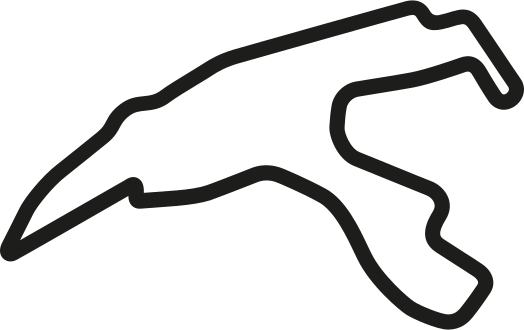
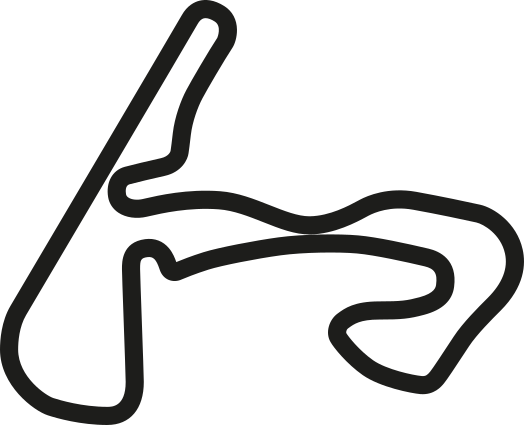
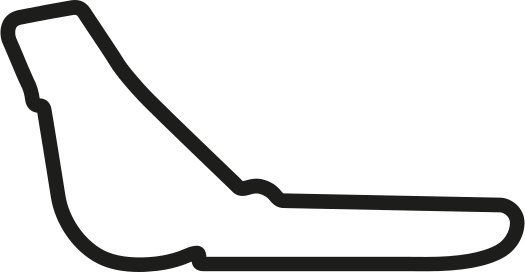
This system is one of the reasons comparing F1 races by lap count can be misleading. Seventy laps around a short circuit like Zandvoort can represent roughly the same race distance as a much smaller number of laps around a long circuit like Spa.
For fans, the simplest way to think about it is this: Formula 1 standardises distance, not laps.
How is the number of laps in an F1 race calculated?
The basic calculation is straightforward. Take the required race distance and divide it by the length of one lap. If the result is not a whole number, it is rounded up to the next complete lap.
In simplified form: 305km ÷ circuit length = number of laps, rounded up
Imagine a hypothetical circuit measuring 5.2km. Dividing 305 by 5.2 gives approximately 58.65. F1 cannot race to 0.65 of a lap, so the race would need 59 complete laps to clear the required distance.
This is why there is no meaningful answer to “How many laps is an F1 race?” without knowing the circuit. A shorter circuit requires more laps; a longer one requires fewer.
It also means the scheduled lap count can change if a circuit itself changes. A revised corner, new chicane, or altered layout can change the official lap length and therefore the number of laps needed to complete the Grand Prix distance.
Why is the Monaco Grand Prix shorter?
Monaco is Formula 1’s major exception. Instead of the normal 305km minimum, its Grand Prix distance is at least 260km.
The difference is practical. Monaco may have a relatively short lap, but its exceptionally low average speeds mean completing the standard Grand Prix distance would take much longer than at a conventional modern circuit. Cutting the required distance reduces the risk of the race running into Formula 1’s two-hour racing limit.
That makes Monaco unusual in two different ways: it is both one of the most distinctive circuits in F1 history and the only race on the calendar operating to this shorter minimum distance.
The reduced mileage matters strategically as well. There is less total distance over which tyres can degrade, strategies can diverge and opportunities can develop. Combine that with Monaco’s notoriously limited overtaking opportunities and the race can become heavily dependent on qualifying position, pit-stop timing, traffic and interruptions.
Formula 1 has tried to address that strategic problem in the modern era. A mandatory two-stop requirement was introduced for the 2025 Monaco Grand Prix, but that measure was subsequently removed from the 2026 regulations.
How long does an F1 race take?
Most Formula 1 Grands Prix take approximately 90 minutes from the start to the chequered flag, although the exact duration depends on the circuit, race pace, Safety Cars, weather and other interruptions.
A fast, uninterrupted dry race can be completed comfortably within the limit. A wet Grand Prix, or one with lengthy Safety Car periods, can push the race much closer to two hours.
That distinction between distance and duration is important. The scheduled distance might be known before the weekend begins, but nobody can say exactly how many minutes the Grand Prix will take.
What is F1’s two-hour race limit?
Under Formula 1’s Sporting Regulations, a race is subject to a two-hour racing limit.
If the scheduled distance has not been completed by the time that limit is reached, the race is not immediately terminated halfway around the circuit. Instead, it ends at the completion of the lap following the lap during which the two-hour period expires.
In ordinary dry races, this rule tends to sit unnoticed in the background. Modern F1 cars complete the scheduled distance well inside two hours under normal conditions.
It becomes much more relevant when conditions slow the field substantially. Heavy rain is the obvious example. Cars may spend prolonged periods behind the Safety Car, lap times rise dramatically and racing conditions can deteriorate before the scheduled distance is reached.
The clock can therefore become as important as the lap counter. When commentators begin discussing the two-hour limit during a chaotic Grand Prix, it is a sign that the race may be decided by time rather than its originally scheduled number of laps.
What is the three-hour F1 race limit?
The second clock is particularly important when a race is suspended.
A red flag can stop the race because of a serious accident, unsafe track conditions, heavy rain or another situation in which continuing is considered unsuitable. The two-hour racing calculation accounts for this suspension, rather than simply treating time spent stationary as racing time.
However, the event cannot be extended indefinitely. There is an outer limit of three hours from the original race start.
This distinction is easiest to understand as two separate limits: the first governs the amount of racing, while the second puts a ceiling on how long the overall event can stretch once suspensions are taken into account.
Consequently, a badly disrupted Grand Prix can finish without completing its planned 305km. In exceptional circumstances, the clock rather than the lap counter determines when the event must conclude.
What happens when an F1 race finishes early?
A shortened Grand Prix can still produce an official result. However, the championship points available depend on how much racing has been completed.
Formula 1 uses a sliding points scale when less than 75% of the scheduled distance has been completed. Reduced points can therefore be awarded in a significantly shortened race, while full points become available once the relevant 75% threshold has been passed.
This gives the distance counter genuine championship significance during severely disrupted events. Restarting a race and completing additional laps is not merely about providing more action: in the right circumstances, it can affect how many championship points are available.
For a modern F1 fan following a rain-delayed race, there are consequently several numbers worth watching at once: laps completed, percentage of scheduled distance, racing time and the overall time since the original start.
How long is an F1 Sprint?
A Formula 1 Sprint follows a different format. Its distance is 100km, approximately one-third of a full Grand Prix, and it typically lasts around 30 minutes.
There is no mandatory pit stop, so the short format is designed around continuous racing rather than the longer strategic arc of a Sunday Grand Prix.
That difference is useful when comparing F1’s two race formats. The Grand Prix is fundamentally an endurance exercise by comparison, with tyre life, pit stops and changing race conditions developing across more than 300km. The Sprint compresses the action into a much shorter window.
Why race distance matters more in modern F1 than it looks
Race distance can appear to be little more than a number printed next to the lap counter, but it shapes much of what happens on Sunday.
Teams plan tyre usage, fuel, pit windows and strategy around the distance that remains. Drivers constantly receive information about laps to go, gaps to rivals and tyre targets. A Safety Car with five laps remaining creates an entirely different strategic calculation from one appearing with 50 laps left.
The same applies to spectators. Knowing that an F1 race is based on distance rather than a universal lap count makes unfamiliar circuits easier to understand. A race with 44 scheduled laps is not necessarily “shorter” than one with 70-plus; the lap itself is simply longer.
It is one of those Formula 1 rules that has remained conceptually simple even as the cars, circuits and technology surrounding the championship have evolved: cover the required distance in the smallest number of complete laps, unless the clock intervenes.
How much time should you allow to watch an F1 race?
If you are planning a Sunday around a Grand Prix, allowing roughly two and a half hours for the main broadcast is a sensible guide once pre-race coverage, approximately 90 minutes of racing and the immediate post-race podium are included.
For the race itself, think of 90 minutes as typical rather than guaranteed. A straightforward dry Grand Prix can be relatively compact. Rain, red flags or other disruption can turn it into a much longer afternoon, potentially extending towards the three-hour outer limit.
The bottom line
An F1 Grand Prix is normally at least 305km long, not a fixed number of laps. Monaco is the exception at 260km. Each circuit’s lap length determines how many complete laps are required, which is why the number on the timing tower changes so dramatically from one Grand Prix to another.
In normal conditions, expect around 90 minutes of racing. The regulations allow up to two hours of racing and impose a three-hour outer limit from the original start when suspensions are involved.
So when someone asks how long an F1 race is, there are really three answers: about 305km, however many complete laps that requires, and usually around an hour and a half.
Proposed F1 Race-Distance Changes for 2027
Formula 1 teams have unanimously backed a plan to reduce the standard Grand Prix distance from 305km to around 290km in 2027, typically removing two or three laps. The proposal responds to higher fuel-flow rates, which would increase fuel requirements and potentially force costly changes to cars designed around the 2026 regulations; limiting drivers to one formation lap is also planned to reduce consumption. A universal distance was preferred over shortening selected races because inconsistent requirements could encourage fuel-saving runs, while Monaco is expected to remain an exception at 260km. The change is currently intended for 2027 only and is not yet official: it must still be approved by the F1 Commission and ratified by the FIA World Motor Sport Council.
Seen in: