






























Few Formula 1 rules can turn a seemingly perfect lap into nothing quite as quickly as track limits. A driver can cross the line fastest in qualifying, celebrate over the radio, and then watch the time disappear from the timing screen seconds later. During a race, the same basic mistake may initially produce little more than a warning before repeated offenses lead to a time penalty. That can make track limits look random from the outside. They aren’t.
The underlying principle is straightforward. Drivers are expected to keep at least part of the car within the defined track. The complications come from how that rule is applied across different sessions, how infringements accumulate during a race, and what happens when leaving the circuit produces a sporting advantage.
Understanding those distinctions makes many of the messages that appear during an F1 weekend much easier to follow.
What To Know?
- The white line is part of the track; kerbs are not. A car leaves the track when no part of it remains in contact with the track.
- In qualifying and practice, a lap set outside track limits can be deleted.
- In a Grand Prix or Sprint, repeated unjustified infringements bring a warning on the third offense and a five-second penalty on the fourth and each further offense.
- Drivers who leave the track must rejoin safely and cannot keep a lasting advantage. Stewards consider why they went off and what happened afterward.
Where the Track Actually Ends
The most important boundary isn’t the kerb. It’s the white line.
Under the FIA Formula 1 Sporting Regulations, the white lines defining the edge of the circuit are considered part of the track, while the kerbs aren’t. A driver is considered to have left the track
when no part of the car remains in contact with it.
That distinction matters because onboard footage can be deceptive. A car may appear to be running well beyond the circuit while its inside tyre is still touching the white line. In that case, it remains legal. Move a few centimeters farther out, and the entire car can suddenly be beyond the permitted area.
Modern circuits make those margins particularly tempting. Wide asphalt runoff areas are safer than barriers close to the racing surface, but they can also give drivers space to carry extra speed without the immediate physical punishment that grass or gravel would provide.
The result is a boundary that sometimes has to be enforced by officials rather than by the circuit itself.
Why Following Track Limits Can Be Surprisingly Difficult
For television viewers, the issue is often clearest when the broadcast cuts to an onboard replay or a camera positioned directly along the white line. Race Control also issues deleted-lap notices and other updates during sessions, so following the timing feed alongside the pictures can help explain why a lap has suddenly vanished.
That becomes less straightforward for fans traveling internationally. Formula 1 broadcasting and streaming arrangements vary by country, meaning the service someone normally uses at home may be unavailable while they are abroad. Travelers who use a VPN for a secure connection on hotel,
airport, or other public Wi-Fi can see how to install ExpressVPN on their device. Access to any particular streaming platform still depends on its terms and regional rights.
The need to check replays also explains why track-limit decisions can occasionally feel delayed. At a busy circuit, officials may have numerous potential infringements to review while cars continue circulating.
One Rule, Different Consequences
Crossing the white line doesn’t produce the same outcome in every situation.
Qualifying
During qualifying, the basic consequence is particularly unforgiving. A lap completed outside the track limits can be deleted. It doesn’t matter if the infringement gained only a tiny amount of time. A driver cannot set a valid lap time outside the defined circuit.
That can transform a qualifying session. A lap quick enough for pole position can disappear, while an infringement during Q1 or Q2 can leave a driver relying on an earlier time or even eliminate them from the session.
Practice
Practice sessions also feature deleted lap times, although the competitive consequences are usually smaller. The driver loses useful timing information rather than a grid position, but repeated mistakes can still disrupt preparations and make comparisons between runs less useful.
Grand Prix
During a Grand Prix, or Sprint the system has to account for something qualifying does not. Repeated infringements over a long period.
The FIA’s 2026 penalty guidelines provide for a strike when a driver leaves the track without justification, with the third offense bringing a black-and-white warning flag and the fourth and each additional offense carrying a five-second penalty.
That structure reflects the nature of a race. A single small error over a Grand Prix distance is different from repeatedly using space beyond the circuit boundary.
Race distance itself is governed by another set of regulations, and readers interested in how laps and distance are determined can also see how long an F1 race is.
Leaving the Track Isn’t Always a Track-Limits Offense
This is where the subject becomes more interesting than simply counting white-line violations.
Drivers leave the circuit for many reasons. One may lock a tire under braking. Another might be forced wide while fighting for position. A driver could also deliberately run beyond the track to complete an overtake or defend a place.
The regulations therefore address not only whether a car left the track but also what happened as a result.
A driver who goes off may rejoin, but the re-entry must be safe, and the driver cannot retain a lasting advantage gained by leaving the circuit. Race Control can allow a driver to give back an advantage, which is why viewers sometimes see a recently completed overtake voluntarily reversed.
Context matters. A car that pushes off while avoiding contact isn’t necessarily treated the same way as one that deliberately cuts across a run-off area and emerges ahead.
This distinction also explains why apparently similar incidents can produce different outcomes. The stewards aren’t necessarily answering only the question, “Did all four wheels cross the line?” They may also be considering whether there was a justifiable reason, whether an advantage was gained, and whether the car rejoined safely.
Why Some Circuits Cause More Trouble Than Others
Track limits tend to become a bigger story at circuits where the quickest line invites drivers toward generous paved run-off.
A driver at the limit naturally uses every centimeter available. If extending a corner exit slightly allows the car to maintain more speed, drivers will repeatedly approach the boundary as closely as possible. That isn’t an attempt to ignore the rules so much as a consequence of elite competition: unused legal track is lost lap time.
Gravel changes that.
Where gravel sits immediately beyond the edge of the circuit, exceeding the limit can cost time on its own. Drivers no longer need a steward’s message to tell them that going too far is undesirable. The circuit provides the deterrent.
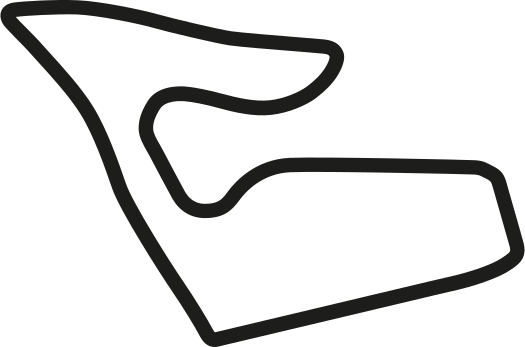
The Red Bull Ring offers a useful example. Track limits became a major feature of previous Austrian Grand Prix weekends, leading to extensive post-race scrutiny. Changes incorporating gravel
strips at troublesome corners helped create a clearer physical consequence for running wide.
There’s a trade-off, however. Circuit design has to consider motorcycle racing, safety requirements, drainage, and other categories that use the venue. Simply surrounding every F1 corner with gravel is not always practical.
Track Limits and F1’s Wider Penalty System
It is also useful to separate track-limit penalties from Formula 1’s penalty points system.
The FIA’s 2026 penalty guidelines list ordinary track-limit offenses without license penalty points. Those points are designed for a different purpose and, following changes for 2026, are focused more narrowly on dangerous, reckless or deliberate conduct.
That wider system remains a subject of debate. Recent discussion around F1’s penalty points system has a big blindspot has highlighted questions over how serious driving incidents are treated under the revised approach.
For track limits, though, the distinction is useful. A driver can receive a sporting penalty that affects the race result without the offense automatically contributing toward a future race ban. Not every regulatory infringement is intended to carry the same long- term consequence.
The Fastest Line Has to Be a Legal One
Track limits sit at an awkward intersection between circuit design, sporting regulation and the driver’s instinct to find speed.
Drivers are supposed to attack the edge. Asking them to leave a comfortable margin would be asking them to give away lap time voluntarily. The challenge for regulators is therefore not to stop drivers approaching the boundary but to make that boundary clear enough that everyone understands what happens when they cross it.
Physical solutions such as gravel can make enforcement more intuitive. Cameras and Race Control remain necessary where the circuit can’t provide that natural deterrent. Neither approach completely removes difficult cases, especially when cars are fighting wheel-to-wheel.
For viewers, the simplest way to interpret a track-limits message is to look beyond the fact that a car crossed a white line. The session, the number of previous infringements, whether an advantage was gained, and why the driver left the circuit can all matter.
The fastest drivers will always search for the final centimeter of usable asphalt. Track limits exist to decide where that search has to stop.
Seen in: