Formula 1 loves a teenage sensation. A fearless newcomer, a spectacular first lap and a future champion supposedly arriving ahead of schedule. But there is something equally satisfying about watching an established driver remind the paddock that speed does not disappear when the birthday candles start getting crowded.
What to know
- Giuseppe “Nino” Farina is the oldest F1 Grand Prix polesitter, aged 47 years and 79 days at the 1954 Argentine Grand Prix.
- Lewis Hamilton ranks fifth after his Mexico City 2026 pole, aged 41 years and 298 days on race day, and became the oldest Grand Prix polesitter since Mario Andretti in 1982.
- This ranking counts each driver once, using their oldest officially credited Grand Prix pole. Sprint poles and Indianapolis 500 results are excluded; ages are calculated on race day.
- Michael Schumacher topped Monaco qualifying in 2012 at 43, but a grid penalty left the official pole credited to Mark Webber, keeping Schumacher’s lap outside this ranking.
In qualifying, there is no patient recovery drive to construct and little opportunity to hide behind strategy. When the final qualifying runs begin, the stopwatch delivers a blunt assessment.
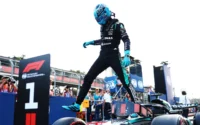
Lewis Hamilton supplied the latest reminder at the 2026 Mexico City Grand Prix. His first Grand Prix pole for Ferrari was the 105th of his career, making him the oldest Grand Prix polesitter since Mario Andretti at Monza in 1982. An achievement separated by 44 years, connected by two champions and a pair of red cars.
Yet even Hamilton has some distance to travel before reaching the oldest driver on this list. That record belongs to a man born in 1906. The wider picture of age and longevity is explored in our guide to F1’s oldest drivers and Grand Prix winners.
The oldest F1 Grand Prix polesitters ranked
| Rank | Driver | Grand Prix | Age on race day | Team |
|---|---|---|---|---|
| 1 | Giuseppe “Nino” Farina | 1954 Argentine Grand Prix | 47 years, 79 days | Ferrari |
| 2 | Juan Manuel Fangio | 1958 Argentine Grand Prix | 46 years, 209 days | Maserati |
| 3 | Jack Brabham | 1970 Spanish Grand Prix | 44 years, 17 days | Brabham |
| 4 | Mario Andretti | 1982 Italian Grand Prix | 42 years, 196 days | Ferrari |
| 5 | Lewis Hamilton | 2026 Mexico City Grand Prix | 41 years, 298 days | Ferrari |
| 6 | Nigel Mansell | 1994 Australian Grand Prix | 41 years, 97 days | Williams |
| 7 | Carlos Reutemann | 1981 Caesars Palace Grand Prix | 39 years, 188 days | Williams |
| 8 | Graham Hill | 1968 British Grand Prix | 39 years, 156 days | Lotus |
| 9 | Kimi Räikkönen | 2018 Italian Grand Prix | 38 years, 320 days | Ferrari |
| 10 | Alain Prost | 1993 Japanese Grand Prix | 38 years, 242 days | Williams |
1. Giuseppe “Nino” Farina: Argentina, 1954
The oldest Grand Prix polesitter remains Formula 1’s first World Champion.
Farina took pole for Ferrari at the 1954 Argentine Grand Prix, aged 47 years and 79 days on race day, recording a time of 1m44.8s.
Born on 30 October 1906, he established a benchmark that still stands more than seven decades later. That longevity gives the record an almost improbable quality. Cars, circuits, and qualifying formats have changed repeatedly, yet nobody has displaced him.
Hamilton‘s Mexico performance brings the discussion into the present, but Farina remains more than five years older at his benchmark event. It is a substantial gap, even before considering the competitive circumstances required to earn another pole. The record is beatable in principle. History suggests it is exceptionally difficult in practice.
Full Race Report

2. Juan Manuel Fangio: Argentina, 1958
Fangio‘s presence makes the scale of the historical comparison clear. At the 1958 Argentine Grand Prix, he was 46 years and 209 days old and still capable of taking pole in a Maserati, crediting him with a 1m42.0s lap at his home event. It was his final World Championship pole.
Full Race Report
3. Jack Brabham: Spain, 1970
There is something particularly appropriate about Jack Brabham occupying a place near the top.
His final pole came at the 1970 Spanish Grand Prix at Jarama, just 17 days after his 44th birthday. He achieved it in a Brabham, adding another layer to an already distinctive career. Few names on an F1 timing screen have ever represented both the driver and the constructor quite so directly.
His pole lap was 1m23.9s.
Full Race Report
4. Mario Andretti: Italy, 1982
Some stand-in appearances deserve a polite thank-you. Mario Andretti‘s Ferrari return at Monza deserves its own highlight reel. Aged 42 years and 196 days on race day, Andretti took pole for the 1982 Italian Grand Prix.
Returning to Ferrari at Monza would have attracted attention whatever the result. Qualifying fastest transformed the appearance into one of the sport’s great veteran performances.
He followed pole with third place in the race, and it remains a wonderful example of an experienced driver making an immediate impact in unfamiliar circumstances. The Ferrari badge and Monza setting supplied the theatre, but it was Andretti who supplied the speed, despite his age.
Full Race Report
5. Lewis Hamilton: Mexico City, 2026
The newest entry comes with a particularly satisfying Ferrari connection.
Hamilton‘s Mexico City pole in 2026 was his first Grand Prix pole for the Scuderia and the 105th of his career. His 1m16.514s lap beat George Russell by just 0.009 seconds. Becoming one of the closest pole position margins. After a wait stretching back to Hungary in 2023, the margin was tiny and the significance considerable.
Hamilton was 41 years, 9 months and 24 days old when qualifying took place on 31 October. On race day, 1 November, he was 41 years, 9 months and 25 days old.
His first pole had arrived in Canada in 2007, aged 22. Nineteen years later, he was still capable of deciding a qualifying session by a handful of thousandths. The comparison with Andretti is irresistible: two Ferrari poles, two champions over 40 and 44 years between the weekends.
Full Race Report

6. Nigel Mansell: Australia, 1994
Nigel Mansell never gave the impression that he had arrived at a circuit merely to make up the numbers.
His final pole came for Williams at Adelaide in 1994, aged 41 years and 97 days. On a weekend dominated by the championship contest between Michael Schumacher and Damon Hill, Mansell placed himself ahead of both on the grid. His official pole time was 1m16.179s.
The enduring appeal is easy to understand. Here was an established champion returning to the sharp end and immediately becoming part of the weekend’s story. For fans accustomed to discussing whether a driver deserves another contract after turning 35, Mansell provides a fairly forceful historical response.
Full Race Report
7. Carlos Reutemann: Caesars Palace, 1981
Before modern Formula 1 turned the Las Vegas Strip into a racing circuit, the championship visited a very different version of the city.
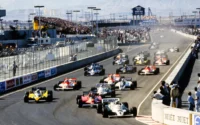
Carlos Reutemann‘s final pole came at the 1981 Caesars Palace Grand Prix, on the temporary circuit laid out in the hotel’s car park. He was 39 years and 188 days old, driving for Williams and competing at a championship-deciding finale.
It is an unusually evocative entry. The venue sounds almost implausible to anyone introduced to F1 through today’s vast Las Vegas spectacle, yet the competitive stakes were entirely serious.
Full Race Report
8. Graham Hill: Britain, 1968
Graham Hill‘s image belongs comfortably in any gallery of classic Formula 1. The distinctive helmet, the immaculate moustache and the expression of a man who could probably explain the evening’s dinner arrangements while balancing a racing car on the limit.
Behind that polished exterior sat considerable competitive steel. Hill‘s last pole came at the 1968 British Grand Prix at Brands Hatch, aged 39 years and 156 days. He secured pole with a time of 1m28.9s.
His appearance here reminds us that a driver’s most familiar reputation rarely tells the whole story. Hill is closely associated with Monaco and endurance across a demanding career, but he could also deliver the quickest lap of a Grand Prix weekend on home ground.
Full Race Report
9. Kimi Räikkönen: Italy, 2018
If anyone could make an extraordinary qualifying lap look like a routine appointment, it was Kimi Räikkönen.
At Monza in 2018, the Finn put his Ferrari on pole with a lap of 1m19.119s. Its average speed of approximately 263.6km/h made it the fastest lap in Formula 1 history by average speed at the time.
Räikkönen headed a Ferrari front-row lockout, delivering his final career pole a few weeks before his 39th birthday.
Full Race Report

10. Alain Prost: Japan, 1993
There is a temptation to remember Alain Prost exclusively as the calculating race strategist “The Professor”. The driver who conserved his equipment, considered the championship and generally appeared to have worked everything out several corners before everyone else.
His final season also contained a substantial amount of outright qualifying speed. Driving for Williams in 1993, Prost collected 13 poles, with the last arriving at Suzuka. His Japanese pole lap was 1m37.154s.
At 38, he was still setting the Saturday benchmark. The Williams gave him formidable equipment, but exploiting a fast car remained a driver’s responsibility. Prost‘s place here offers a useful correction to the idea that experience and raw speed occupy different corners of the garage.
Full Race Report
Why Schumacher’s Monaco lap does not appear
Michael Schumacher‘s 2012 Monaco qualifying performance is the obvious question whenever that appears on the list.
At 43, Schumacher set the fastest qualifying time for Mercedes. However, he carried a five-place grid penalty from the previous race and started sixth. Mark Webber inherited the first starting position and received the official pole position in F1 history books.
Despite the penalty, Schumacher‘s lap absolutely belongs in the conversation about extraordinary speed from older drivers.
Full Race Report

The Indianapolis detail that changes the top ten
There is another historical wrinkle. The Indianapolis 500 counted towards the World Championship from 1950 to 1960, despite running under different regulations from the European Grand Prix events.
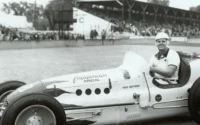
This article follows the Grand Prix scope of the original list and excludes those Indianapolis results. Include every World Championship round, and Fred Agabashian‘s 1952 Indianapolis pole places him tenth, aged 38 years and 283 days on race day, moving Prost to eleventh.
Full Race Report
Seen in: