































Formula 1 races can last close to two hours, cover more than 300 kilometres, and be decided by strategy, tyre management, pit stops and hundreds of individual decisions. Yet occasionally, after all of that, the difference between winning and losing is measured in hundredths of a second.
The closest finishes in F1 history come from very different eras. Some were the result of flat-out slipstream battles on circuits that barely resemble their modern versions. Others came from last-lap charges, fading tyres or, in one particularly unusual case, an attempted Ferrari photo finish.
What to know
- The officially smallest F1 winning margin is 0.010 seconds, recorded when Peter Gethin beat Ronnie Peterson at the 1971 Italian Grand Prix.
- Timing precision matters: 1971 results were recorded to hundredths, while Rubens Barrichello’s 0.011-second 2002 Indianapolis victory was measured to thousandths.
- Monza features twice in the seven closest finishes, reflecting the extreme slipstream racing produced by its historic high-speed layouts.
- Five of these seven finishes happened before 1990, showing how rare winning margins below one tenth of a second have become in modern Formula 1.
What links these closest finishes in F1 is how little separated first from second at the chequered flag.
Here are seven of the closest officially recorded winning margins in Formula 1 World Championship history, counting down from the largest gap to the smallest.
| Rank | Grand Prix | Winner | Runner-up | Winning margin |
|---|---|---|---|---|
| 7 | 1954 French Grand Prix | Juan Manuel Fangio | Karl Kling | 0.100s |
| 6 | 1961 French Grand Prix | Giancarlo Baghetti | Dan Gurney | 0.100s |
| 5 | 1969 Italian Grand Prix | Jackie Stewart | Jochen Rindt | 0.080s |
| 4 | 1982 Austrian Grand Prix | Elio de Angelis | Keke Rosberg | 0.050s |
| 3 | 1986 Spanish Grand Prix | Ayrton Senna | Nigel Mansell | 0.014s |
| 2 | 2002 United States Grand Prix | Rubens Barrichello | Michael Schumacher | 0.011s |
| 1 | 1971 Italian Grand Prix | Peter Gethin | Ronnie Peterson | 0.010s |
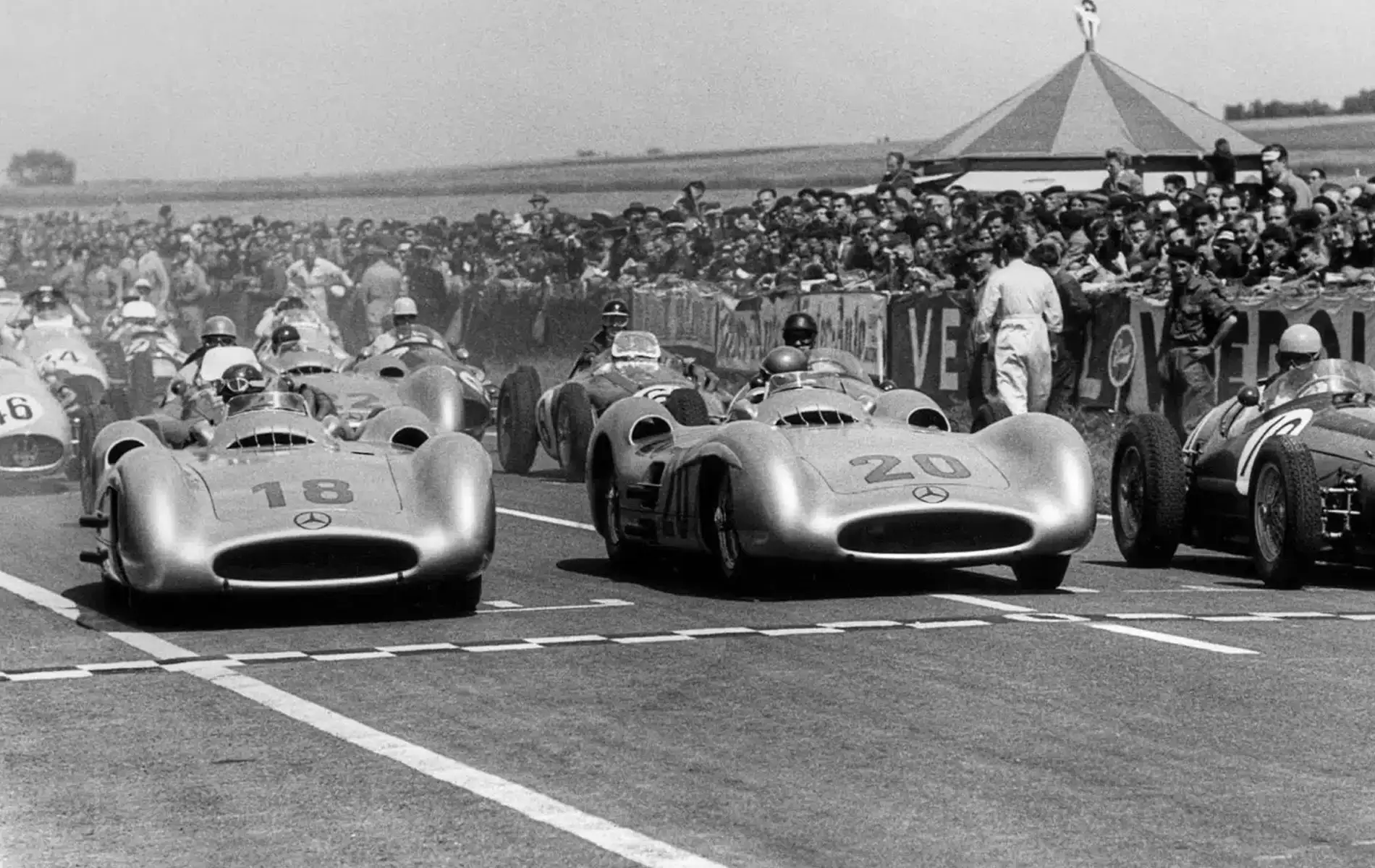
7. 1954 French Grand Prix – Fangio beat Kling by 0.100 seconds
The 1954 French Grand Prix at Reims-Gueux marked the arrival of one of Formula 1’s most famous machines: the Mercedes-Benz W196.
Mercedes had been absent from Grand Prix racing since before the Second World War, but its return was emphatic. Juan Manuel Fangio and team-mate Karl Kling dominated at Reims, leaving the opposition unable to match the new car’s pace.
After 61 laps and more than two hours and 40 minutes of racing, Fangio crossed the line just 0.1 seconds ahead of Kling. Robert Manzon‘s Ferrari was third — a full lap behind the two Mercedes.
For a modern fan, the remarkable part is the contrast. A tenth of a second is a small qualifying margin today; in France in 1954 it separated two cars after almost three hours of racing.
Fangio’s victory was also the beginning of an extraordinary Mercedes chapter. He went on to win the 1954 World Championship and retained the title with Mercedes in 1955.
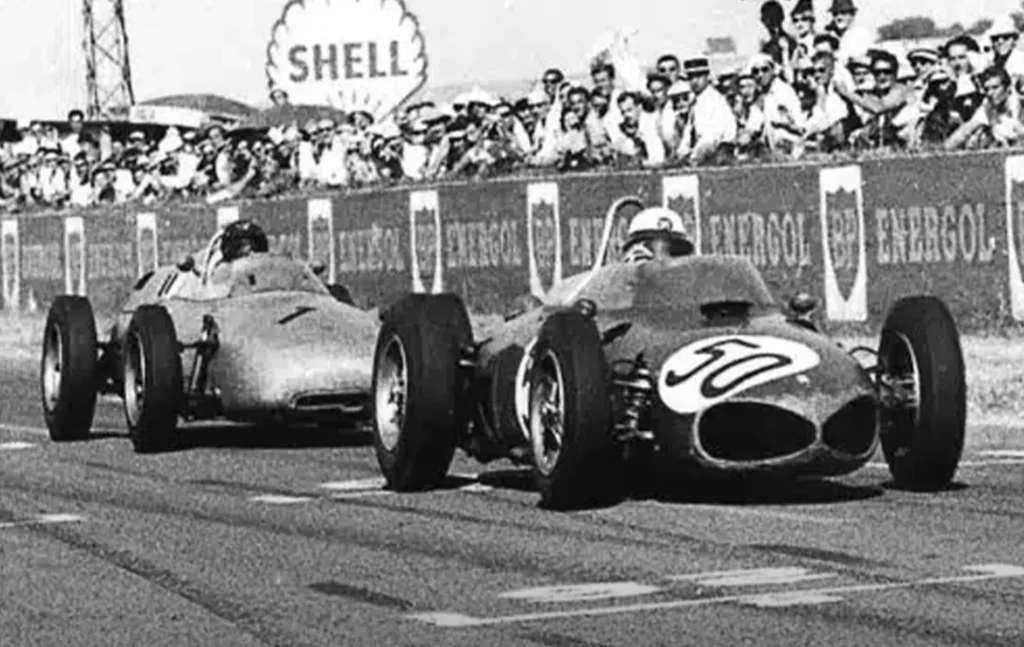
6. 1961 French Grand Prix – Baghetti beat Gurney by 0.100 seconds
Seven years later, Reims produced another 0.1-second finish — but the story could hardly have been more different.
Giancarlo Baghetti started only 12th in a privately entered Ferrari. This was his first Formula 1 World Championship Grand Prix, yet by the closing stages he was fighting Dan Gurney‘s Porsche for victory.
The two repeatedly used the slipstream around the high-speed Reims circuit before Baghetti emerged ahead at the line, winning by one tenth of a second. Jim Clark finished third, more than a minute behind.
Baghetti therefore won on his World Championship debut — an achievement made even more remarkable by what followed. It proved to be the only World Championship Grand Prix victory of his career.
Modern F1 rookies arrive with thousands of kilometres of simulator work, junior-series preparation and extensive engineering support. Baghetti’s story belongs to a completely different world: turn up for your first championship Grand Prix, start on the sixth row and beat the established stars.
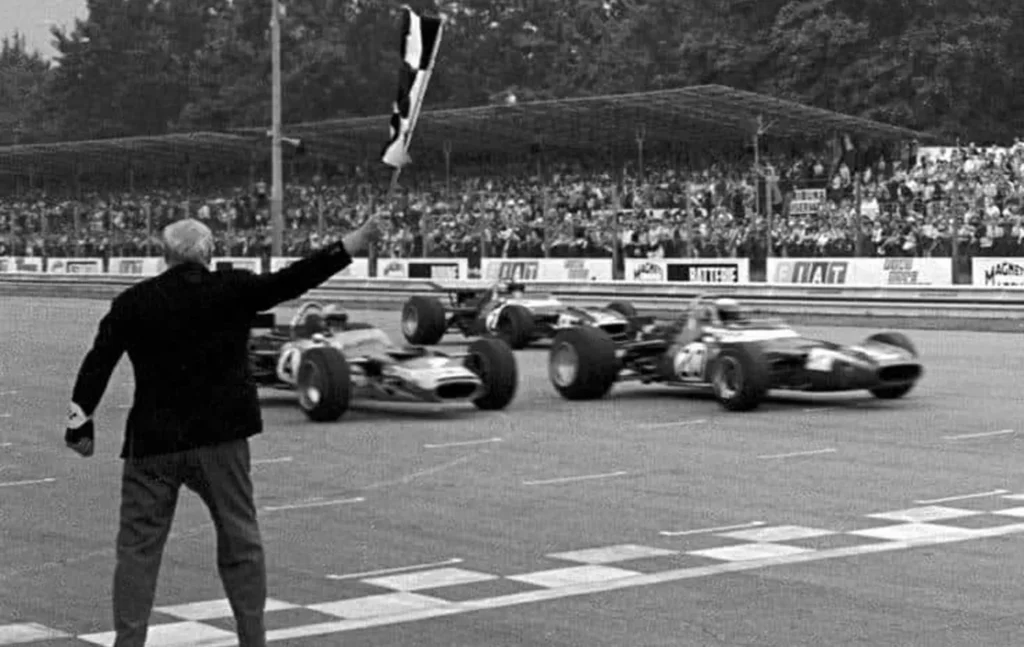
5. 1969 Italian Grand Prix – Stewart beat Rindt by 0.080 seconds
Old Monza was built for slipstream racing, and the 1969 Italian Grand Prix demonstrated exactly why.
Jackie Stewart, Jochen Rindt, Jean-Pierre Beltoise and Bruce McLaren arrived at the finish almost as a single group. Stewart’s Matra-Ford took the victory by just 0.080 seconds over Rindt’s Lotus, with Beltoise 0.170 seconds behind the winner and McLaren only 0.190 seconds back.
That means the first four cars completed 68 laps of Monza and were separated by less than two tenths of a second.
The result was about more than the finish itself. Victory secured Stewart his first Formula 1 World Championship, making one of the sport’s closest finishes simultaneously a title-clinching moment.
Two years later, Monza would produce an even more extreme version of the same spectacle.
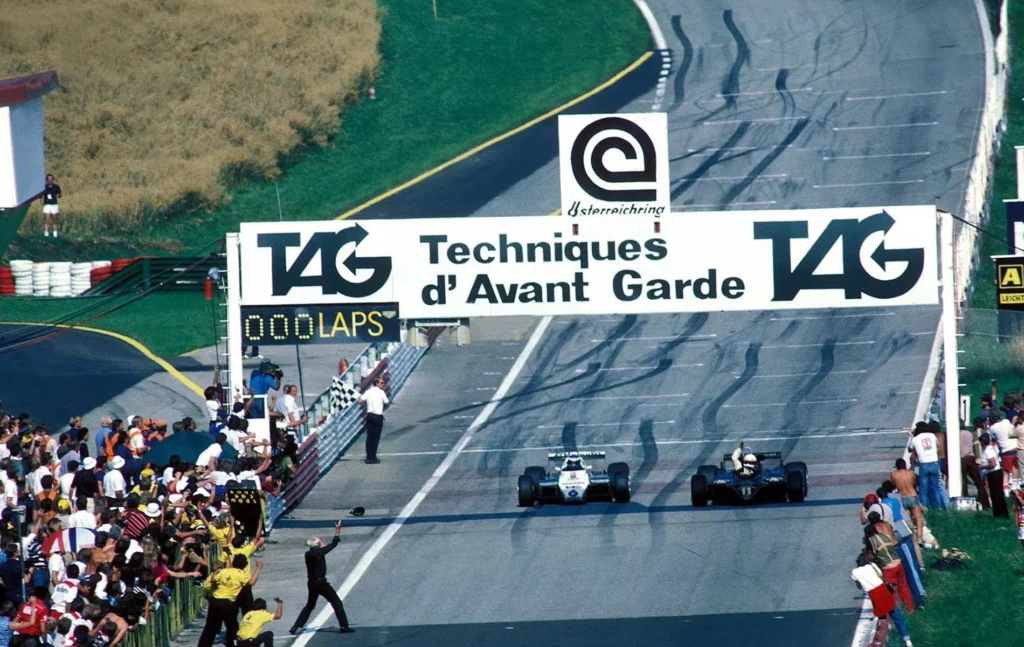
4. 1982 Austrian Grand Prix – de Angelis beat Rosberg by 0.050 seconds
The 1982 Austrian Grand Prix looked as though it belonged to Alain Prost until his Renault failed late in the race.
That left Elio de Angelis in the Lotus ahead of Keke Rosberg‘s Williams. Rosberg closed rapidly and attacked on the final lap, getting alongside as the pair raced towards the line.
He ran out of road — and time.
De Angelis won by 0.050 seconds. Jacques Laffite finished third, an entire lap behind them.
It was de Angelis’s first Formula 1 victory and an emotional one for Lotus. It became the final Grand Prix victory achieved by the team during founder Colin Chapman‘s lifetime; Chapman died later that year.
Rosberg did not have to wait long for his consolation. He won the next race and eventually became the 1982 World Champion, despite winning only one Grand Prix during the season.
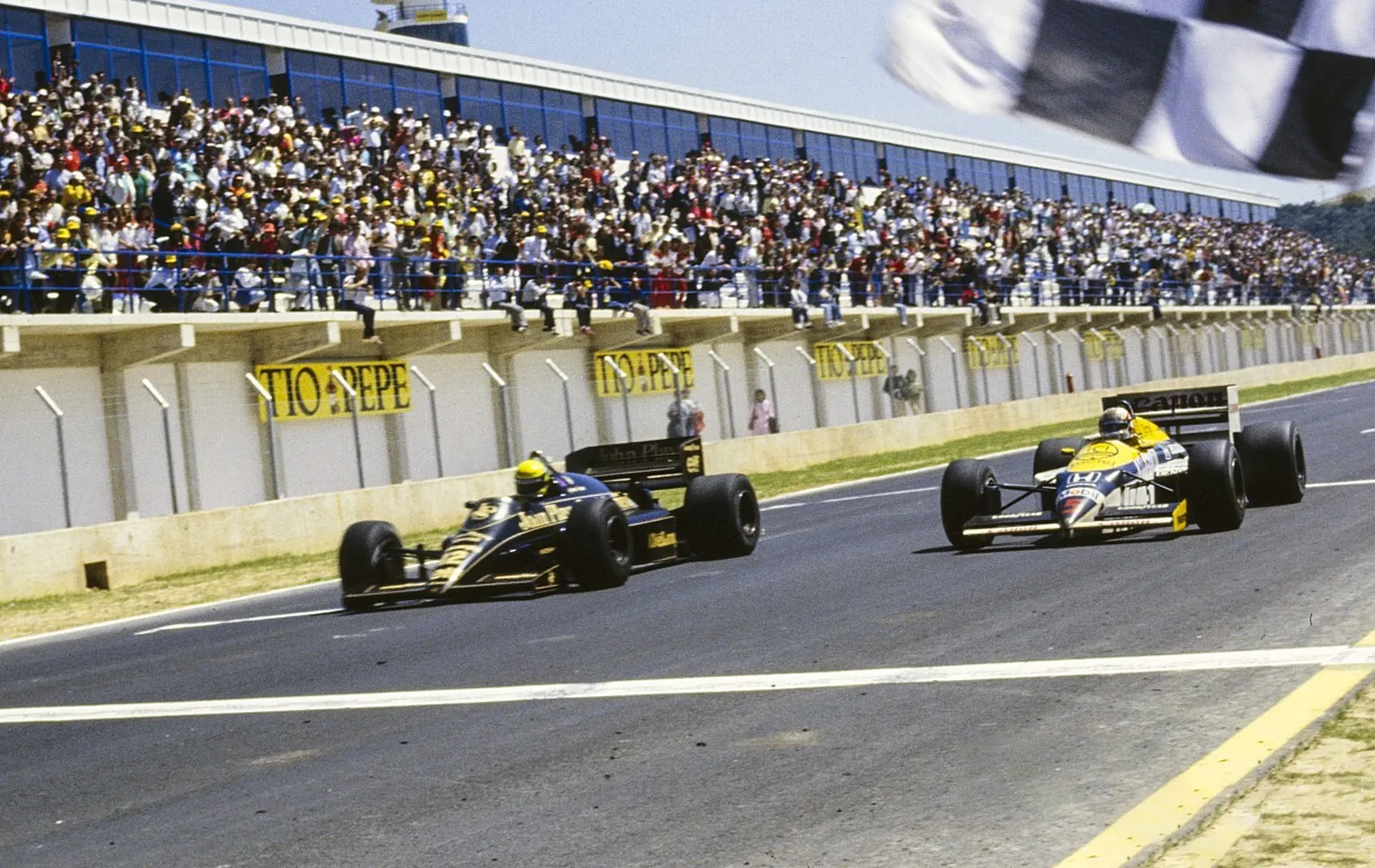
3. 1986 Spanish Grand Prix – Senna beat Mansell by 0.014 seconds
If one finish on this list resembles the sort of final-lap battle a modern F1 fan dreams about, it is Jerez 1986.
Ayrton Senna was trying to nurse his Lotus-Renault to the finish while Nigel Mansell was charging on fresher tyres in his Williams-Honda. Mansell had made a late stop and then rapidly erased the gap, setting up a drag race out of the final corner.
Mansell pulled alongside, but Senna reached the timing line first.
The official margin was 0.014 seconds.
Formula 1’s retrospective account notes that Senna was managing heavily worn tyres and fuel while Mansell’s fresh rubber allowed him to close dramatically in the final laps. The strain was evident afterwards, with Senna exhausted on the podium.
Fourteen thousandths of a second after 72 laps.
For comparison, an F1 car travelling at 250km/h covers roughly one metre in 0.014 seconds. The margin between Senna and Mansell was effectively the length of a very small section of racing car.
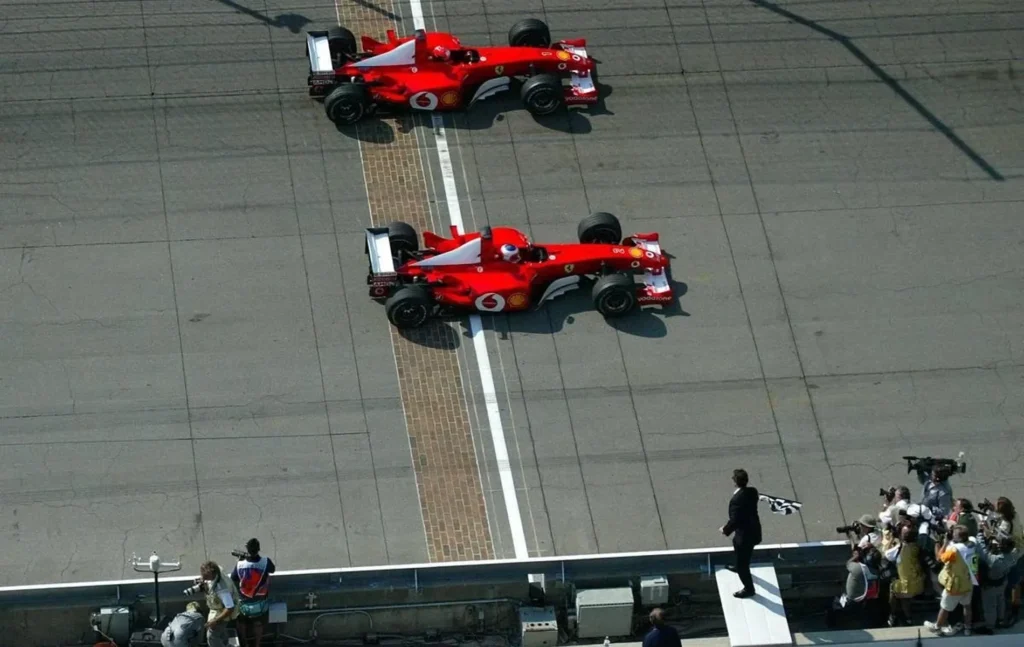
2. 2002 United States Grand Prix – Barrichello beat Schumacher by 0.011 seconds
The second-smallest recorded margin came in unusual circumstances.
Ferrari dominated the 2002 season. By Indianapolis, Michael Schumacher had already secured his fifth World Championship, while the team had also wrapped up the Constructors’ title.
Schumacher started from pole and led most of the race ahead of Rubens Barrichello. But approaching the chequered flag, he slowed as the Ferraris attempted an extraordinarily close formation finish.
It went slightly too far.
Barrichello crossed the line first by 0.011 seconds, with Schumacher second.
Barrichello said afterwards that no specific finish had been planned and that he did not initially know what Schumacher was doing. Schumacher’s move was widely interpreted in the context of that year’s controversial Austrian Grand Prix, where Barrichello had been ordered to surrender victory to his team-mate.
The result remains one of F1’s strangest statistical records: a margin so tiny that it would normally suggest an epic fight, but which instead resulted from the dominant team trying to manufacture a photo finish.
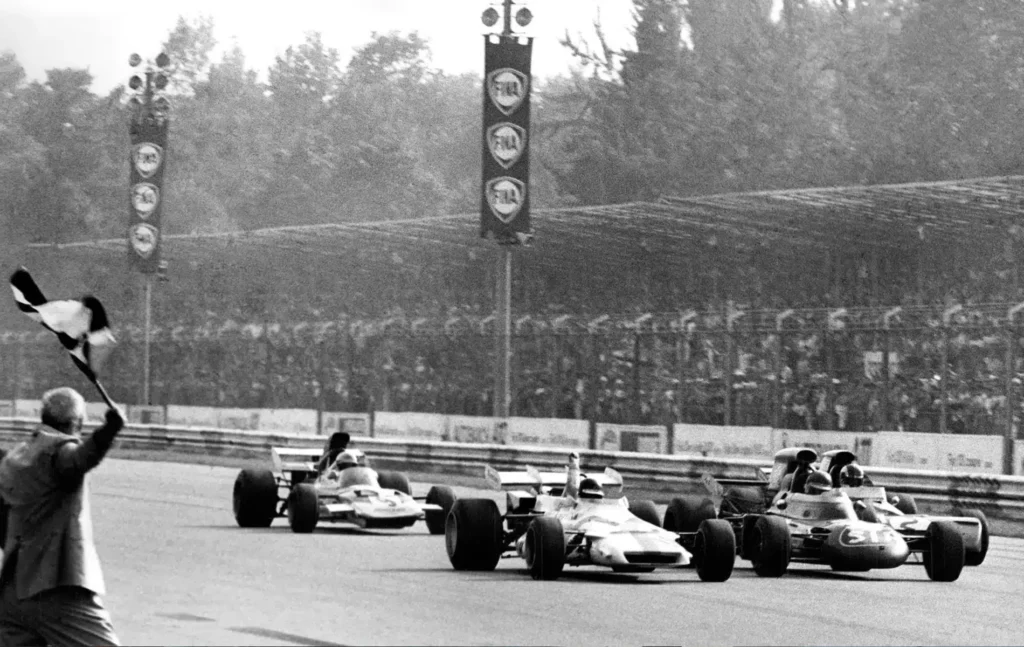
1. 1971 Italian Grand Prix – Gethin beat Peterson by 0.010 seconds
Nothing else on this list quite matches Monza 1971.
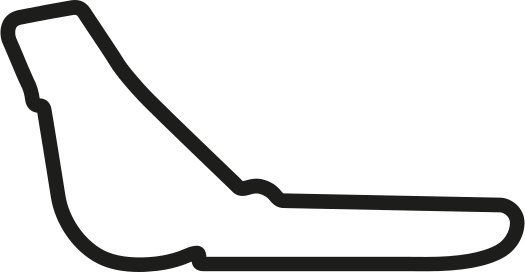
Peter Gethin, Ronnie Peterson, François Cevert, Mike Hailwood and Howden Ganley entered the final stages locked in an enormous slipstream battle around the pre-chicane Monza.
The circuit configuration encouraged cars to tow past one another repeatedly, producing eight different leaders and 26 official lead changes.
Then came the finish.
Gethin’s BRM crossed the line 0.010 seconds ahead of Peterson’s March. Cevert was only 0.090 seconds behind the winner, Hailwood 0.180 seconds back and Ganley 0.610 seconds behind.
Five cars. Six-tenths of a second.
It was Gethin’s first and only Formula 1 World Championship victory.
There is, however, an important historical qualification when calling it the closest F1 finish ever.
Timing in 1971 was recorded only to hundredths of a second, whereas by the 2002 United States Grand Prix F1 was recording results to thousandths. The FIA has consequently noted that Gethin’s 0.01-second margin has a claim to being the closest finish, while Barrichello’s 0.011-second Indianapolis victory was measured with greater precision. We cannot retrospectively know whether the true 1971 difference was, for example, 0.006 seconds or 0.014 seconds.
On the official results, though, Gethin versus Peterson remains at the top of the list.
Why are F1 finishes this close so rare today?
One thing jumps out from this ranking: five of the seven races happened before 1990.
That is not simply nostalgia.
Circuits such as old Monza and Reims allowed prolonged slipstream battles in which several cars could repeatedly exchange positions. Modern circuits, aerodynamic characteristics, pit-stop strategy and increasingly precise race management create a different type of Grand Prix.
Safety-driven circuit changes also transformed places such as Monza. The 1971 race took place before the chicanes that subsequently broke up the circuit’s huge flat-out sections.
Modern F1 can still produce extremely close racing, but a sub-0.1-second winning margin remains exceptionally rare. Even the dramatic 2026 British Grand Prix, where Charles Leclerc beat George Russell by just 0.427 seconds, was more than four times the margin separating Fangio and Kling in 1954 — and more than 40 times Gethin’s officially recorded advantage in 1971, and that was down to the race finishing under the Safety Car.
That perspective is what makes these seven finishes extraordinary.
F1 has changed beyond recognition since Fangio raced through the French countryside or Gethin slipstreamed down Monza’s straights. Cars are safer, timing is vastly more precise and races are analysed in levels of detail unimaginable in the 1950s.
But the simplest measure has never changed. The first car across the line wins. And sometimes, after hundreds of kilometres, there is almost nothing in it.
Seen in: