



























LEC Refrigeration Racing was a British Formula One constructor and racing team based in Bognor Regis, West Sussex. Backed by the Purley family’s refrigeration business, the team competed in Formula One during the 1973 and 1977 seasons, initially with a customer March chassis before returning with its own car, the LEC CRP1.
| Nationality | British |
| Years Active | 1973, 1977 |
| First entry | 1973 Monaco Grand Prix |
|---|---|
| Races entered | 10 |
| Engines | Cosworth |
| Race victories | 0 |
| Points | 0 |
| Pole positions | 0 |
| Fastest laps | 0 |
| Final entry | 1977 British Grand Prix |
Although its results were modest, LEC is remembered for two defining moments in Formula One history: David Purley‘s courageous attempt to rescue Roger Williamson at the 1973 Dutch Grand Prix, and Purley’s remarkable survival after one of the most violent crashes ever recorded in motorsport during the 1977 British Grand Prix weekend.
1973 Season
LEC Refrigeration Racing entered Formula One in 1973 when David Purley purchased a March 731 with financial backing from his family’s refrigeration company. The small privateer team made its World Championship debut at the 1973 Monaco Grand Prix, where a broken fuel tank ended Purley’s race prematurely.
At the 1973 British Grand Prix, Purley spun off before the race restart and was unable to continue. However, it was the following round at Zandvoort that secured his place in Formula One history.
During the 1973 Dutch Grand Prix, Purley witnessed fellow Briton Roger Williamson crash and become trapped beneath his overturned, burning car. Immediately stopping his own race, Purley ran across the circuit and made repeated attempts to lift the wreckage and extinguish the fire while Williamson called for help from inside the cockpit.
Despite desperately signalling to marshals and passing drivers for assistance, Purley received little meaningful help. The marshals lacked fire-resistant clothing and were reluctant to intervene, while many drivers mistakenly believed Purley was attempting to rescue himself rather than another competitor. Tragically, Williamson died from asphyxiation before he could be freed.
Purley’s extraordinary bravery earned widespread admiration throughout the motorsport community and remains one of Formula One’s most courageous acts. He was later awarded the George Medal for his efforts.
On the sporting side, LEC completed its first Formula One finish at the German Grand Prix before reaching the chequered flag again later in the season at the Italian Grand Prix.
Return with the LEC CRP1
After a three-year absence, LEC returned to Formula One in 1977 with its own chassis, the LEC CRP1. Designed by respected engineer Mike Pilbeam and run by Mike Earle, the new car represented the team’s first fully independent Formula One design.
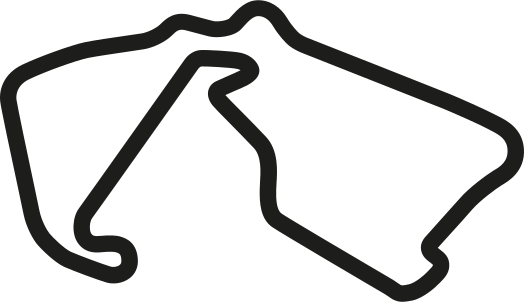
The project’s ambitions were cut short during pre-qualifying for the 1977 British Grand Prix at Silverstone. Purley suffered a catastrophic accident when his throttle jammed fully open, sending the CRP1 into a wall at approximately 173 km/h (108 mph). The impact brought the car to a halt in just 66 centimetres, subjecting Purley to an estimated deceleration of 179.8 g.
The crash left him with multiple fractures to his legs, pelvis and ribs, but he survived against all expectations. For many years, the impact was widely believed to be the highest g-force ever survived by a human being and remains one of the most extraordinary survival stories in Formula One history.
Purley’s injuries effectively ended LEC’s Formula One ambitions, and the team never returned to World Championship competition.
Legacy
Although LEC Refrigeration Racing competed in only ten Formula One World Championship Grands Prix, the team occupies a unique place in the sport’s history. David Purley’s selfless actions at Zandvoort and his survival of the devastating Silverstone accident have ensured that LEC is remembered for far more than its race results.
One of the original LEC CRP1 chassis has since been restored and has appeared in historic Formula One events, while a faithful modern replica has also been built by WKD Motorsport, preserving the legacy of one of Britain’s most remarkable independent Formula One teams.
Complete Formula One World Championship results
| Year | Chassis | Engine | Tyres | Driver | 1 | 2 | 3 | 4 | 5 | 6 | 7 | 8 | 9 | 10 | 11 | 12 | 13 | 14 | 15 | 16 | 17 | Points | WCC |
|---|---|---|---|---|---|---|---|---|---|---|---|---|---|---|---|---|---|---|---|---|---|---|---|
| 1973 | March 731 | Cosworth DFV 3.0 V8 | G | ARG | BRA | RSA | ESP | BEL | MON | SWE | FRA | GBR | NED | GER | AUT | ITA | CAN | USA | |||||
| David Purley | Ret | DNS | Ret | 15 | 9 | ||||||||||||||||||
| 1977 | LEC CRP1 | Cosworth DFV 3.0 V8 | G | ARG | BRA | RSA | USW | ESP | MON | BEL | SWE | FRA | GBR | GER | AUT | NED | ITA | USA | CAN | JPN | — | 0 | |
| David Purley | DNQ | 13 | 14 | Ret | DNPQ |
