































Stebro was a Canadian constructor best known for building Formula Junior racing cars and for achieving one of the most distinctive one-race appearances in Formula One history. Founded by John Stevens and Peter Broeker, the marque entered a single World Championship Grand Prix—the 1963 United States Grand Prix—where its lone car finished a remarkable seventh.
| Nationality | Canadian |
| Years Active | 1963 |
| First Race | 1963 United States Grand Prix |
| Last Race | 1963 United States Grand Prix |
| Race Entries | 1 |
| Race Starts | 1 |
| Wins | 0 |
| Podiums | 0 |
| Pole Positions | 0 |
| Fastest Laps | 0 |
| Points | 0 |
| Constructors’ Championships | 0 |
| Drivers’ Championships | 0 |
| Best Start | 21st |
| Best Finish | 7th |
| Did Not Start | 0 |
| Did Not Qualify | 0 |
| Retirements | 0 |
Stebro
That result alone would make Stebro memorable. But the team’s story goes much deeper: a home-grown Canadian racing project, an engineering side-business turned constructor, and a car that went on to win extensively across North America after its Formula One cameo.
Origins of the Stebro name
The Stebro name was formed from its two founders: Stevens and Broeker. Peter Broeker, owner of an automotive accessories company, used the project to help promote the brand in Canada while also pursuing his passion for motorsport.
Broeker had moved to Canada with his family at the end of the Second World War. He first established an automotive repair business in Hamilton, Ontario, before relocating to Montreal during the 1950s, where he opened the Stebro Garage.
Though always interested in racing, it was in Montreal that Broeker became deeply involved in single-seater competition. He began supplying custom exhaust systems designed to improve performance, then took the logical next step: build complete race cars himself.
Stebro exhaust systems
Around 1959, Broeker introduced the Stebro brand of performance exhaust systems for imported road cars. Early products were sourced from Italy through a business relationship with Frank Reisner, who was then beginning what would become Intermeccanica.
Broeker soon established his own manufacturing facility in Pointe-Claire, Quebec, later relocating operations to eastern Ontario. Even after the racing programme ended, Stebro remained known as a manufacturer of aftermarket exhaust systems for European and American cars for many years.
The brand was later revived by Swiss mechanic Andy Petschenig, who relaunched Stebro stainless-steel systems near Ottawa. However, delivery issues damaged the reborn company’s reputation, and the second-era Stebro business closed in 2013.
Building the Stebro race cars
The first Stebro racing machine, the Mark I, was built in 1960 inside the Stebro repair garage on McGill Street in Montreal. It featured a front-engined Formula Junior layout powered by a BMC engine and drivetrain.
The Mark II followed with a more modern mid-engined design, again using BMC power. Then came the Mark III, based on a Sadler MKV sports racer that was stretched by eight inches and fitted with a conventional transaxle.
By the winter of 1962 and 1963, Broeker produced the most famous Stebro of all: the Mark IV.
The Mark IV used a spaceframe chassis built from thin-wall chrome-moly tubing. Its aluminium bodywork wrapped around a modified Ford Formula Junior engine paired to a Hewland MkIV five-speed gearbox. Suspension featured double wishbones at the front and a reversed lower A-arm with top link at the rear. Girling brakes—sourced from a Lotus 21 Formula One car—were fitted at all four corners.
Formula One dream: Watkins Glen
Broeker originally intended to enter two cars in the 1963 United States Grand Prix at Watkins Glen. Planned drivers were John Cannon and Ernie DeVos, both successful names in Canadian Formula Junior racing.
The intention was to use specialist Martin-built Ford-based Formula One engines from England. But delays and reliability problems meant the motors never arrived in time, despite Broeker having already paid for them.
Forced to improvise, Broeker assembled an essentially stock Ford 1500cc engine using whatever performance parts he had available. It was hardly ideal preparation for a World Championship Grand Prix.
DeVos, recognising the car would be significantly underpowered, withdrew. That left Peter Broeker to drive the Stebro himself.
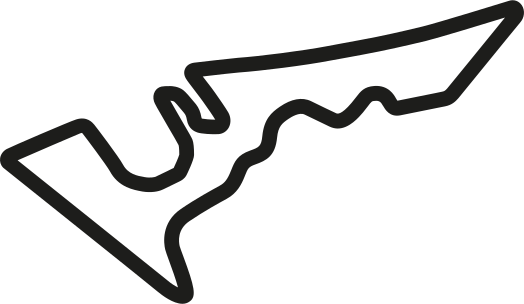
The 1963 United States Grand Prix
Even reaching the grid was an achievement. During practice, the hastily prepared engine suffered a failed front oil seal, spilling oil onto the circuit. Despite that setback, Broeker qualified the car only three-and-a-half seconds slower than Giancarlo Baghetti in the ATS.
Early in the race, the gearbox jammed in fourth gear after only a few laps. Many would have retired immediately. Broeker kept going.
With limited power and stuck transmission ratios, he battled on to the finish and was classified seventh after completing 88 of the 110 laps. Against the vastly more sophisticated Formula One machinery of the day, it was an extraordinary result.
The race also secured two historic firsts: Broeker became the first Canadian to start and finish a Formula One World Championship Grand Prix, while Stebro became the first—and still only—Canadian-built car to finish a World Championship Formula One race.
European Formula Two adventure
In 1964, Broeker took the Mark IV to Europe for the inaugural European Formula Two Championship. Power came from an 1100cc Martin Ford engine.
Unfortunately, the unit lacked the performance of the finely developed Cosworth competition. Even so, the team managed respectable eighth-place finishes at Hockenheim and Zeltweg—further proof the chassis itself was a capable machine.
North American winning machine
Returning to Canada for 1965, Broeker updated the Mark IV with a larger radiator, revised bodywork and a Lotus-Ford twin-cam engine.
In this new form, the Stebro became a prolific winner. It claimed the all-formula sprint at Mosport’s Indian Summer Trophy races on September 4, 1965, then went on to rack up more than 100 victories across North America over the next three seasons in Formula Libre and Formula B competition.
For a car that once tackled Formula One with a jammed gearbox, that was quite the second act.
Crash, rebuild and preservation
Late in 1968, Broeker crashed the Stebro heavily at St. Jovite. He escaped injury, but the car was badly damaged. It was rebuilt, though handling problems encouraged Broeker to move on and purchase a British Chevron instead.
Broeker continued racing until his death in 1980. The Mark IV survived, though it deteriorated outdoors until being purchased in 1985 and fully restored.
After restoration, it returned to competition in 1988, winning the vintage class at the Canadian Run Offs at St. Jovite.
A living artifact
The surviving car retains remarkable originality. It is powered once more by a Ford 1500cc engine in the same spirit as its 1963 Formula One appearance, while still carrying its original gearbox and many major components.
Even better, the bodywork preserves the 1965 paint scheme along with dents and scars collected through decades of racing. It wears its history proudly.
Legacy
Stebro was never a factory giant, never a championship contender and never intended to be. It was something arguably more charming: a fiercely independent Canadian motorsport dream built in a workshop by enthusiasts who refused to think small.
One Formula One start, one seventh-place finish, over 100 later victories, and a permanent place in Canadian racing folklore ensure Stebro remains one of motorsport’s great underdog stories.
Stebro Stats by Season
| Year | Engine | Drivers | Entries | Starts | Wins | Podiums | Poles | Fastest Laps | Front Rows | DNF | Best Start | Best Result | Points | Championship |
|---|---|---|---|---|---|---|---|---|---|---|---|---|---|---|
| 1963 | Ford | Peter Broeker | 1 | 1 | 0 | 0 | 0 | 0 | 0 | 0 | 21 | 7 | 0 | NC |
