





























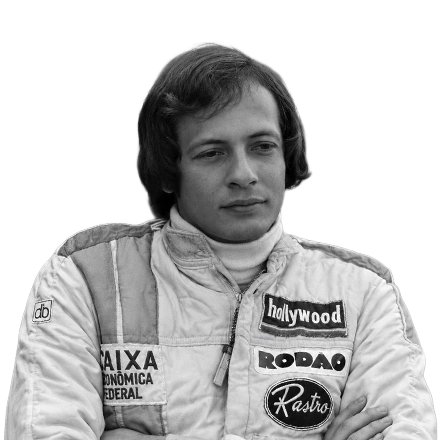
Alex Dias Ribeiro (born 7 November 1948) is a former Brazilian racing driver who entered 20 Formula One World Championship Grands Prix. Although he did not score any World Championship points, Ribeiro built a career that stretched far beyond the results sheet, encompassing Formula Two success, Formula One, faith-based work in the paddock and service as a medical car driver.
Driver Bio
| Nationality | Brazilian |
| Birthplace | Belo Horizonte, Brazil |
| Born | 7 November 1948 |
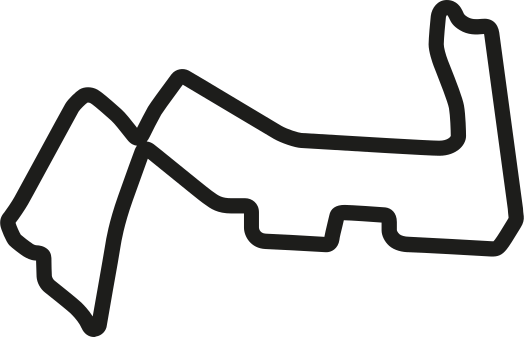
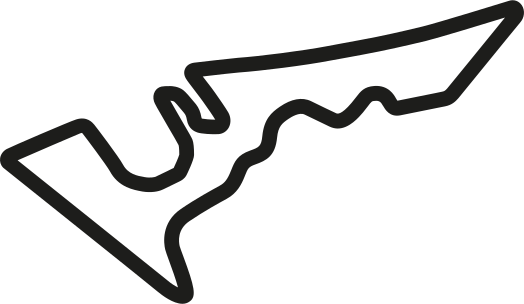
| First Grand Prix | 1976 United States Grand Prix |
| Last Grand Prix | 1979 United States Grand Prix |
| Years Active | 1976–1977, 1979 |
| Current/Last Team | Fittipaldi |
Career
Ribeiro progressed steadily through the junior categories and established himself as a serious prospect by finishing fifth in the 1976 European Formula Two Championship.
That result helped him secure a Formula One seat with March for the 1977 season, backed primarily by Caixa Econômica Federal and Souza Cruz. The move looked like a major opportunity, but the campaign quickly unravelled. March’s owner, Max Mosley, had signed four drivers, leaving the team overstretched and unable to support each entry properly. The lack of resources and organisation made the season extremely difficult, and Ribeiro’s reputation suffered as a consequence.
Determined to rebuild his career, Ribeiro returned to European Formula Two in 1978 with a privately run team of his own. His car carried the words “Jesus Saves”, a message that also appeared on his helmet and later on his Formula One machinery, reflecting the Christian faith that became central to his public identity.
The championship was dominated by the factory March operation, but Ribeiro still delivered one of the most memorable results of his career at the Nürburgring. After leading contenders Bruno Giacomelli and Marc Surer retired, Ribeiro swept through to win the race on the fearsome 22.8-kilometre version of the circuit. The victory made him the only Brazilian driver to win on the old Nürburgring. Unfortunately, the remainder of the season brought little further reward.
In 1979, the Brazilian Fittipaldi team gave Ribeiro two opportunities to qualify a second car, at the Canadian and United States Grands Prix. With the team’s attention centred on former World Champion Emerson Fittipaldi, however, Ribeiro was unable to qualify for either race.
Faith and work in Formula One
Ribeiro remained involved in Formula One after his frontline driving career ended. A committed Christian, he served as a chaplain at Grands Prix while also working as a driver of the championship’s medical car.
His faith also led him into international football. In 1994, Ribeiro joined the Brazil national team as a pastor during the FIFA World Cup in the United States. He organised worship services for the squad and later wrote a book about Brazil’s victorious campaign, titled Who Won the ’94 World Cup?
Ribeiro’s medical car duties were not without drama. Before Saturday practice at the 2000 Monaco Grand Prix, he crashed the car at the Tabac corner, leaving passenger and Formula One medical chief Sid Watkins with three broken ribs.
An even more alarming incident occurred at the 2002 Brazilian Grand Prix, which marked Ribeiro’s final appearance as a Formula One medical car driver. During the Sunday morning warm-up, Enrique Bernoldi crashed his Arrows at Turn 2. Ribeiro drove to the scene and opened the medical car’s door just as Nick Heidfeld arrived in his Sauber and struck it. Despite the severity of the impact, both Ribeiro and Heidfeld escaped injury.
Life beyond racing
In 1981, Ribeiro published an autobiography titled Mais Que Vencedor, roughly translated as More Than a Winner. In the book, he humorously referred to March owner Max Mosley as “Mack Mouse” and engineer Robin Herd as “Robin Hood”.
Ribeiro also owned a motorcycle shop in Brasília where future Formula One drivers Nelson Piquet and Roberto Moreno both worked as young mechanics. Combined with Ribeiro’s own career, the workshop achieved the remarkable distinction of helping launch three Brazilian Formula One drivers.
Although Ribeiro never achieved the World Championship results he had hoped for, his career remains one of the most unusual in Brazilian motorsport, combining racing, religion, writing, medical support work and a lasting connection to some of the country’s greatest drivers.
Grand Prix Stats
| Race Entries | 20 |
| Race Starts | 10 |
| Did Not Start | 0 |
| Best Race Start | 17th |
| Best Race Finish | 8th |
| Retirements | 4 |
| First-Lap Retirements | 0 |
| Not Classified | 0 |
| Disqualified | 0 |
| Did Not Qualify | 10 |
Qualifying
| Qualifying Sessions | 20 |
| Reached Q3 | 0 |
| Q2 Eliminations | 0 |
| Q1 Eliminations | 0 |
| Did Not Qualify | 10 |
Stats by Season
| Year | Constructor | Entries | Starts | Wins | Podiums | Poles | Fastest Laps | Front Rows | DNF | Best Start | Best Result | Pts Finishes | Points | Championship |
|---|---|---|---|---|---|---|---|---|---|---|---|---|---|---|
| 1976 | Hesketh | 1 | 1 | 0 | 0 | 0 | 0 | 0 | 0 | 22 | 12 | 0 | 0 | NC |
| 1977 | March | 17 | 9 | 0 | 0 | 0 | 0 | 0 | 4 | 17 | 8 | 0 | 0 | NC |
| 1979 | Fittipaldi | 2 | 0 | 0 | 0 | 0 | 0 | 0 | 0 | DNQ | DNQ | 0 | 0 | NC |
Stats by Constructor
| Constructor | Years | Entries | Starts | Wins | Podiums | Poles | Fastest Laps | Front Rows | DNF | Best Start | Best Result | Pts Finishes | Points |
|---|---|---|---|---|---|---|---|---|---|---|---|---|---|
| Hesketh | 1976 | 1 | 1 | 0 | 0 | 0 | 0 | 0 | 0 | 22 | 12 | 0 | 0 |
| March | 1977 | 17 | 9 | 0 | 0 | 0 | 0 | 0 | 4 | 17 | 8 | 0 | 0 |
| Fittipaldi | 1979 | 2 | 0 | 0 | 0 | 0 | 0 | 0 | 0 | DNQ | DNQ | 0 | 0 |
Teammates & Qualifying Head-to-Head
| Teammate | Years | Races | Qualifying H2H |
|---|---|---|---|
| Emerson Fittipaldi | 1979 | 2 | 0-2 |