




























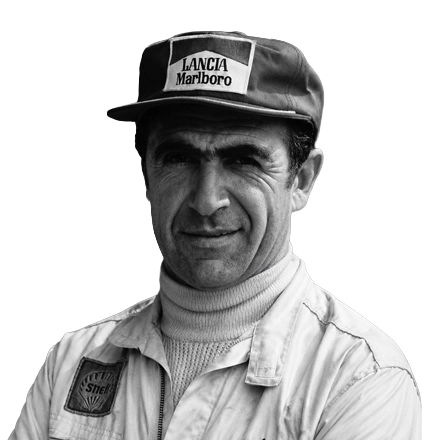
Carlo Giovanni Facett is one of Italy’s great racing all-rounders — a fiercely intelligent driver, gifted engineer, engine builder, and relentless competitor whose career stretched across four decades of motorsport. Although Formula One brought him only a single, unsuccessful qualifying attempt at the 1974 Italian Grand Prix, Facetti’s true legacy was forged elsewhere: in touring cars, endurance racing, and the workshops where raw mechanical genius often mattered just as much as outright speed.
Driver Bio
| Nationality | Italian |
| Birthplace | Cormano, Italy |
| Born | 26 June 1935 |
| First Grand Prix | 1974 Italian Grand Prix |
| Last Grand Prix | 1974 Italian Grand Prix |
| Years Active | 1974 |
| Current/Last Team | Privateer: Brabham |
Born in Cormano, Lombardy, Facetti grew up immersed in motorsport. Racing was in the family bloodline — his father, Piero Facetti, was both a mechanic and racer who famously finished fourth in the 1947 Mille Miglia, while his siblings Giuliano and Rosadelle also became drivers. Carlo himself learned to drive at just 11 years old under the guidance of none other than Alberto Ascari, a close family friend and future Formula One World Champion. It was an extraordinary introduction to racing, and one that helped shape a lifelong obsession with speed, engineering, and competition.
Facetti began racing in 1953 at the Giro di Calabria alongside Elio Zagato, driving a Fiat 8V fitted with engines prepared by the Facetti workshop. By the early 1960s he was building and racing Formula Junior machinery powered by Lancia Appia engines, often creating competitive cars with limited resources but enormous ingenuity. He later recalled the era with pride and humour, joking that success required “a lot of passion, a racing seat and reverse shift from a Fiat 600.” Despite the humble beginnings, he quickly earned respect for his pace against future stars including Ludovico Scarfiotti, Lorenzo Bandini, and Giancarlo Baghetti.
In 1963, Facetti moved into touring car racing with Lancia’s HF Squadra Corse during the inaugural European Touring Car Challenge. Racing across legendary venues such as Nürburgring, Brands Hatch, and Budapest’s Népliget Park, he scored his first major international victory alongside Luigi Cabella. Around the same period, he raced Formula Junior in Argentina with Scuderia Sant’Ambroeus, where he met Juan Manuel Fangio — a friendship that would continue long after their racing encounters in Buenos Aires and Mar del Plata.
Facetti also managed Formula Three teams featuring rising talents like Jo Siffert and Clay Regazzoni before returning himself to competitive driving, finishing runner-up in the Italian Formula Three championship in 1965 with a Brabham-Ford BT16.
His career truly accelerated in 1969 when Alfa Romeo recruited him to Autodelta, the marque’s competition division. There, Facetti became instrumental in both development and competition programmes, racing alongside names such as Ignazio Giunti and Nino Vaccarella in the European Touring Car Championship and the World Championship for Makes. He twice finished third in the Spa 24 Hours and became a key figure in Alfa Romeo’s increasingly competitive endurance efforts.
By 1973 and 1974, he was racing the Alfa Romeo T33/TT sportscar internationally, often partnered with Andrea de Adamich. The pairing claimed multiple podium finishes, including second place at the 1000 km Österreichring. Yet despite winning the Italian title, Facetti departed Alfa Romeo amid frustrations over recognition and opportunity.
That departure unexpectedly opened the door to one of the most fascinating chapters of his career. Recruited by Cesare Fiorio, Facetti joined Lancia to develop advanced versions of the Stratos engine alongside legendary engineer Mike Parkes. As both driver and designer, he helped evolve the Stratos into an even more fearsome machine, experimenting with fuel injection, turbocharging, and four-valve cylinder heads while simultaneously racing the cars across Europe.
In 1974, amid his work with Lancia and touring cars, Facetti made his lone Formula One attempt at the Italian Grand Prix at Monza in a Scuderia Finotto-entered Brabham BT42. Despite determined efforts, neither he nor the team could extract enough pace to qualify for the race. Although his Formula One story ended before it truly began, Facetti’s reputation elsewhere in motorsport was already flourishing.
The late 1970s marked the peak of his touring car success. Partnering Martino Finotto in BMW CSL machinery, Facetti became one of Europe’s dominant touring car competitors. After finishing runner-up in the European Touring Car Championship in 1977 and fourth in 1978, he finally secured the 1979 ETCC crown through a season filled with dramatic battles, mechanical recoveries, and relentless performances across Europe’s toughest circuits. Victories at Nürburgring, Zandvoort, Salzburgring, Silverstone, and Zolder cemented his place among touring car racing’s elite.
But Facetti was never content simply driving other people’s machinery. Alongside Finotto, he launched Achille Motors in Milan and began pursuing increasingly ambitious engineering projects. The most famous of these was the extraordinary Carma FF — a heavily modified Ferrari 308 GTB Group 5 monster designed to challenge the dominant Porsche 935s. Facetti engineered bespoke cylinder heads and twin-turbocharging systems capable of producing up to 840 bhp in qualifying trim, transforming the Ferrari into one of the wildest creations of its era.
The Carma FF became legendary for its speed, unpredictability, and spectacular appearance. Facetti himself often extracted astonishing performances from the car, taking pole positions and fastest laps despite persistent reliability problems. It perfectly embodied his approach to motorsport: daring, inventive, and uncompromisingly ambitious.
During the 1980s, Facetti continued developing engines and prototypes for endurance racing, particularly through the Alba and Carma FF projects in Group C2 and IMSA competition. Working closely with Giorgio Stirano and Martino Finotto, he designed turbocharged engines and lightweight prototypes that achieved considerable success in lower-displacement endurance categories, including victories in the Group C Junior Cup.
Even after stepping back from full-time international racing in the late 1980s, Facetti’s competitive instincts never fully disappeared. In 1995, long after most drivers of his generation had retired, he returned for a one-off appearance in a Ferrari F355 at Mugello, finishing an impressive fourth.
Grand Prix Stats
| Race Entries | – |
| Race Starts | – |
| Did Not Start | 0 |
| Best Race Start | – |
| Best Race Finish | – |
| Retirements | – |
| First-Lap Retirements | 0 |
| Not Classified | – |
| Disqualified | 0 |
| Did Not Qualify | 1 |
Qualifying
| Qualifying Sessions | – |
| Reached Q3 | – |
| Q2 Eliminations | – |
| Q1 Eliminations | – |
| Did Not Qualify | 1 |
Stats by Season
| Year | Constructor | Entries | Starts | Wins | Podiums | Poles | Fastest Laps | Front Rows | DNF | Best Start | Best Result | Pts Finishes | Points | Championship |
|---|---|---|---|---|---|---|---|---|---|---|---|---|---|---|
| 1974 | Privateer: Brabham | 1 | 0 | 0 | 0 | 0 | 0 | 0 | 0 | DNQ | DNQ | 0 | 0 | NC |