































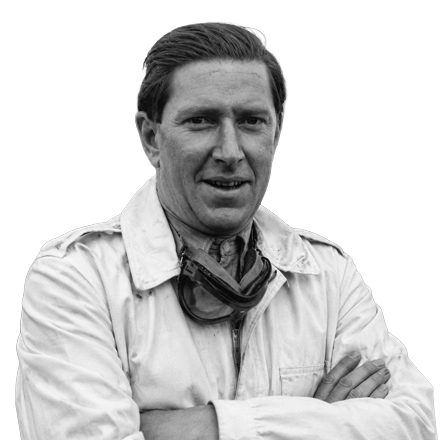
David Alan Hampshire (29 December 1917 – 25 August 1990) was a British racing driver whose career spanned the years before and after the Second World War. Competing in Grand Prix racing, Formula One, endurance events and hill climbs, Hampshire established himself as one of Britain’s respected privateer racers during the late 1940s and early 1950s.
Born in Mickleover, Derbyshire, he remained closely associated with the county throughout his life and died in nearby Newton Solney, South Derbyshire, in 1990.
Driver Bio
| Nationality | British |
| Birthplace | Mickleover, England, UK |
| Born | 29 December 1917 |
| Died | 25 August 1990 |
| First Grand Prix | 1950 British Grand Prix |
| Last Grand Prix | 1950 French Grand Prix |
| Years Active | 1950 |
| Current/Last Team | Privateer: Scuderia Ambrosiana Maserati |
Early Racing Career
Hampshire first appeared on the British racing scene in 1939, lining up alongside leading names such as Prince Bira, Luigi Villoresi, Tony Rolt, Raymond Mays, Peter Whitehead, Leslie Brooke and Reg Parnell in the prestigious Nuffield Trophy at Donington Park.
He drove a Maserati 6CL that had previously belonged to Arthur Dobson and had been modified with a reduced-capacity 1,100 cc engine. Unfortunately, mechanical problems struck early, with a melted piston forcing his retirement after only a handful of laps. The car was later restored to its original 1.5-litre specification.
Hampshire continued to campaign the Maserati during 1939, competing at the Brooklands Whit Monday meeting and the Sydenham Trophy at Crystal Palace, the latter becoming one of the early motor races to be televised by the BBC. His final pre-war appearance came at Donington Park in August 1939, shortly before racing was halted by the outbreak of the Second World War.
Return to Racing
When motorsport resumed after the war, permanent racing circuits in Britain were scarce, so Hampshire initially competed in sprint events at venues including Gransden Lodge and Shelsley Walsh.
Later in 1946, he returned to international competition with a Delage 158L, originally a 1927 Grand Prix car. He contested both the Albi Grand Prix and the Grand Prix des Nations, recording an eighth-place finish in the latter.
The following season saw Hampshire drive Reg Parnell’s famous “The Challenger” in the British Empire Trophy, before taking the wheel of Parnell’s ERA E-type (GP1) at Lausanne. Although both outings ended in retirement, they strengthened his association with some of Britain’s leading racing teams.
Grand Prix Success
Hampshire enjoyed a far more productive campaign in 1948. Driving his trusted Delage 158L, he finished second in the British Empire Trophy on the Isle of Man and secured seventh place in the Zandvoort Grand Prix in the Netherlands. He also competed in that year’s Jersey Road Race, continuing to build his reputation as a capable and consistent Grand Prix competitor.
In 1949, he acquired the experienced but ageing ERA R12B, a car already a decade old. Despite its age, Hampshire extracted impressive performances, finishing fourth in both the British Grand Prix at Silverstone and the Goodwood Trophy. Additional top-ten finishes followed in the Jersey Road Race and the British Empire Trophy, while he also placed 11th at the International Trophy meeting. Mechanical problems, however, forced retirements in both the Albi and Lausanne Grands Prix.
Formula One Career
Hampshire entered the inaugural Formula One World Championship in 1950, making two World Championship Grand Prix starts alongside numerous appearances in non-championship Formula One events.
One of his finest performances came in the Jersey Road Race, where he claimed pole position driving a Scuderia Ambrosiana Maserati 4CLT. Victory looked within reach until a magneto failure brought his challenge to an end. Despite the disappointment, he set the fastest lap of the race, which was ultimately won by Peter Whitehead’s Ferrari.
Later that year, Hampshire finally celebrated a Formula One victory by winning the 1950 Nottingham Trophy at Gamston. Driving the same Scuderia Ambrosiana Maserati 4CLT, he secured one of the most significant successes of his racing career in one of the leading non-championship Formula One races of the era.
Endurance Racing
In addition to his Grand Prix exploits, Hampshire also competed in endurance racing. At the 1951 24 Hours of Le Mans, he partnered his long-time friend Reg Parnell in a works Aston Martin DB2. The pair produced a strong performance, finishing third in class and seventh overall against some of the world’s leading sports car teams.
Grand Prix Stats
| Race Entries | 2 |
| Race Starts | 2 |
| Did Not Start | 0 |
| Best Race Start | 16th |
| Best Race Finish | 9th |
| Retirements | 1 |
| First-Lap Retirements | 0 |
| Not Classified | 0 |
| Disqualified | 0 |
| Did Not Qualify | 0 |
Qualifying
| Qualifying Sessions | 2 |
| Reached Q3 | 0 |
| Q2 Eliminations | 0 |
| Q1 Eliminations | 0 |
| Did Not Qualify | 0 |
Stats by Season
| Year | Constructor | Entries | Starts | Wins | Podiums | Poles | Fastest Laps | Front Rows | DNF | Best Start | Best Result | Pts Finishes | Points | Championship |
|---|---|---|---|---|---|---|---|---|---|---|---|---|---|---|
| 1950 | Privateer: Scuderia Ambrosiana Maserati | 2 | 2 | 0 | 0 | 0 | 0 | 0 | 1 | 16 | 9 | 0 | 0 | NC |
Stats by Constructor
| Constructor | Years | Entries | Starts | Wins | Podiums | Poles | Fastest Laps | Front Rows | DNF | Best Start | Best Result | Pts Finishes | Points |
|---|---|---|---|---|---|---|---|---|---|---|---|---|---|
| Privateer: Scuderia Ambrosiana Maserati | 1950 | 2 | 2 | 0 | 0 | 0 | 0 | 0 | 1 | 16 | 9 | 0 | 0 |
Teammates & Qualifying Head-to-Head
| Teammate | Years | Races | Qualifying H2H |
|---|---|---|---|
| David Murray | 1950 | 1 | – |
| Reg Parnell | 1950 | 1 | – |