




























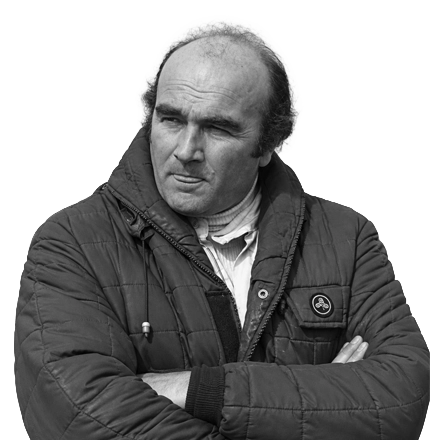
David Ruff Piper (born 2 December 1930) is a British former Formula One and sports-car driver from England. Although his World Championship record amounted to three Grands Prix entries, beginning on 18 July 1959, his real legacy was forged in long-distance racing, where privately owned Ferraris and Porsches became his trademark. More than four decades after his Formula One debut, he was still collecting trophies, winning the Le Mans Legend race in 2001.
Driver Bio
| Nationality | British |
| Birthplace | Edgware, England, UK |
| Born | 2 December 1930 |
| First Grand Prix | 1959 British Grand Prix |
| Last Grand Prix | 1960 British Grand Prix |
| Active Years | 1959–1960 |
| Current/Last Team | Privateer: Robert Bodle Ltd. Lotus |
Racing career
From hill-climbs to Formula One
Born in Edgware, Middlesex, Piper entered motorsport during the mid-1950s through sprints and hill-climbs. Circuit racing followed in a Lotus Eleven, before he stepped into the more demanding Lotus 16.
That car performed double duty during 1959 and 1960. By fitting the appropriate engine, Piper could switch between Formula One and Formula Two competition—an economical bit of versatility in an era when ingenuity mattered almost as much as speed. His finest result in the Lotus came at the 1960 Lady Wigram Trophy, where he finished second behind Jack Brabham’s Cooper.
Piper joined Jo Siffert on the European Formula Junior trail in 1961, while also appearing in the Oulton Park Gold Cup aboard the Gilby Formula One car. Further non-championship single-seater outings followed in 1962, but the category was beginning to lose its appeal. Piper turned his attention to sports cars instead, initially choosing one of the most desirable machines imaginable: the Ferrari 250 GTO.
Building a sports-car reputation
From 1962 until 1970, Piper became a familiar figure at circuits around the world. He usually arrived with machinery he owned himself, racing a succession of Ferraris before adding a Porsche 917 to his collection. Outright victories did not come at every stop, but his consistency, mechanical sympathy and dependability made him a respected international competitor.
Ferrari remained the marque most closely associated with Piper. He occasionally handled rare factory prototypes, but much of his racing was conducted in customer GT and Group 4 machinery. His varied stable included the Ferrari 250 LM, Lola T70 and Porsche 917.
The 917 existed because Porsche pushed the Group 4 regulations to their limit. When the required production run was reduced to 25 cars, the company created a batch of fearsome 4.5-litre, flat-12 machines. They resembled full-blooded prototypes and offered considerably more muscle than the three-litre, flat-eight Porsche 908. What they did not initially offer was peace of mind.
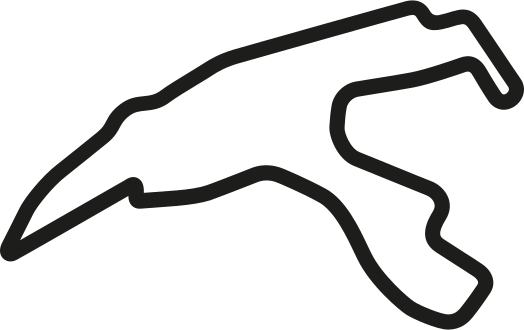
At the 917’s first appearance, the 1969 Spa 1000 Kilometres, Porsche’s works drivers preferred the proven 908 on the fast public-road circuit. The new car completed only a single racing lap. Matters looked still less inviting at that year’s Nürburgring 1000 Kilometres. The twisting, bumpy track magnified the 917’s excessive power and aerodynamic instability, and none of Porsche’s regular drivers wanted to race it. They chose the 908/02 Spyder instead and swept the first five places, helping secure Porsche the 1969 World Sportscar Championship.
That left the factory with millions invested, roughly two dozen 917s built and a pressing need to convince private teams to buy them. BMW works drivers Hubert Hahne and Dieter Quester practised in the car on Friday, only for BMW to prevent them from racing it. Porsche then called Piper and his neighbour, Frank Gardner. The pair were flown in on Saturday, although a wet circuit gave them little opportunity to learn the notoriously difficult machine. Piper started the race on Sunday, and he and Gardner brought the 917 home eighth, four laps behind the victorious 908.
The 1969 24 Hours of Le Mans offered another demonstration of the car’s speed—and its unfinished edges. Porsche’s factory 917s led for much of the event but failed to reach the finish. John Woolfe, the model’s first private customer, was killed in a first-lap accident that also eliminated Chris Amon’s Ferrari 312 P. Piper shared Scuderia Ferrari’s second 312 P with Pedro Rodríguez, but their race also ended in retirement.
Making the Porsche 917 his own
The World Sportscar Championship season concluded in Austria with the Zeltweg 1000 Kilometres. Porsche supplied two 917s under the banners of prospective customer teams. Chassis 009, entered by Freiherr von Wendt and driven by Jo Siffert and Kurt Ahrens, won the race but remained factory property before being allocated to Gulf-Wyer.
Chassis 010 appeared under the David Piper Racing name. Richard Attwood and Brian Redman guided it to third place, while Piper’s own Lola T70-Chevrolet retired after overheating. Piper subsequently purchased the Porsche, beginning a partnership that would become central to his racing identity.
He first raced his 917 at the Japanese Grand Prix in October 1969. With support from Siffert, Piper finished sixth. Back in Europe, he took third at Hockenheim before ending November on a high by winning the Kyalami 9 Hours alongside Attwood.
Piper’s association with the 917 later carried a terrible personal cost. On 16 September 1970, while working on the filming of Le Mans, he crashed a JWA-supplied Porsche 917K. The injuries resulted in the loss of part of one leg.
The 917K’s frontline career in the World Sportscar Championship and comparable Group 4 events ended after the 1971 season. Versions of the car remained eligible for Group 7 series such as Can-Am and Interserie, but the original 917 lacked the power needed there. Porsche’s answer was turbocharging, producing the substantially different 917/10 TC.
Piper nevertheless remained connected to competition. He returned to the track in historic events, driving cars from his own collection as well as machinery belonging to others, and eventually claimed victory in the 2001 Le Mans Legend.
His cars were easy to spot. Rather than traditional British racing green—a shade he never particularly liked—Piper favoured a vivid, unmistakable green. The colour originated with BP, which replaced Esso as his sponsor after the 1956 Suez Crisis. Piper took such a liking to the brighter shade that it became his personal racing colour, turning a sponsor’s palette into one of motorsport’s most recognisable privateer signatures.
Grand Prix Stats
| Race Entries | 3 |
| Race Starts | 2 |
| Did Not Start | 1 |
| Best Race Start | 22nd |
| Best Race Finish | 12th |
| Retirements | 1 |
| First-Lap Retirements | 0 |
| Not Classified | 2 |
| Disqualified | 0 |
| Did Not Qualify | 0 |
Qualifying
| Qualifying Sessions | 3 |
| Reached Q3 | – |
| Q2 Eliminations | – |
| Q1 Eliminations | – |
| Did Not Qualify | 1 |