






















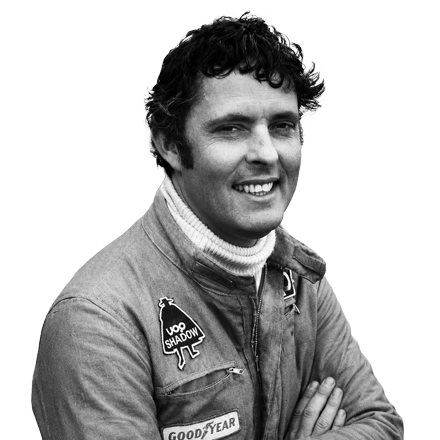
Brian Herman Thomas Redman (born 9 March 1937) is a British former racing driver whose career encompassed Formula One, Formula 5000, Can-Am, IMSA and some of the greatest sports-car races in the world. Although his Formula One appearances were comparatively limited, Redman became one of the outstanding international sports-car drivers of his generation.
| Born | Brian Herman Thomas Redman 9 March 1937 Burnley, Lancashire, England |
| F1 Career | 1968, 1970–1974 |
|---|---|
| Teams | Cooper, Frank Williams Racing, Surtees, McLaren, BRM, Shadow |
| Entries | 15 (12 starts) |
| Championships | 0 |
| Wins | 0 |
| Podiums | 1 |
| Career points | 8 |
| Pole positions | 0 |
| Fastest laps | 0 |
| First entry | 1968 South African Grand Prix |
| Last entry | 1974 Monaco Grand Prix |
Redman began racing in 1959 and rapidly established a reputation as a versatile and dependable driver. His breakthrough onto the international stage came during the late 1960s, particularly through his association with John Wyer Automotive Engineering.
In 1968, driving the Ford GT40 alongside Jacky Ickx, Redman helped contribute to Ford’s successful World Sportscar Championship campaign. It was the beginning of a period in which he became closely associated with some of the era’s most formidable endurance-racing machinery.
Formula One
Redman participated in 15 Formula One World Championship Grands Prix, making his debut at the 1968 South African Grand Prix. His Formula One career included appearances for Cooper, McLaren, Shadow, and Frank Williams Racing-associated entries.
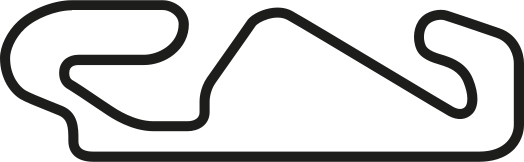
His greatest World Championship result came almost immediately. At the 1968 Spanish Grand Prix, Redman drove his Cooper-BRM to third place behind Graham Hill and Denny Hulme, earning the only Formula One podium of his career.
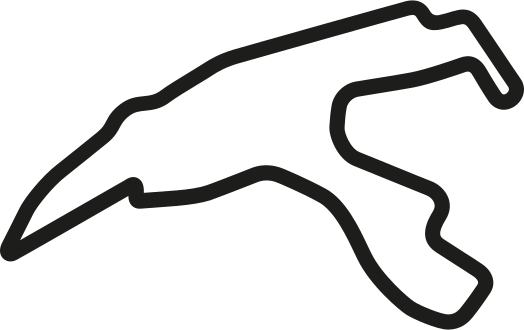
Later that season, however, he suffered a serious accident at Spa-Francorchamps. Suspension failure sent his Cooper-BRM off at high speed during the Belgian Grand Prix, leaving Redman with a badly broken arm.
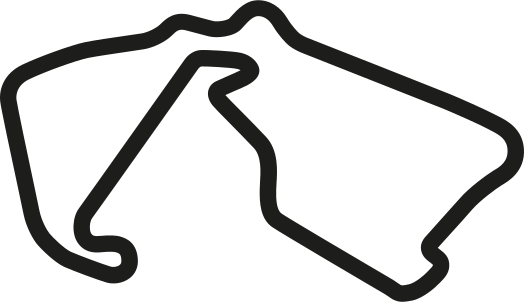
He subsequently returned to Formula One on an intermittent basis. Driving a Yardley McLaren in 1972, he finished fifth at both the Monaco Grand Prix and German Grand Prix.
Redman ultimately accumulated eight Formula One World Championship points. His relatively modest F1 record contrasts sharply with his achievements elsewhere, largely because he concentrated much of his career on sports cars rather than pursuing Formula One full-time.
Sports-car success
Sports-car racing was where Redman established his greatest reputation.
He competed for several of the most important factory and works-supported teams of the period, including Ford, Porsche, Ferrari and Alfa Romeo. His combination of outright speed and consistency made him particularly valuable in long-distance events.
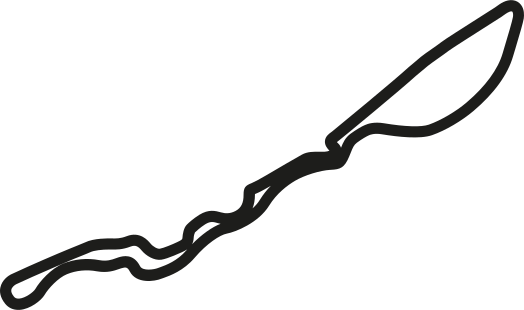
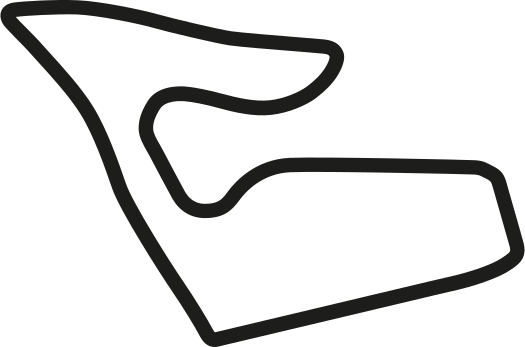
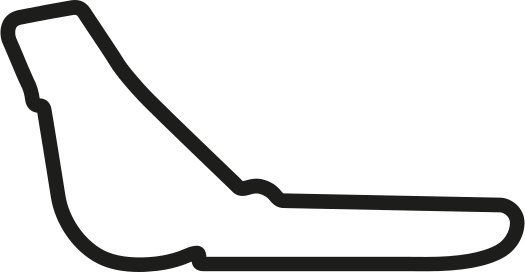
Redman became especially associated with Spa-Francorchamps, where he enjoyed extraordinary success in the 1000-kilometre race. His extensive list of major victories also included wins at the Nürburgring, Daytona, Sebring, Watkins Glen, Monza, Brands Hatch, the Österreichring and Kyalami.
One of his most celebrated victories came in the 1970 Targa Florio, one of the most demanding road races in motorsport. Redman and Jo Siffert won for Porsche, negotiating the lengthy Sicilian mountain circuit in the Porsche 908/03.
During this period he raced some of the defining sports prototypes of the era. After his time with the Gulf-backed Ford GT40s, he became a Porsche works driver in 1969 and 1970 and later raced Ferrari’s spectacular 312 PB.
The 1972 season with Ferrari was particularly successful. The 312 PB dominated the World Championship for Makes, and Redman was an important part of Ferrari’s campaign.
Across his career, his victories included multiple successes in the Daytona 24 Hours, Sebring 12 Hours, Nürburgring 1000 km, Spa 1000 km, Monza 1000 km, Österreichring 1000 km, Brands Hatch endurance races and Kyalami 9 Hours, as well as class victories at Le Mans.
Formula 5000 dominance
Redman’s career took another major turn when he increasingly concentrated on racing in North America.
Driving for the Carl Haas/Jim Hall operation, Redman became the dominant driver in American Formula 5000 during the middle of the 1970s.
At the wheel of Lola machinery, principally the Lola T330 and T332, he won the SCCA Formula 5000 championship in 1974, 1975 and 1976.
The achievement was particularly impressive because the championship attracted an exceptionally strong field. Among Redman’s rivals were Mario Andretti, Al Unser, Jody Scheckter, Jackie Oliver, Alan Jones, David Hobbs, Brett Lunger, and Sam Posey.
Three consecutive championships established Redman as one of the defining Formula 5000 drivers of the era.
The Mont-Tremblant accident
Formula 5000 was subsequently transformed into a revived Can-Am championship, with the existing single-seaters fitted with enclosed, full-width bodywork.
During practice at Mont-Tremblant in 1977, Redman suffered one of the most serious accidents of his career. His car became airborne at approximately 160 mph, flew high into the air and overturned before landing upside down.
Redman sustained multiple fractures and a serious head injury. His condition was so grave that he was at one stage mistakenly reported dead.
His recovery took approximately nine months.
Remarkably, Redman returned to top-level competition and almost immediately demonstrated that he had lost little of his ability.
Comeback and IMSA championship
In 1978, Redman completed an extraordinary comeback by winning the 12 Hours of Sebring, driving a Porsche 935.
He continued racing Porsche machinery with Dick Barbour Racing through the end of the decade before becoming involved with another important development in sports-car history.
In 1981, Redman drove the new Lola T600, one of the pioneering ground-effect sports prototypes that helped establish the design philosophy of the emerging IMSA GTP category.
Redman won the car’s debut at Laguna Seca and went on to capture the 1981 IMSA Camel GT championship, adding another major title to his career well into his forties.
He remained active at the highest levels of sports-car competition into the late 1980s. His final season as a professional driver came in 1989, when, aged 52, he competed for the works Aston Martin team in the World Sports Prototype Championship.
Legacy
Brian Redman’s career is unusual because his Formula One statistics reveal only a small part of his significance in motorsport.
He raced successfully across several generations of machinery, from the Ford GT40 and Porsche prototypes of the 1960s through the Ferrari 312 PB, Formula 5000 Lolas and Porsche 935 to the ground-effect Lola T600 and Aston Martin Group C prototypes.
His résumé includes three consecutive Formula 5000 championships, an IMSA championship, a Formula One podium and victories in many of the world’s premier endurance races.
Redman remained closely involved with motorsport after retiring from professional competition, including historic racing and the management of the Redman Bright racing team. He became particularly associated with historic racing in the United States and with Road America, whose major vintage-racing weekend has long carried his name.
His achievements have also been recognised through induction into numerous motorsport halls of fame, including those associated with Daytona, Sebring and Talladega, as well as the British Motor Sport Hall of Fame.
More than his brief Formula One career, it is Redman’s exceptional versatility and endurance-racing record that define his place in motorsport history. Few drivers of his era competed successfully in such a wide variety of cars and championships—or returned from such serious accidents to win major races and championships again.
Complete Formula One World Championship results
| Year | Entrant | Chassis | Engine | 1 | 2 | 3 | 4 | 5 | 6 | 7 | 8 | 9 | 10 | 11 | 12 | 13 | 14 | 15 | WDC | Pts |
|---|---|---|---|---|---|---|---|---|---|---|---|---|---|---|---|---|---|---|---|---|
| 1967 | David Bridges | Lola T100 (F2) | Ford Cosworth FVA 1.6 L4 | RSA | MON | NED | BEL | FRA | GBR | GER DNS | CAN | ITA | USA | MEX | NC | 0 | ||||
| 1968 | Cooper Car Company | Cooper T81B | Maserati 10/F1 3.0 V12 | RSA Ret | 19th | 4 | ||||||||||||||
| Cooper T86B | BRM P101 3.0 V12 | ESP 3 | MON | BEL Ret | NED | FRA | GBR | GER | ITA | CAN | USA | MEX | ||||||||
| 1970 | Frank Williams Racing Cars | De Tomaso 505/38 | Ford Cosworth DFV 3.0 V8 | RSA | ESP | MON | BEL | NED | FRA | GBR DNS | GER DNQ | AUT | ITA | CAN | USA | MEX | NC | 0 | ||
| 1971 | Team Surtees | Surtees TS7 | Ford Cosworth DFV 3.0 V8 | RSA 7 | ESP | MON | NED | FRA | GBR | GER | AUT | ITA | CAN | USA | NC | 0 | ||||
| 1972 | Yardley Team McLaren | McLaren M19A | Ford Cosworth DFV 3.0 V8 | ARG | RSA | ESP | MON 5 | BEL | FRA 9 | GBR | GER 5 | AUT | ITA | CAN | 14th | 4 | ||||
| Marlboro BRM | BRM P180 | BRM P142 3.0 V12 | USA Ret | |||||||||||||||||
| 1973 | Shadow Racing Team | Shadow DN1 | Ford Cosworth DFV 3.0 V8 | ARG | BRA | RSA | ESP | BEL | MON | SWE | FRA | GBR | NED | GER | AUT | ITA | CAN | USA DSQ | NC | 0 |
| 1974 | UOP Shadow Racing Team | Shadow DN3 | Ford Cosworth DFV 3.0 V8 | ARG | BRA | RSA | ESP 7 | BEL 18 | MON Ret | SWE | NED | FRA | GBR | GER | AUT | ITA | CAN | USA | NC | 0 |
Teammates & Qualifying Head-to-Head
| Teammate | Years | Races | Qualifying H2H |
|---|---|---|---|
| Ludovico Scarfiotti | 1968 | 2 | – |
| Lucien Bianchi | 1968 | 1 | – |
| Denny Hulme | 1972 | 3 | – |
| Howden Ganley | 1972 | 1 | – |
| Peter Gethin | 1972 | 1 | – |
| Jean-Pierre Beltoise | 1972 | 1 | – |
| George Follmer | 1973 | 1 | – |
| Jackie Oliver | 1973 | 1 | – |
| Jean-Pierre Jarier | 1974 | 3 | – |