

























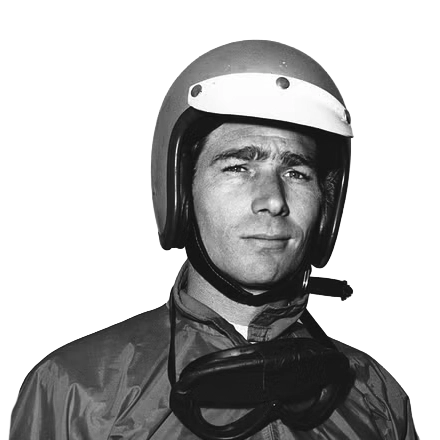
James Ellis Hall (born July 23, 1935) is an American motorsport legend whose influence stretches far beyond the cockpit. A retired racing driver, race car designer and team owner, Hall earned acclaim not only for his remarkable success behind the wheel but also for revolutionising the way racing cars are built. Although many remember him as the creative force behind the groundbreaking Chaparral machines, Hall was also one of America’s finest sports car drivers, claiming back-to-back United States Road Racing Championships in 1964 and 1965 alongside victories in many of North America’s most prestigious endurance and road racing events.
Driver Bio
| Nationality | American |
| Birthplace | Abilene, Texas, USA |
| Born | 23 July 1935 |
| First Grand Prix | 1960 United States Grand Prix |
| Last Grand Prix | 1963 Mexican Grand Prix |
| Years Active | 1960–1963 |
| Current/Last Team | BRP |
His driving résumé includes two Road America 500 victories (1962 and 1964), consecutive Watkins Glen Grand Prix victories for sports cars (1964 and 1965), the 1965 Canadian Grand Prix for sports cars, the Pacific Northwest Grand Prix, and one of endurance racing’s greatest upsets at the 1965 12 Hours of Sebring. There, Hall defeated an imposing field of factory-backed Ford GTs, Shelby Daytona Coupes and Ferrari entries despite the odds being heavily stacked against his small team.
Yet Hall’s greatest legacy arguably came away from the driver’s seat. Through the development of the Chaparral sports racing and Indy cars, he introduced engineering concepts that transformed motorsport forever. His creations won races and championships in virtually every major category they entered, including the USRRC, Can-Am, Trans-Am, Formula 5000, the World Sportscar Championship, the Canadian Sports Car Championship, the Autoweek Championship and even the Indianapolis 500. Many of the innovations first seen on Chaparral race cars remain fundamental elements of modern racing car design today.
Background
Born in Abilene, Texas, Hall spent much of his childhood growing up in Colorado and New Mexico. His fascination with engineering led him to study at the California Institute of Technology, where he combined his academic interests with an emerging passion for motorsport by competing in local sports car races.
Hall originally expected to begin his career at General Motors working on the Corvette programme. However, when the late-1950s economic recession forced the opportunity to disappear, his career took an unexpected turn. Instead, he joined his older brother Dick at Carroll Shelby Sport Cars in Dallas, then one of the country’s leading importers of European performance and competition cars.
The dealership became Hall’s perfect training ground. Carroll Shelby regularly placed the young Texan in newly arrived race cars, confident that Hall’s natural speed would showcase their capabilities. More often than not, Hall justified that confidence by winning. Shelby famously joked that if a newcomer could take victory in one of the cars, it proved just how exceptional the machine really was. While the sales pitch worked, racing fans across the American Southwest soon realised the real story was Hall’s extraordinary talent.
His breakthrough on the national stage arrived during the 1960 United States Grand Prix at Riverside. Driving an ageing Lotus-Climax of his own, Hall stunned experienced competitors by running as high as fifth for much of the race before a failing differential robbed him of the result only a handful of laps from the finish. The performance attracted widespread attention, with Competition Press declaring that Texas had produced another driver capable of succeeding Shelby on the international stage.
That same weekend proved pivotal for another reason. Hall met California constructors Troutman and Barnes, who were seeking backing for a new front-mid-engined sports racer. Hall invested in the project and christened the car the Chaparral. Success followed quickly, including victory at the Road America 500, but Hall’s engineering instincts were already pointing towards something even more ambitious. Rather than relying on others to build his next car, he decided he would design it himself.
Influence
Few engineers have changed motorsport as profoundly as Jim Hall. Many technologies now considered standard across top-level racing first appeared on his Chaparral designs. Among his pioneering ideas were high-mounted wings, movable aerodynamic devices, side-mounted radiators, semi-automatic transmissions and composite monocoque chassis construction. Every one of those concepts would eventually become commonplace in Formula 1 and numerous other racing categories.
Hall also recognised the importance of chassis stiffness long before many of his rivals. His original Chaparral 2 chassis was designed to be roughly four times more torsionally rigid than competing sports cars, delivering major gains in handling precision and overall performance.
Perhaps his boldest creation arrived in 1970 with the Chaparral 2J. Nicknamed the “vacuum cleaner” car, it generated constant downforce by using a separate engine to power twin fans that extracted air from beneath the chassis. Unlike wings or ground-effect tunnels, whose effectiveness varied with speed, Hall’s system produced aerodynamic grip regardless of how fast the car was travelling.
The results were astonishing. At Riverside, the 2J qualified more than two seconds faster than the championship-winning McLaren M8D. The car also introduced flexible skirts to seal airflow beneath the chassis, another idea that later became a cornerstone of Formula 1 aerodynamics.
Although the 2J was quickly outlawed, the concept refused to disappear. Eight years later, Brabham designer Gordon Murray adapted many of its principles into the BT46B Formula 1 “fan car”. It won the only race it entered — the 1978 Swedish Grand Prix — before being voluntarily withdrawn. In doing so, it demonstrated just how far ahead Hall’s thinking had been.
Throughout the 1960s and 1970s, Hall continuously refined aerodynamic downforce. Beginning with simple spoilers on the Chaparral 2A, progressing to sophisticated movable wings on the 2C, 2D, 2E, 2F, 2G and 2H, and culminating in the revolutionary suction system of the 2J, he fundamentally reshaped racing car performance.
His influence extended once again in 1979 when the Chaparral 2K introduced full ground-effect tunnels to IndyCar racing, changing the direction of open-wheel design almost overnight.
Today, virtually every major form of motorsport depends upon aerodynamic downforce. Formula 1, IndyCar, Le Mans prototypes, NASCAR, NHRA drag racing, World Rally Championship machinery and even modern high-performance road cars all trace part of their aerodynamic philosophy back to Hall’s relentless pursuit of innovation.
Reflecting on his work years later, Hall explained the principle in characteristically simple terms. “When you put aerodynamic downforce on a car, it increases traction and allows it to corner much faster than before. That’s really what Chaparral explored over many years in different ways, and that single idea changed the future of auto racing.”
Driver and constructor
By 1962, Jim Hall was ready to bring his own vision to life. Construction of the first true Hall-designed Chaparral began at the team’s workshop in Midland, Texas, where Hall and business partner Hap Sharp set about creating a sports racing car unlike anything else on the grid.
At a time when Colin Chapman was pioneering the monocoque Formula 1 chassis in Europe, Hall was pursuing a similar goal for sports cars—but with an even more ambitious twist. Rather than relying on aluminium, he wanted to build a lightweight composite monocoque. To make it happen, Hall and Sharp visited some of America’s leading aerospace companies, searching for the latest manufacturing techniques.
Their journey led them to General Dynamics, where engineer Andy Green was developing fibreglass structures for the Convair B-58 Hustler, the world’s first operational supersonic bomber. Hall immediately recognised the potential. Green joined the project, helping create what became the first successful full-composite monocoque racing car.
The benefits were significant. Compared with conventional chassis designs, the composite structure was dramatically stiffer and considerably lighter, improving handling, responsiveness, and outright speed.
Hall’s engineering curiosity also brought him into contact with Chevrolet Research & Development during the 1962 June Sprints at Road America. Conversations with GM’s experimental engineering team inspired another innovation that would become a Chaparral trademark—the semi-automatic torque-converter transmission.
Today, paddle-shift gearboxes are commonplace across motorsport, but Hall’s system was decades ahead of its time. Many competitors struggled to understand why anyone would abandon a traditional manual gearbox until Hall began winning races with it.
Explaining the concept in Autocar during 1965, Hall highlighted both the performance and reliability advantages. “There is literally less work to do. We can keep both hands on the steering wheel at all times, concentrating entirely on placing the car accurately through corners and braking precisely. It also improves reliability because you cannot over-rev the engine or shock the drivetrain through poor gear changes.”
Formula 1 opportunity
Development of the Chaparral continued steadily, although progress briefly slowed when Hall’s driving performances attracted attention from Europe.
At the season-ending 1962 Mexican Grand Prix, Hall delivered another eye-catching display that earned him an offer from the British Racing Partnership (BRP) Formula 1 team for the 1963 World Championship season.
Although BRP had previously enjoyed considerable success, neither Hall nor the team fully appreciated that its competitive peak had already passed. Even so, Hall adapted well to Grand Prix racing and scored three World Championship points during his only full F1 campaign.
His finest result came at the legendary Nürburgring, where he finished fifth in the 1963 German Grand Prix despite tackling the daunting circuit for the very first time.
While Hall competed across Europe, construction of the new Chaparral continued back in Midland. The team’s headquarters may have been far removed from the traditional motorsport centres, but it sat alongside the aptly named Rattlesnake Raceway, where Hall and Sharp carried out countless hours of testing.
A sensational debut
When the Chaparral was finally completed, it immediately demonstrated just how advanced Hall’s thinking had become.
The car made its competitive debut at the 1963 Los Angeles Times Grand Prix, and Hall promptly claimed pole position against one of the strongest fields assembled anywhere in the world.
Among those left behind were future Formula 1 World Champions Jim Clark, Graham Hill and John Surtees, along with American legends Dan Gurney, A.J. Foyt, Roger Penske, Lloyd Ruby, Parnelli Jones, Rodger Ward and Richie Ginther.
Hall then dominated the early stages of the race before an electrical fire forced his retirement, denying what could have been one of the sport’s most remarkable debut victories.
Dominating American sports car racing
Any disappointment quickly faded.
Across the 1964 and 1965 seasons, Hall and Hap Sharp established one of the most dominant partnerships in American road racing history. Driving first the Chaparral 2A and later the evolved 2C, the pair overwhelmed their rivals with a combination of speed, reliability and technical innovation.
When Hall suffered injuries in an accident at Mosport, Roger Penske stepped into the car and maintained the team’s winning momentum.
The statistics from 1965 alone underline just how dominant Chaparral had become. Against leading international opposition, the cars started 22 major races, winning 16 of them while also recording 16 fastest laps.
Hall secured the overall United States Road Racing Championship in 1964 before adding the unlimited-class title in 1965.
Sebring glory
One of Chaparral’s greatest triumphs came earlier in 1965 at the legendary 12 Hours of Sebring.
Hall and Sharp stunned the paddock by putting their Chaparral 2A on pole position, lapping an incredible nine seconds faster than the previous year’s benchmark set by reigning World Champion John Surtees in a factory Ferrari.
Even so, very few observers believed the privately run American team could survive twelve gruelling hours against the might of the world’s biggest manufacturers.
Ford arrived with seven factory-supported entries featuring drivers including Dan Gurney, Ken Miles, Bruce McLaren, Richie Ginther and Phil Hill. Ferrari countered with Pedro Rodríguez and Formula 1 World Champion Graham Hill among its star-studded line-up.
Against all expectations—and despite torrential, monsoon-like conditions—Hall and Sharp defeated them all.
The Sebring victory remains one of the greatest upsets in endurance racing history and firmly established Chaparral as a genuine world-class force.
The Chaparral 2E changes everything
If the Chaparral 2A announced Hall’s arrival as a constructor, the 2E transformed the future of racing car aerodynamics.
Designed for the inaugural Canadian-American Challenge Cup (Can-Am) season in 1966, the 2E combined side-mounted radiators, the semi-automatic transmission and numerous mechanical innovations. Yet what captured everyone’s attention was the enormous high-mounted rear wing supported on slender uprights that towered above the rear bodywork.
Its appearance alone left rivals speechless.
Racing driver, broadcaster and historian Sam Posey later remembered the moment vividly. “When those cars arrived in the paddock at Bridgehampton, people stopped what they were doing. Their jaws simply dropped. Nothing like them had ever existed. They went out onto the track, and the world changed.”
Hall had already experimented with movable aerodynamic devices on the Chaparral 2C, but those earlier solutions acted primarily as adjustable spoilers, producing rear downforce that could upset the car’s balance.
The 2E represented a far more sophisticated solution.
Its symmetrical rear wing generated very little drag on the straights but produced enormous downforce when tilted through corners. To balance the aerodynamic load, Hall incorporated an adjustable front nose duct linked to the same control system.
With the Chaparral’s semi-automatic gearbox eliminating the need for a clutch pedal, the driver’s left foot operated a dedicated downforce pedal, allowing the wing and front duct to change position while cornering.
Phil Hill later summed up the effect perfectly. “With the wing, you could out-brake everybody, out-corner everybody and drive underneath them. It genuinely felt like the car had unbelievable road-holding.”
The 2E quickly proved to be the fastest machine in the inaugural Can-Am championship. Reliability issues prevented it from converting numerous pole positions and fastest laps into victories, but when everything worked—as it did at Laguna Seca—the Chaparrals comfortably finished first and second with Hall and Phil Hill.
Speed was never the problem. The future had simply arrived before the technology had fully caught up.
Grand Prix Stats
| Race Entries | 12 |
| Race Starts | 11 |
| Did Not Start | 1 |
| Best Race Start | 12th |
| Best Race Finish | 5th |
| Retirements | 4 |
| First-Lap Retirements | 0 |
| Not Classified | 0 |
| Disqualified | 0 |
| Did Not Qualify | 0 |
Qualifying
| Qualifying Sessions | 12 |
| Reached Q3 | 0 |
| Q2 Eliminations | 0 |
| Q1 Eliminations | 0 |
| Did Not Qualify | 0 |
Points
| Points Scored | 3 |
| Points Finishes | 2 |
| Most Points in a Single Season | 3 |
| Seasons with Points | 1 |
Complete Formula One results
| Year | Entrant | Chassis | Engine | 1 | 2 | 3 | 4 | 5 | 6 | 7 | 8 | 9 | 10 | WDC | Pts. |
|---|---|---|---|---|---|---|---|---|---|---|---|---|---|---|---|
| 1960 | Jim Hall | Lotus 18 | Climax straight-4 | ARG | MON | 500 | NED | BEL | FRA | GBR | POR | ITA | USA 7 | NC | 0 |
| 1961 | Jim Hall | Lotus 18 | Climax straight-4 | MON | NED | BEL | FRA | GBR | GER | ITA | USA Ret | NC | 0 | ||
| 1962 | Jim Hall | Lotus 21 | Climax straight-4 | NED | MON | BEL | FRA | GBR | GER | ITA | USA DNS | RSA | NC | 0 | |
| 1963 | British Racing Partnership | Lotus 24 | BRM V8 | MON Ret | BEL Ret | NED 8 | FRA 11 | GBR 6 | GER 5 | ITA 8 | USA 10 | MEX 8 | RSA | 12th | 3 |
Teammates & Qualifying Head-to-Head
| Teammate | Years | Races | Qualifying H2H |
|---|---|---|---|
| Innes Ireland | 1963 | 7 | – |