


























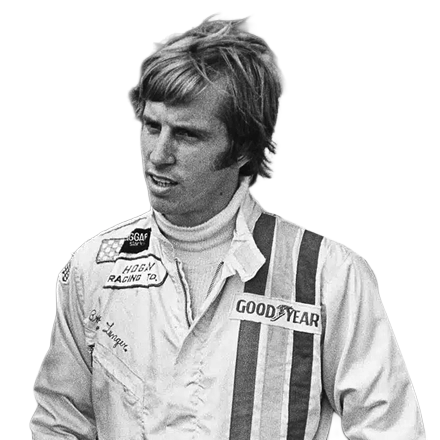
Robert Brett Lunger (born 14 November 1945) is an American former racing driver and United States Marine whose career took him from Formula 5000 to Formula One, while his life away from the circuit was every bit as unconventional. He entered 43 Formula One World Championship Grands Prix between 1975 and 1978, never scoring a championship point, and became especially well known for helping rescue Niki Lauda from his burning Ferrari at the Nürburgring in 1976.
Driver Bio
| Nationality | American |
| Birthplace | Wilmington, Delaware, United States |
| Born | 14 November 1945 |
| First Grand Prix | 1975 Austrian Grand Prix |
| Last Grand Prix | 1978 United States Grand Prix |
| Years Active | 1975 – 78 |
| Current/Last Team | Ensign |
Lunger was educated at the Holderness School and later Princeton University, where he studied political science. After three years, he left Princeton and enlisted for service in Vietnam. At the time, he had been preparing a thesis on American policy in Southeast Asia, only for the Gulf of Tonkin incident to undermine much of the argument he had been developing.
He served in the United States Marine Corps, rising to officer rank and later receiving the Purple Heart. Motor racing had not been an obsession from childhood; Lunger grew up more interested in baseball, hockey and football. His interest in cars only really began after a friend took him to a race in 1965.
From there, things moved quickly. By 1966 he was competing in Can-Am, and that year he finished eighth in the 252-mile Nassau Trophy in a McLaren-Chevrolet, only a few seconds behind Peter Gregg’s Porsche Carrera 6. Two years later, Lunger campaigned a Lola T160 in the Canadian-American Challenge Cup.
After his military service, he returned to serious competition and became one of the stronger drivers in Formula 5000. In 1971, despite starting a Lime Rock race with a 103-degree fever after being diagnosed with mononucleosis, he remained in contention for second place in the championship before fading as his strength disappeared. He was hospitalised after the race.
That same year brought his first major victory, in the Minnesota Grand Prix at Brainerd International Raceway, and he ended the season third in the standings behind champion David Hobbs. He repeated third place in the 1972 L&M Continental 5000 Championship, helped by victories at Road Atlanta and Lime Rock.
Lunger also crossed the Atlantic to compete in European Formula Two between 1972 and 1973. His best result was fourth at Mantorp Park in Sweden, driving a March-Ford BDA 722 for Space Racing. At the same time, he continued his Formula 5000 programme on both sides of the Atlantic.
The 1973 season produced another strong collection of results. Lunger finished second to Peter Gethin in the opening round of the European Formula 5000 Championship at Brands Hatch, took third at Watkins Glen behind Jody Scheckter and Brian Redman, and finished second at Pocono. In Britain, he also won at Snetterton and Mallory Park for Sid Taylor Racing in a Trojan T101.
For 1974, Lunger joined Dan Gurney’s Anglo American Racers operation, driving the Jorgensen Eagle 73A in Formula 5000. He started all seven championship rounds, collecting a second, a third and a sixth place on his way to fifth in the standings. He also raced a BMW 3.0 CSL at Watkins Glen and competed in Trans-Am machinery with George Follmer.
That year also produced another dramatic rescue. During the California Grand Prix at Ontario Motor Speedway, Lunger collided with Mickey Rupp while fighting through traffic and trying to keep Mario Andretti behind. After both cars left the circuit, Lunger helped rescue crews pull Rupp from his wreck.
Formula One finally arrived in 1975. Lunger joined Hesketh Racing for the Austrian Grand Prix, becoming one of only a handful of American drivers in the championship alongside Mario Andretti and Mark Donohue. His friends had helped finance the opportunity, and he made his debut at the age of 29.
He finished 13th in Austria, later took tenth in Italy and ran as high as eighth at Watkins Glen before retiring from the United States Grand Prix. His first season was brief, but it was enough to keep him on the Formula One grid.
For 1976, Lunger moved to Surtees. The year was difficult competitively, though he produced one of his strongest drives at the British Grand Prix, climbing through the field and challenging teammate Alan Jones.
Then came the 1976 German Grand Prix at the Nürburgring, the race that would forever attach Lunger’s name to one of Formula One’s most famous rescue efforts.
On the second lap, Niki Lauda crashed heavily and his Ferrari burst into flames. Lunger arrived moments later and could not avoid the wreckage, his Surtees becoming tangled with Lauda’s car. The impact triggered Lunger’s onboard fire extinguishers, which helped suppress the flames at a crucial moment.
Alongside Guy Edwards, Arturo Merzario and Harald Ertl, Lunger immediately joined the rescue. With the Ferrari still burning, he climbed onto the car and grabbed Lauda by the shoulders while Merzario worked to release the Austrian’s belts. Together they pulled him from the wreck as marshals covered the scene with foam.
It was one of the defining acts of courage of 1970s Formula One, and Lunger’s role in it became far more memorable than anything he achieved on the timing sheets.
He continued racing in Formula One through 1977 and 1978, increasingly as one of the championship’s last genuine privateers. In 1977 he began with a year-old March 761 entered as Chesterfield Racing before switching to a McLaren M23 run by Bob Sparshott’s BS Fabrications.
Results remained modest, but Lunger regularly brought the car home. He finished ninth at Zandvoort and tenth at Watkins Glen in 1977, while also driving the same basic McLaren design that James Hunt had used to win the previous year’s World Championship.
In 1978, he stayed with BS Fabrications, racing both the McLaren M23 and M26. At the British Grand Prix, he started last in 24th place and fought his way through to eighth, the best Formula One finish of his career. He repeated eighth place in Austria later that season.
Lunger also finished fourth in the rain-hit non-championship 1978 BRDC International Trophy at Silverstone, behind Keke Rosberg, Emerson Fittipaldi and Tony Trimmer. A one-off appearance for Ensign at the United States Grand Prix brought his Formula One career to a close.
After four seasons, 43 Grands Prix and no championship points, Lunger stepped away from Formula One at the end of 1978. His career had been shaped by independent teams, older cars and privately funded opportunities, making him one of the final representatives of a disappearing breed of Grand Prix racer.
Sports cars remained part of his story. In 1977, Lunger and George Follmer finished second in the Watkins Glen six-hour race in a Vasek Polak Porsche 935. Two years later, Lunger teamed with Follmer and Derek Bell in another Porsche 935 to finish third in the Los Angeles Times 6-Hour Grand Prix of Endurance, despite starting from the 23rd row after qualifying problems.
When he could not secure a suitable racing seat for 1979, Lunger moved into broadcasting and worked with CBS, covering Formula One events including the South African Grand Prix. He also returned to Princeton and completed the degree he had abandoned years earlier to join the Marines.
Later in life, Lunger became an author and founded Responsibility Today, developing educational material centred on personal responsibility and decision-making. He also created the “I Am Responsible” movement, drawing on lessons from his military service, racing career, successes and mistakes.
Away from motorsport, he remained active as a cyclist and pilot, and together with his wife became involved with the Angel Flight network. He also ran a research and development business.
Brett Lunger’s career is difficult to reduce to Formula One statistics. He never scored a World Championship point, but he raced successfully in Formula 5000, competed in sports cars, served in Vietnam, earned a Purple Heart, worked in television and education, and played a crucial role in saving Niki Lauda’s life. Few racing careers have taken quite so many unexpected turns.
Grand Prix Stats
| Race Entries | 43 |
| Race Starts | 34 |
| Did Not Start | 9 |
| Best Race Start | 13 |
| Best Race Finish | 7 |
| Retirements | 13 |
| First-Lap Retirements | 2 |
| Not Classified | 0 |
| Disqualified | 0 |
| Did Not Qualify | 9 |
Qualifying
| Qualifying Sessions | 43 |
| Reached Q3 | 0 |
| Q2 Eliminations | 0 |
| Q1 Eliminations | 0 |
| Did Not Qualify | 9 |
Complete Formula One World Championship results
| Year | Team | Chassis | Engine | 1 | 2 | 3 | 4 | 5 | 6 | 7 | 8 | 9 | 10 | 11 | 12 | 13 | 14 | 15 | 16 | 17 | WDC | Points |
|---|---|---|---|---|---|---|---|---|---|---|---|---|---|---|---|---|---|---|---|---|---|---|
| 1975 | Hesketh Racing | Hesketh 308 | Ford Cosworth DFV 3.0 V8 | ARG | BRA | RSA | ESP | MON | BEL | SWE | NED | FRA | GBR | GER | AUT 13 | ITA 10 | USA Ret | NC | 0 | |||
| 1976 | Chesterfield Team Surtees | Surtees TS19 | Ford Cosworth DFV 3.0 V8 | BRA | RSA 11 | USW DNQ | ESP DNQ | BEL Ret | MON | SWE 15 | FRA 16 | GBR Ret | GER Ret | AUT 10 | NED | ITA 14 | CAN 15 | USA 11 | JPN | NC | 0 | |
| 1977 | Chesterfield Racing | March 761 | Ford Cosworth DFV 3.0 V8 | ARG | BRA | RSA 14 | USW Ret | ESP 10 | MON | NC | 0 | |||||||||||
| McLaren M23B | BEL DNS | SWE 11 | FRA DNQ | GBR 13 | GER Ret | AUT 10 | NED 9 | ITA Ret | USA 10 | CAN 11 | JPN | |||||||||||
| 1978 | Liggett Group / B & S Fabrications | McLaren M23B | Ford Cosworth DFV 3.0 V8 | ARG 13 | BRA Ret | RSA 11 | USW DNQ | NC | 0 | |||||||||||||
| McLaren M26 | MON DNPQ | BEL 7 | ESP DNQ | SWE DNQ | FRA Ret | GBR 8 | GER DNPQ | AUT 8 | NED Ret | ITA Ret | ||||||||||||
| Team Tissot Ensign | Ensign N177 | USA 13 | CAN | |||||||||||||||||||
Teammates & Qualifying Head-to-Head
| Teammate | Years | Races | Qualifying H2H |
|---|---|---|---|
| James Hunt | 1975 | 3 | – |
| Alan Jones | 1976 | 11 | – |
| Derek Daly | 1978 | 1 | – |