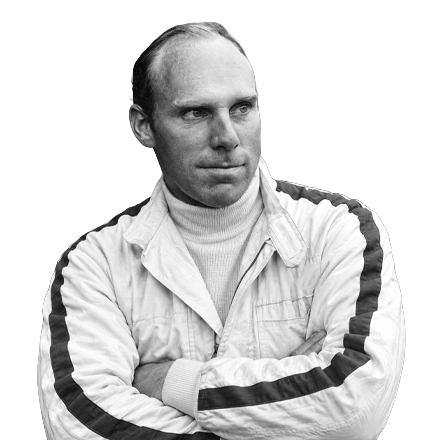
Richard James David “Dickie” Attwood (born 4 April 1940) is a British former racing driver whose career encompassed Formula One, Formula Two and some of sports-car racing’s most important machinery.
Driver Bio
| Nationality | British |
| Birthplace | Wolverhampton, England |
| Born | 4 April 1940 |
| First Grand Prix | 1964 British Grand Prix |
| Last Grand Prix | 1969 Monaco Grand Prix (1969) |
| Years Active | 1964–1965, 1967–1969 |
| Current/Last Team | Frank Williams Racing Cars |
Attwood entered 17 Formula One World Championship Grands Prix for teams including BRM, Lotus and Cooper, scoring 11 points and one podium. His defining achievement came at the 1970 24 Hours of Le Mans, where he and Hans Herrmann drove a Porsche 917K to the manufacturer’s first overall victory in the race.
Early career
Attwood entered the motor industry as an apprentice with Jaguar before beginning his competitive career in a Triumph TR3 in 1960.
He joined the Midlands Racing Partnership for 1961 and spent two seasons contesting club-level Formula Junior events. When the team expanded onto the international stage in 1963, Attwood seized the opportunity by winning the Formula Junior support race at Monaco in a Lola Mk5A.
That victory and his other performances earned him the inaugural Grovewood Award, decided by a panel from the Guild of Motoring Writers.
MRP moved into Formula Two for 1964. Attwood won in Vienna and collected second places at Pau, the Eifelrennen and Albi. Formula Two grids of the period regularly included established Grand Prix stars; at Pau, only reigning Formula One World Champion Jim Clark beat him.
Formula One and single-seaters
Attwood’s Formula Two results attracted the attention of BRM owner Alfred Owen. His first Formula One outing came in the non-championship News of the World Trophy at Goodwood.
Driving a BRM P57, Attwood finished fourth—the highest-placed non-Lotus and the only driver to complete the race on the same lap as Colin Chapman’s dominant cars.
BRM then chose him to race its experimental four-wheel-drive P67 at the 1964 British Grand Prix. Attwood had already performed much of the car’s testing and managed to qualify the heavy prototype, although only in last place. Since the P67 was primarily a mobile development laboratory, BRM withdrew it before the race.
Reg Parnell Racing
Tim Parnell signed Attwood for a full Formula One season in 1965. He drove a Lotus 25 that had once been among the class of the field but was now showing its age. Combined with an uncompetitive BRM engine, the chassis offered little scope for heroics.
Reliability helped Attwood salvage two sixth-place finishes towards the end of the season, giving him his first World Championship points.
In 1966, he travelled to Australia and New Zealand with BRM’s Tasman Series operation. A victory at Levin highlighted a promising campaign.
Despite that success, Attwood spent most of the 1966 and 1967 Formula One seasons away from the World Championship, partly because of his growing sports-car commitments. His only appearance came at the 1967 Canadian Grand Prix, where he replaced Pedro Rodríguez at Cooper and finished tenth in the Maserati-powered car.
Attwood remained competitive in Formula Two, winning the 1966 Rome Grand Prix and finishing second at Pau, before placing greater emphasis on sports cars during 1967.
BRM return
The death of Mike Spence during practice for the 1968 Indianapolis 500 brought Attwood back to BRM as his replacement.
His return began spectacularly. At Monaco, Attwood set the fastest lap and finished second behind Graham Hill’s Lotus—the only Formula One podium of his career.
Results declined as the season progressed, however, and BRM replaced him with Bobby Unser four races before the end of the championship.
Monaco also hosted Attwood’s final World Championship start. In 1969, Colin Chapman called him in to substitute for the injured Jochen Rindt in a Lotus 49B. Attwood finished a strong fourth.
He made one further appearance at a World Championship meeting that year, entering the German Grand Prix in a Formula Two Brabham run by Frank Williams. Attwood placed sixth overall and second among the Formula Two competitors.
Sports-car racing
Ford and David Piper
Attwood became involved with Ford’s new GT prototype programme in 1964, helping develop the car that evolved into the GT40. He was among the first drivers to race it and shared one with Jo Schlesser at Le Mans, where fire forced the car into retirement.
His first major international sports-car victory came later that year in the Rand Nine Hours. Attwood won in South Africa at the wheel of David Piper’s Ferrari P2.
That success began a long professional partnership with Piper. Over the next five years, Attwood regularly drove the team’s distinctive green Ferraris, including the 250 LM and 330 P3/4, and also appeared with Piper for Maranello Concessionaires.
Their notable results included third in the 1967 Spa 1000 Kilometres and second in the 500 Kilometres of Zeltweg.
Attwood was never tied to a single manufacturer. Alongside his Ford and Ferrari appearances, he raced Porsche 906s and Alfa Romeo T33s. He also drove the notoriously troublesome Ford P68, retiring from the 1968 Nürburgring 1000 Kilometres with mechanical failure.
Porsche
After several appearances in privately entered Porsches, Attwood joined the factory team for the 1969 World Sportscar Championship.
Usually partnered by fellow Briton Vic Elford, he finished second in both the BOAC 500 at Brands Hatch and the Watkins Glen Six Hours while driving a Porsche 908.
Attwood also became involved in developing the new Porsche 917. At Le Mans, he and Elford led for a substantial portion of the race and completed 327 laps. With only two hours remaining, gearbox failure ended what had looked like a possible breakthrough victory.
Porsche’s first Le Mans victory
Attwood returned in 1970 with Porsche Salzburg, sharing a 917K with veteran German driver Hans Herrmann.
Contested in dreadful weather, the race became an ordeal of rain, darkness and attrition. Attwood and Herrmann survived it all, taking overall victory and delivering Porsche the first of its record 19 Le Mans wins.
The pair also finished second at the Nürburgring that season, switching back to a Porsche 908.
Attwood nearly repeated his Le Mans triumph in 1971. Driving a John Wyer Automotive Porsche 917 with Herbert Müller, he finished second. He also partnered Pedro Rodríguez to victory in the 1000 Kilometres of Zeltweg.
At the conclusion of the season, Attwood retired from professional competition.
Return and historic racing
Attwood briefly returned in 1984 as part of Aston Martin’s struggling Nimrod Le Mans project.
The car failed to finish the 24-hour race after a violent accident while John Sheldon was driving. Following that appearance, Attwood withdrew from frontline motorsport permanently.
Historic racing later brought him back into the public eye. He became a regular at Porsche demonstrations and events including the Goodwood Festival of Speed, Goodwood Revival and Members’ Meeting.
Attwood frequently appeared with his own Porsche 917, a car used by Steve McQueen during production of the film Le Mans. He had it painted to resemble his victorious 1970 machine and jokingly called it “my pension” as its value climbed.
He cashed in that pension in 2000, selling the 917 at auction for a reported £1 million.
Personal life
Attwood once owned a Peugeot 405 estate that offered a very different sort of endurance record. Bought new in 1989, it covered 415,000 miles while retaining its original engine and clutch.
The car was later featured in Evo magazine. A subsequent owner advertised it for sale in June 2017, although nearly 2,000 views had produced no offers after several days.
Grand Prix Stats
| Race Entries | 17 |
| Race Starts | 16 |
| Did Not Start | 1 |
| Best Race Start | 6th |
| Best Race Finish | 2nd |
| Retirements | 5 |
| First-Lap Retirements | 0 |
| Not Classified | 0 |
| Disqualified | 0 |
| Did Not Qualify | 0 |
Podiums
| Podiums | 1 |
| First Podium | 1968 Monaco Grand Prix |
| Last Podium | 1968 Monaco Grand Prix |
| 1st Place | 0 |
| 2nd Place | 1 |
| 3rd Place | 0 |
| Most Consecutive Podiums | 1 |
| Most Podiums in a Single Season | 1 (1968) |
| Seasons with Podiums | 1 (1968) |
Qualifying
| Qualifying Sessions | 17 |
| Reached Q3 | Not applicable/Not listed |
| Q2 Eliminations | Not applicable/Not listed |
| Q1 Eliminations | Not applicable/Not listed |
| Did Not Qualify | 0 |
Fastest Laps
| Fastest Laps | 1 |
| First Fastest Lap | 1968 Monaco Grand Prix |
| Last Fastest Lap | 1968 Monaco Grand Prix |
| Win + Fastest Lap | 0 |
| Most Consecutive Fastest Laps | 1 |
| Most Fastest Laps in a Season | 1 |
| Seasons with Fastest Laps | 1 (1968) |
Points
| Points Scored | 11 |
| Points Finishes | 4 |
| Most Points in a Single Season | 6 (1968) |
| Seasons with Points | 3 (1965, 1968, 1969) |
Complete Formula One World Championship results
| Year | Entrant | Chassis | Engine | 1 | 2 | 3 | 4 | 5 | 6 | 7 | 8 | 9 | 10 | 11 | 12 | WDC | Points |
|---|---|---|---|---|---|---|---|---|---|---|---|---|---|---|---|---|---|
| 1964 | Owen Racing Organisation | BRM P67 | BRM V8 | MON | NED | BEL | FRA | GBR DNS | GER | AUT | ITA | USA | MEX | NC | 0 | ||
| 1965 | Reg Parnell Racing | Lotus 25 | BRM V8 | RSA | MON Ret | BEL 14 | FRA | GBR 13 | NED 12 | GER Ret | ITA 6 | USA 10 | MEX 6 | 16th | 2 | ||
| 1967 | Cooper Car Company | Cooper T81B | Maserati V12 | RSA | MON | NED | BEL | FRA | GBR | GER | CAN 10 | ITA | USA | MEX | NC | 0 | |
| 1968 | Owen Racing Organisation | BRM P126 | BRM V12 | RSA | ESP | MON 2 | BEL Ret | NED 7 | FRA 7 | GBR Ret | GER 14 | ITA | CAN | USA | MEX | 13th | 6 |
| 1969 | Gold Leaf Team Lotus | Lotus 49B | Cosworth V8 | RSA | ESP | MON 4 | NED | FRA | GBR | 13th | 3 | ||||||
| Frank Williams Racing Cars | Brabham BT30 (F2) | Cosworth Straight-4 | GER 6* | ITA | CAN | USA | MEX | ||||||||||