

























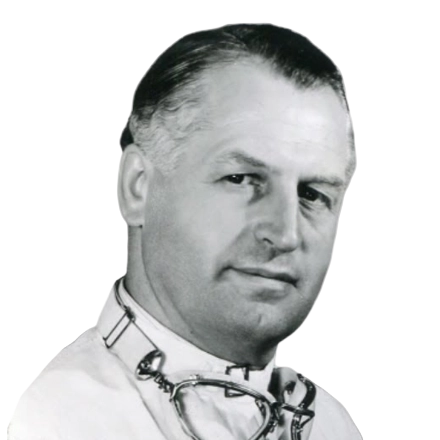
Karl Kling was a German racing driver and later a senior motorsport executive, best known for his role in Mercedes-Benz’s post-war return to top-level competition. He raced in 11 Formula One World Championship Grand Prix between 1954 and 1955, becoming a quiet but significant figure in the Silver Arrows’ modern revival.
| Nationality | German |
|---|---|
| Born | Karl Kling 16 September 1910 Giessen, Hesse, German Empire |
| Died | 18 March 2003 (aged 92) Lake Constance, Germany |
Kling had been an employee of Daimler-Benz since the mid-1930s, long before he ever appeared on a Grand Prix grid. His Formula One debut came at the 1954 French Grand Prix, where he finished a remarkable second behind teammate Juan Manuel Fangio. That result made him the first German driver to stand on a Formula One podium. Kling went on to start ten more World Championship races, scoring another podium finish at the 1955 British Grand Prix and accumulating 17 championship points overall.
After stepping away from frontline competition, Kling moved seamlessly into management. From 1956 to 1968, he served as head of Mercedes-Benz motorsport, guiding the company’s competition activities during a period when factory racing focused on rallies and production-based events rather than Grand Prix racing.
Early life and career
Karl Kling was born on 16 September 1910 in Giessen, then part of the Grand Duchy of Hesse in the German Empire. His racing career is often described as being shaped by unfortunate timing: too young to be part of Mercedes’ dominant Grand Prix teams of the 1930s, and slightly too old to fully capitalise on the opportunities offered by Formula One’s rebirth in the mid-1950s.
Unusually for a Grand Prix driver, Kling’s route into motorsport began not through racing, but through work. Employed as a reception clerk at Daimler-Benz in the mid-1930s, he spent his spare time competing in hillclimbs and trials using production cars. During the Second World War, he acquired valuable mechanical experience while servicing Luftwaffe aircraft. After the war, with Germany slowly returning to motorsport, Kling resumed racing behind the wheel of a BMW 328.
Kling played a crucial role in preparing Mercedes-Benz’s return to international competition in the early 1950s. His victory in the 1952 Carrera Panamericana, driving the experimental Mercedes-Benz 300 SL, proved decisive in convincing Daimler-Benz management that motorsport could once again serve the brand’s future. In the same period, Kling and co-driver Hans Klenk were pioneers in the use of pacenotes—now a standard practice in rallying and endurance racing.
When Mercedes re-entered Grand Prix racing in 1954, Kling was called into the revived works team, which missed the first two races of the season. On his Formula One debut at Reims-Gueux, one of the fastest circuits in the world, he finished less than a second behind Fangio, securing second place. It was a stunning introduction, though it would prove difficult to sustain.
By 1955, Mercedes was competing simultaneously in Formula One and the World Sportscar Championship, often requiring two drivers per car. The arrival of Stirling Moss relegated Kling to a third-driver role within a four-man squad. The team fielded four Formula One cars at the 1955 Argentine Grand Prix and four 300 SLRs at the 1955 Mille Miglia. During that event, Kling crashed in Rome, suffered broken ribs, and was forced to miss the Monaco Grand Prix.
Kling still demonstrated his speed away from the World Championship, taking an impressive victory at the non-championship 1954 Berlin Grand Prix on the ultra-fast AVUS circuit.
After sweeping all the major titles they fought—Formula One World Championships in 1954 and 1955 and the World Sportscar Championship in 1955—Mercedes-Benz withdrew from international racing to concentrate on road-car development. Kling succeeded the legendary Alfred Neubauer as head of Mercedes motorsport, overseeing competition activities limited to near-standard production cars. During this period, Mercedes enjoyed notable rallying success in the 1960s, with Kling occasionally returning to the driver’s seat himself. One standout moment came in 1961, when he drove a Mercedes-Benz 220 SE to victory in the formidable trans-African Algiers–Bangui–Algiers Rally.
Karl Kling died in 2003 at the age of 92.
Karl Kling Formula One World Championship career
| F1 Career | 1954–1955 |
|---|---|
| Teams | Mercedes |
| Entries | 11 |
| Championships | 0 |
| Wins | 0 |
| Podiums | 2 |
| Career points | 17 |
| Pole positions | 0 |
| Fastest laps | 1 |
| First entry | 1954 French Grand Prix |
| Last entry | 1955 Italian Grand Prix |
Karl Kling Teammates
| 5 drivers | Involvement | First Year | Last Year |
|---|---|---|---|
| Juan Manuel Fangio | 11 | 1954 | 1955 |
| Hans Herrmann | 6 | 1954 | 1955 |
| Hermann Lang | 1 | 1954 | |
| Stirling Moss | 5 | 1955 | |
| Piero Taruffi | 2 | 1955 |
Karl Kling Complete Formula One Results
| Year | Entrant | Chassis | Engine | 1 | 2 | 3 | 4 | 5 | 6 | 7 | 8 | 9 | WDC | Pts |
|---|---|---|---|---|---|---|---|---|---|---|---|---|---|---|
| 1954 | Daimler-Benz AG | Mercedes W196 | Mercedes straight-8 | ARG | 500 | BEL | FRA 2 | GBR 7 | GER 4 | SUI Ret | ITA Ret | ESP 5 | 5th | 12 |
| 1955 | Daimler-Benz AG | Mercedes W196 | Mercedes straight-8 | ARG 4* | MON | 500 | BEL Ret | NED Ret | GBR 3 | ITA Ret | 11th | 5 |