
























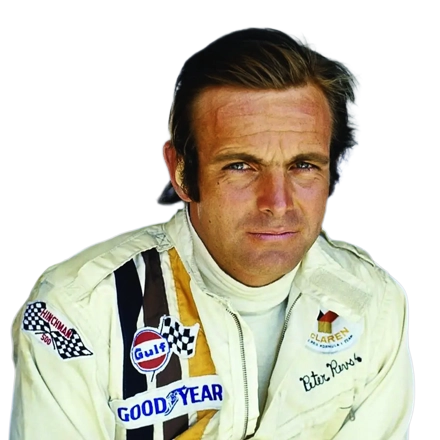
Peter Revson was an American racing driver whose career spanned the most demanding years in motorsport. Competing in Formula One between 1964 and 1974, Revson claimed two Grand Prix wins and established himself as one of the most versatile drivers of his generation.
| Nationality | American |
|---|---|
| Born | Peter Jeffrey Revlon Revson 27 February 1939 New York City, U.S. |
| Died | 22 March 1974 (aged 35) Kyalami, Gauteng, South Africa |
Born and raised in New York, Revson was no ordinary racer. He was the nephew of Charles Revson, co-founder of the Revlon cosmetics empire, and a natural heir to a life of comfort and privilege. Instead, he chose speed, risk, and competition. Over the course of his career, Revson won the Canadian-American Challenge Cup (Can-Am) championship in 1971, finished fifth overall in the Formula One World Drivers’ Championship in both 1972 and 1973 with McLaren, and came heartbreakingly close to Indianapolis 500 glory as runner-up to Al Unser in 1971.
Alongside Dan Gurney, Revson became one of only two drivers ever to win races in Formula One, IndyCar, Can-Am, and Trans-Am—a testament to his adaptability and talent across wildly different machines. His trademark champagne-soaked victory celebrations earned him the enduring nickname “Champagne Peter.” In recognition of his achievements, Revson was inducted into the Motorsports Hall of Fame of America in 1996.
Background
Peter Revson was born in New York City to Martin Revson and Julie (née Phelps) Hall. His father, Martin, had been a founding partner in Revlon alongside his brother Charles, before leaving the company in 1958. Martin later became chairman of Del Laboratories in 1963. Julie Revson had been a nightclub singer when she met Martin, adding a touch of show business flair to the family mix.
Revson’s full name—Peter Jeffrey Revlon Revson—made his family connection unmistakable, and newspapers of the era often referred to him simply as Peter Revlon Revson. Young, charismatic, and famously handsome, he was frequently described as a free spirit. Rather than embracing an easy life of inherited wealth, Revson pursued danger and competition with enthusiasm. Beyond racing cars at the highest levels in both Europe and the United States, he piloted a 32-foot Chris-Craft powerboat and was romantically linked with some of the most glamorous women of his era. At the time of his death, he was engaged to Marjorie Wallace, the recently dethroned 1973 Miss World.
Early Life and the Road to Racing
Revson grew up in White Plains, New York, and attended a series of preparatory schools. He had two sisters, Jennifer and Julie Ann, and a younger brother, Douglas. Tragically, Doug Revson was killed in a racing accident in Denmark in 1967, a loss that deeply affected Peter.
Although he attended Columbia University, Cornell University, and the University of Hawaiʻi, Revson never completed a college degree. It was in Hawaiʻi, in 1960, that his racing career truly began. He purchased a Morgan sports car and entered local races—finishing second in his debut and winning his very next outing. When he committed to racing full time, his family withdrew financial support, forcing Revson to rely on savings and education funds.
Teaming up with Cornell classmate Timmy Mayer and friend Bill Smith, and managed by Teddy Mayer, Revson raced under the Rev-Em Racing banner in Formula Junior during 1962. The following year, with Formula One ambitions firmly in mind, Revson liquidated his remaining resources—about US$12,000 (roughly $123,200 in 2024)—and relocated to the United Kingdom. There, he bought a Formula Junior Cooper T56 and a Ford Thames van and began crisscrossing Europe, racing anyone who would line up against him. Victories over future stars such as Denny Hulme and Jochen Rindt soon followed.
His performances attracted the attention of Reg Parnell, who offered Revson workshop space and a seat on his planned Formula One team. Revson made his F1 debut at a non-championship exhibition race, the 1963 Gold Cup at Oulton Park, finishing ninth. In 1964, he raced alongside Chris Amon and Mike Hailwood for Reg Parnell Racing—dubbed the “Ditton Road Flyers,” a group remembered as much for their lively off-track antics as for their results.
That season was difficult. The sudden death of Reg Parnell, financial instability, and the uncompetitive Lotus 24 all took their toll. Revson started four of the ten World Championship races in 1964, finishing only two, with a best result of 13th at the Italian Grand Prix. In non-championship events, he fared better, recording a fourth-place finish at the Solitude Grand Prix in West Germany.
Building a Reputation in America
In 1965, Revson returned to the United States, focusing primarily on sports car racing in the Can-Am and Trans-Am series, where his reputation steadily grew. He also competed in American open-wheel racing, including the elite USAC Championship Car series.
At the 1969 Indianapolis 500, Revson qualified 33rd—the final spot on the grid—but drove an inspired race to finish fifth in an underpowered Brabham BT25, despite completing only 197 laps. Later that season at Indianapolis Raceway Park, he finished third in the first leg of the Indianapolis 200 and then claimed his first Championship Car victory in the second leg.
That performance earned him a call from McLaren for the 1970 Indianapolis 500, stepping in after Chris Amon failed to qualify. Revson started 16th but retired after 87 laps due to mechanical failure. The same year, he teamed with Steve McQueen in a Porsche 908/02 at the 12 Hours of Sebring. They finished second overall and won the 3-liter class, just seconds behind a Ferrari 512 driven by Mario Andretti’s team. McQueen famously drove with a broken foot, meaning Revson carried much of the workload. Revson also finished eighth overall in the 1970 Can-Am championship, driving a Lola T220 for Carl Haas Racing.
The Breakthrough: 1971
The 1971 season transformed Revson’s career. Driving for McLaren at the Indianapolis 500, he qualified on pole in a McLaren M16 and finished second. In Can-Am, he dominated. Driving the McLaren M8F, Revson won five races and scored three additional podium finishes in ten rounds, securing the championship.
His success earned him a Formula One appearance with Tyrrell at the 1971 United States Grand Prix. Although he started 19th, a mechanical failure ended his race after just one lap.
Formula One Success with McLaren
Revson’s performances earned him a full-time Formula One seat with McLaren for 1972, under the leadership of longtime friend Teddy Mayer. That year, Revson competed across McLaren’s IndyCar, Can-Am, and F1 programs.
In Formula One, he finished fifth in the World Drivers’ Championship, scoring four podiums—including three thirds and a second place at the Canadian Grand Prix—and helping McLaren secure third in the 1972 Constructors’ Championship.
As part of his contract, Revson also contested the 1972 IndyCar Triple Crown. Mechanical issues plagued him: he retired from the Indianapolis 500 after 23 laps, from the Pocono 500 after seven laps, and finished 23rd at the California 500.
The 1973 season brought Revson to the peak of his Formula One career. Driving the McLaren M23, he claimed his first Grand Prix victory at the British Grand Prix, followed by a second triumph at the Canadian Grand Prix. With two more podium finishes—a second and a third—he once again helped McLaren finish third in the Constructors’ Championship.
Despite his success, McLaren chose to sign reigning champion Emerson Fittipaldi for 1974. Revson again competed in the IndyCar Triple Crown, qualifying second for the Indianapolis 500 but retiring after brushing the wall on lap three. He took pole positions at both the Pocono and California 500s, though neither race delivered a strong result.
Shadow and Tragedy
For 1974, Revson joined the young Shadow Racing Cars team. Driving the Shadow DN3, he retired from the opening race after a lap-two accident and from the second race due to engine overheating.
On March 22, 1974, during a test session at Kyalami ahead of the South African Grand Prix, tragedy struck. A front suspension failure sent Revson’s DN3 into the Armco barrier at Barbecue Bend. The car pierced beneath the barrier, caught fire, and despite rapid intervention, Revson was killed.
Designer Tony Southgate later recalled the devastation of the accident and accepted responsibility for a titanium suspension component failure—a sobering reminder of Formula One’s dangers during the era.
Revson was the second member of his family lost to racing, following the death of his brother Douglas in 1967. The brothers are interred together at Ferncliff Cemetery in Hartsdale, New York. Revson’s autobiography, Speed with Style, co-written with Leon Mandel, was published posthumously in 1974.
He was replaced at Shadow by Tom Pryce, who himself died three years later at the same Grand Prix.
Peter Revson Formula One World Championship career
| F1 Career | 1964, 1971–1974 |
|---|---|
| Teams | Privateer Lotus, Parnell, Tyrrell, McLaren, Shadow |
| Entries | 32 (30 starts) |
| Championships | 0 |
| Wins | 2 |
| Podiums | 8 |
| Career points | 61 |
| Pole positions | 1 |
| Fastest laps | 3 |
| First entry | 1964 Monaco Grand Prix |
| First win | 1973 British Grand Prix |
| Last win | 1973 Canadian Grand Prix |
| Last entry | 1974 Brazilian Grand Prix |
Peter Revson Teammates
| 9 drivers | Involvement | First Year | Last Year |
|---|---|---|---|
| Mike Hailwood | 1 | 1964 | |
| Chris Amon | 1 | 1964 | |
| Jackie Stewart | 1 | 1971 | |
| Francois Cevert | 1 | 1971 | |
| Denny Hulme | 23 | 1972 | 1973 |
| Brian Redman | 1 | 1972 | |
| Jody Scheckter | 6 | 1972 | 1973 |
| Jacky Ickx | 1 | 1973 | |
| Jean-Pierre Jarier | 3 | 1974 |
Peter Revson Wins
| Win No. | Grand Prix |
|---|---|
| 1 | 1973 British Grand Prix |
| 2 | 1973 Canadian Grand Prix |
Peter Revson Complete Formula One Results
| Year | Entrant | Chassis | Engine | 1 | 2 | 3 | 4 | 5 | 6 | 7 | 8 | 9 | 10 | 11 | 12 | 13 | 14 | 15 | WDC | Pts |
|---|---|---|---|---|---|---|---|---|---|---|---|---|---|---|---|---|---|---|---|---|
| 1964 | Revson Racing | Lotus 24 | BRM V8 | MON DNQ | NED | GER 14 | AUT | ITA 13 | USA | MEX | NC | 0 | ||||||||
| Reg Parnell Racing | Lotus 24 | BRM V8 | BEL DSQ | GBR Ret | NC | 0 | ||||||||||||||
| Reg Parnell Racing | Lotus 25 | BRM V8 | FRA DNS | NC | 0 | |||||||||||||||
| 1971 | Elf Team Tyrrell | Tyrrell 001 | Cosworth V8 | RSA | ESP | MON | NED | FRA | GBR | GER | AUT | ITA | CAN | USA Ret | NC | 0 | ||||
| 1972 | Team Yardley McLaren | McLaren M19A | Cosworth V8 | ARG Ret | RSA 3 | ESP 5 | MON | BEL 7 | FRA | GBR 3 | GER | 5th | 23 | |||||||
| McLaren M19C | Cosworth V8 | AUT 3 | ITA 4 | CAN 2 | USA 18 | 5th | 23 | |||||||||||||
| 1973 | Team Yardley McLaren | McLaren M19C | Cosworth V8 | ARG 8 | BRA Ret | RSA 2 | 5th | 38 | ||||||||||||
| Team Yardley McLaren | McLaren M23 | Cosworth V8 | ESP 4 | BEL Ret | MON 5 | SWE 7 | FRA | GBR 1 | NED 4 | GER 9 | AUT Ret | ITA 3 | CAN 1 | USA 5 | 5th | 38 | ||||
| 1974 | UOP Shadow Racing Team | Shadow DN3 | Cosworth V8 | ARG Ret | BRA Ret | RSA | ESP | BEL | MON | SWE | NED | FRA | GBR | GER | AUT | ITA | CAN | USA | NC | 0 |