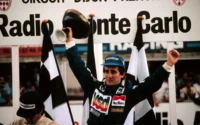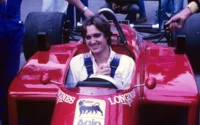



















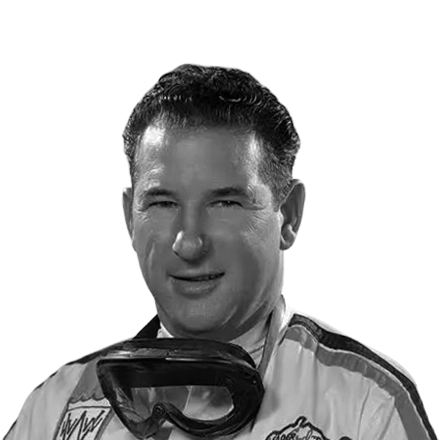
Rodger Ward was one of the toughest, smartest, and most versatile American racers of the post-war era. A two-time U.S. National Champion and two-time winner of the Indianapolis 500 (1959 and 1962), Ward built a career that spanned midgets, stock cars, championship cars—and even a cameo in Formula One. Add in a wartime career as a decorated fighter pilot, and you have the résumé of a man who lived at full throttle. He also captured the AAA National Stock Car Championship in 1951, proving early that his talent wasn’t confined to one discipline.
| Nationality | American |
|---|---|
| Born | Rodger Morris Ward 10 January 1921 Beloit, Kansas, U.S. |
| Died | 5 July 2004 (aged 83) Anaheim, California, U.S. |
Ward was born in Beloit, Kansas, to Ralph and Geneva (née Banta) Ward. By 1930, the family had relocated to California, where his father ran an auto wrecking business in Los Angeles. Engines and machinery were part of daily life. At just 14, Ward built a Ford hot rod—an early sign that he preferred creating speed to merely watching it.
World War II temporarily redirected that passion skyward. Ward became a P-38 Lightning fighter pilot and loved flying enough to consider it a lifelong career. He later transitioned to the B-17 Flying Fortress and was so proficient he was retained as an instructor. After the war, while stationed in Wichita Falls, Texas, a quarter-mile dirt track opened nearby. The seed of a second high-risk profession was planted.
Ward eventually settled in Anaheim, California, where he would later pass away in 2004 at age 83.
Midgets and Mechanics
Ward began racing midget cars in 1946 after leaving the Army. The early results were humbling. But by 1948, he had sharpened his skills enough to win the San Diego Grand Prix. In 1949, driving an Offenhauser (“Offy”), he collected multiple victories.
Then came a seismic moment in 1950. At Gilmore Stadium on 10 August, Ward stunned the midget world by ending the Offenhauser engine’s long dominance. Instead, he ran Vic Edelbrock’s Ford 60 “shaker” motor—one of the first to burn nitromethane. The result? Victory. The very next night at Orange Show Stadium, Ward and Edelbrock won again.
In 1959, Ward added another unlikely chapter: at Lime Rock Park, he drove Ken Brenn’s Offy midget in a Formula Libre race and beat top-tier sports cars—machines far more expensive and exotic. At the time, midgets were considered oval-only specialists. Ward proved otherwise.
That same year, with supreme confidence (and perhaps a dash of miscalculation), he entered the United States Grand Prix in a midget car, believing it would dominate in the corners. Reality intervened. The car struggled from the first practice laps, and he retired after 20 laps with mechanical trouble.
Stock Car Success
Ward competed in AAA and later USAC Stock Car competition, starting 66 races. He won seven, finished in the top five 29 times, and in 1951 captured the AAA National Stock Car Championship. It earned him a rookie test at the Indianapolis 500.
The Long Road to Indy Glory
Ward debuted at the 1951 Indianapolis 500. His car broke an oil line after 34 laps. In the 1952 Indianapolis 500, oil pressure failed after 130 laps. At the 1953 Indianapolis 500, he lasted 170 laps. In 1954, the car stalled on the backstretch. Year after year, he came close—only to be undone by mechanical misfortune.
Finally, in 1956, he completed all 200 laps and finished eighth.
The “3 W’s” and the Breakthrough
In 1959, Ward joined Leader Card Racers, owned by Bob Wilke, with master mechanic A. J. Watson. The trio became known as the “3 W’s”—Wilke, Watson, Ward.
That year, everything clicked. Ward won the 1959 Indianapolis 500 and secured the USAC National Championship with victories at Milwaukee, DuQuoin, and the Indy Fairgrounds. He also competed in the United States Grand Prix at Sebring that season.
The Duel for the Ages
The 1960 Indianapolis 500 produced one of the greatest head-to-head battles in race history. Ward and Jim Rathmann swapped the lead 14 times. On lap 197, Ward, nursing a frayed right-front tire, slowed to survive. Rathmann—himself on worn rubber—took the lead. Both limped to the finish in a finale still remembered as one of Indy’s most dramatic duels.
Second Crown: 1962
In 1962, Ward took control of the Indianapolis 500 on lap 126—and never relinquished it. He went on to win both the race and the season championship, becoming a two-time Indy 500 winner and two-time National Champion.
Tragedy And a Hard Goodbye
By 1964, the rear-engine revolution—led by Lotus-Ford—was reshaping Indy. A. J. Watson built a rear-engine Watson paired with Ford’s four-cam engine for Ward. But on the eve of the race, Ward and Watson made a costly decision: they ran gasoline instead of the cooler-burning methanol recommended by Ford.
The car was fast—but thirsty. Ward had to pit every 20 laps. Later calculations suggested he spent two fewer minutes on track than winner A. J. Foyt, yet still lost by roughly a minute.
That race was also marked by tragedy. A horrific second-lap crash claimed the lives of Dave MacDonald and Eddie Sachs in a gasoline-fueled fire—an event that deeply affected Ward.
By 1965, he endured the rare sting of failing to qualify. He left Leader Card mid-season and joined Mecom Racing under John W. Mecom Jr. In 1966, he won at Trenton driving a supercharged Offy-powered Lola.
At the 1966 Indianapolis 500, handling problems forced him to retire while running 15th. Late attrition reduced the field to just five finishers; he might have salvaged a strong result had he continued. Instead, after 74 laps, Ward parked the car—and quietly weighed his future.
At the post-race banquet, he delivered a heartfelt farewell: “I always said I’d quit racing when it stopped being fun… Today it wasn’t fun anymore.”
In 150 Championship Car starts between 1950 and 1966, Ward scored 26 victories and finished in the top ten more than half the time. Few walked away with such honesty—or such numbers.
F1 World Drivers’ Championship Involvement
From 1950 to 1960, the Indianapolis 500 counted toward the FIA World Drivers’ Championship. Ward started ten World Championship races at Indianapolis and also competed in the 1959 United States Grand Prix and again in 1963.
Across his World Championship career, he secured one victory, the 1959 Indianapolis 500, two podium finishes, and accumulated 14 championship points—remarkable achievements for a driver whose primary battleground was American open-wheel racing.
Life After the Checkered Flag
Ward didn’t stray far from the sport. From 1965 to 1970, he served as a commentator for ABC’s Wide World of Sports, covering NASCAR and IndyCar events. Later, from 1980 to 1985, he was a driver expert for the Indianapolis Motor Speedway Radio Network.
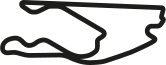
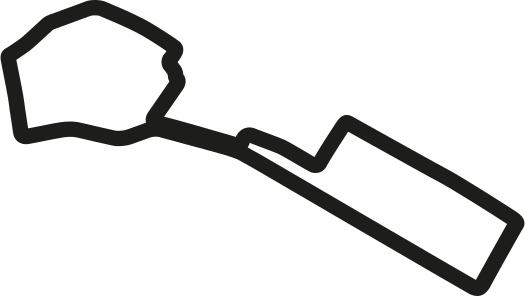
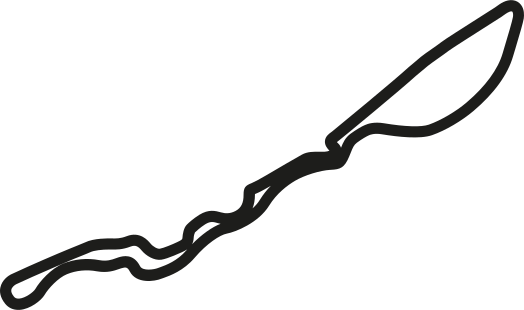
He also helped design Pocono Raceway in Long Pond, Pennsylvania, working with the Mattioli family. Drawing inspiration from favorite corners at Trenton, Indianapolis, and Milwaukee, Ward contributed to the track’s distinctive triangular layout—still one of motorsport’s most unique circuits.
In later years, he worked in public relations for Ontario Motor Speedway and managed the Circus Circus unlimited hydroplane team. In 1962, at the height of his fame, he even appeared on the television show To Tell the Truth—a reminder that his reputation extended beyond pit lane.
The Measure of the Man
Rodger Ward was fearless without being reckless. Innovative without being gimmicky. Patriotic, pragmatic, and fiercely competitive. He mastered midgets, conquered stock cars, ruled Indy, and stepped onto the world stage—sometimes with nothing more than confidence and an unconventional idea.
Two Indy 500 wins. Two National Championships. A stock car crown. A pilot’s wings.
Not bad for a kid who started by building a hot rod at fourteen.
Rodger Ward Formula One World Championship career
| F1 Career | 1950 – 1960, 1963 |
|---|---|
| Teams | Bromme, Kurtis Kraft, Pawl, Kuzma, Lesovsky, Watson, Lotus |
| Entries | 12 |
| Championships | 0 |
| Wins | 1 |
| Podiums | 2 |
| Career points | 14 |
| Pole positions | 0 |
| Fastest laps | 0 |
| First entry | 1951 Indianapolis 500 |
| First win | 1959 Indianapolis 500 |
| Last win | 1959 Indianapolis 500 |
| Last entry | 1963 United States Grand Prix |
Rodger Ward Wins
| Win No. | Grand Prix |
|---|---|
| 1 | 1959 Indianapolis 500 |
Rodger Ward Teammates
| 4 drivers | Involvement | First Year | Last Year |
|---|---|---|---|
| George Connor | 1 | 1952 | |
| Chuck Stevenson | 1 | 1960 | |
| Masten Gregory | 1 | 1963 | |
| Hap Sharp | 1 | 1963 |
Rodger Ward Complete Formula One Results
| Year | Entrant | Chassis | Engine | 1 | 2 | 3 | 4 | 5 | 6 | 7 | 8 | 9 | 10 | 11 | WDC | Pts. |
|---|---|---|---|---|---|---|---|---|---|---|---|---|---|---|---|---|
| 1951 | L & B Bromme | Bromme | Offenhauser | SUI | 500 27 | BEL | FRA | GBR | GER | ITA | ESP | NC | 0 | |||
| 1952 | Federal Auto Associates | Kurtis Kraft 4000 | Offenhauser | SUI | 500 23 | BEL | FRA | GBR | GER | NED | ITA | NC | 0 | |||
| 1953 | M. A. Walker | Kurtis Kraft | Offenhauser | ARG | 500 16 | NED | BEL | FRA | GBR | GER | SUI | ITA | NC | 0 | ||
| 1954 | R. N. Sabourin | Pawl | Offenhauser | ARG | 500 22 | BEL | FRA | GBR | GER | SUI | ITA | ESP | NC | 0 | ||
| 1955 | E. R. Casale | Kuzma | Offenhauser | ARG | MON | 500 28 | BEL | NED | GBR | ITA | NC | 0 | ||||
| 1956 | Ed Walsh | Kurtis Kraft 500C | Offenhauser | ARG | MON | 500 8 | BEL | FRA | GBR | GER | ITA | NC | 0 | |||
| 1957 | Roger Wolcott | Lesovsky | Offenhauser | ARG | MON | 500 30 | FRA | GBR | GER | PES | ITA | NC | 0 | |||
| 1958 | Roger Wolcott | Lesovsky | Offenhauser | ARG | MON | NED | 500 20 | BEL | FRA | GBR | GER | POR | ITA | MOR | NC | 0 |
| 1959 | Leader Cards Inc. | Watson | Offenhauser | MON | 500 1 | 10th | 8 | |||||||||
| Leader Cards Inc. | Kurtis Kraft | Offenhauser | NED | FRA | GBR | GER | POR | ITA | USA Ret | 10th | 8 | |||||
| 1960 | Leader Cards Inc. | Watson | Offenhauser | ARG | MON | 500 2 | NED | BEL | FRA | GBR | POR | ITA | USA | 12th | 6 | |
| 1963 | Reg Parnell Racing | Lotus 24 | BRM V8 | MON | BEL | NED | FRA | GBR | GER | ITA | USA Ret | MEX | RSA | NC | 0 |