




























Connew Racing Team, more commonly known simply as Connew, was one of Formula One’s most remarkable independent constructors. Founded by British designer Peter Connew in 1971, the team embodied the classic spirit of motorsport ingenuity.
| Nationality | British |
| Years Active | 1972 |
| First Race | 1972 Austrian Grand Prix |
| Last Race | 1972 Austrian Grand Prix |
| Race Entries | 2 |
| Race Starts | 1 |
| Podiums | 0 |
| Pole Positions | 0 |
| Fastest Laps | 0 |
| Points | 0 |
| Constructors’ Championships | 0 |
| Drivers’ Championships | 0 |
| Best Start | 25th |
| Did Not Start | 1 |
| Did Not Qualify | 0 |
| Retirements | 1 |
Despite operating on a tiny budget, Connew designed and built its own Formula One car, the PC1. An early monocoque chassis had to be abandoned following a regulation change, with a revised tub constructed and internally known as the PC2, although the car continued to be officially recorded as the PC1 in racing records.
The team’s ambitious goal was to contest the 1972 Formula One World Championship. Financial limitations and technical setbacks meant the car started just one World Championship Grand Prix—the 1972 Austrian Grand Prix—with French driver François Migault. After its Formula One campaign, the chassis was converted for Formula 5000 competition in 1973 before being destroyed in an accident at Brands Hatch, bringing the Connew story to an end.
History
The Beginning of an Unlikely Dream
The Connew story began in 1969 with an impulsive decision that would change Peter Connew’s life forever.
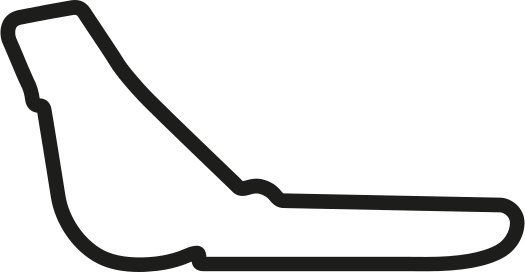
At just 23 years old, Connew was invited by a friend to attend the Italian Grand Prix at Monza. When his employer refused to grant him time off, he resigned from his job rather than miss the opportunity. After returning to England, he secured work as a draughtsman with the Surtees Formula One team, run by former World Champion John Surtees.
Working inside a Formula One operation gave Connew invaluable experience, but after leaving Surtees following a disagreement, he decided to pursue an ambitious goal that many considered impossible—designing and building his own Formula One car.
Operating from a modest garage in Chadwell Heath, construction of the chassis jig began in December 1970. Connew was assisted by Roger Doran, a shopfitter by trade, and his cousin Barry Boor, creating a tiny workforce that relied almost entirely on enthusiasm rather than financial backing.
Building the PC1
From the outset, Connew wanted his Formula One car to be both competitive and practical. The design focused on simplicity, ease of maintenance and efficient engineering rather than expensive innovation.
Despite their limited resources, the team even carried out aerodynamic testing using the wind tunnel at a local technical college—an inventive solution that reflected the team’s resourcefulness.
As the project progressed, several established racing drivers stopped by to inspect the car, including Tony Trimmer, Howden Ganley and Gerry Birrell. Trimmer was particularly impressed, describing it as one of the most comfortable Formula One cars he had ever sat in.
The team’s efforts also earned praise from Ford Competition Manager Stuart Turner, who famously remarked: “His car proves you can build a Formula One car by sweat alone, and makes you wonder about some of the astronomic development costs you hear the Establishment quoting!”
It was perhaps the greatest compliment the small independent team could have received.
1972: Formula One
Connew originally hoped to make its Formula One debut at the 1972 Monaco Grand Prix. However, a late regulation change requiring a different grade of aluminium forced the team to abandon its original chassis and build a second monocoque from scratch, causing significant delays.
At the same time, the team secured a used Cosworth DFV engine from McLaren, giving the project proven Formula One power. French driver François Migault joined the team and even supplied the Ford transporter that carried the car across Europe.
Unfortunately, the truck broke down before reaching the French Grand Prix at Clermont-Ferrand, forcing the team to abandon its plans and instead conduct testing at the Bugatti Circuit in Le Mans.
Connew finally appeared at the British Grand Prix, where the car participated in practice. However, its innovative rear suspension revealed significant weaknesses. Although the team repaired the car overnight, a cracked rear upright was discovered before the race, forcing a withdrawal before the start.
The team’s perseverance continued with an appearance at the German Grand Prix, but without having completed the necessary entry procedures in advance, race officials refused permission for the car to compete.
Austrian Grand Prix
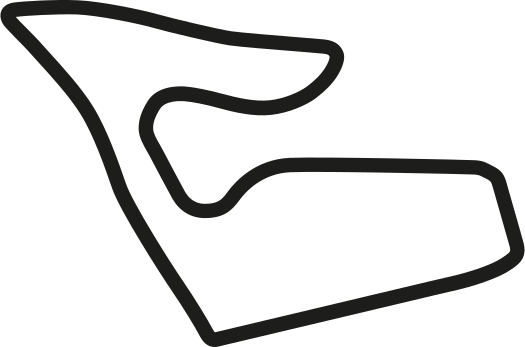
The breakthrough finally came at the 1972 Austrian Grand Prix.
Following several modifications, Migault successfully qualified the Connew at the back of the grid despite experiencing engine problems throughout the weekend.
During the race, the little British team briefly demonstrated its potential. Migault climbed four positions over the opening laps and was making encouraging progress before disaster struck on lap 22 when a rear wishbone mounting failed.
The failure caused the car to veer violently towards the barriers along the start-finish straight. Fortunately, Migault managed to keep control and safely brought the damaged car to a halt without hitting anything, ending Connew’s one and only Formula One World Championship race.
Later that season, the team entered the non-championship World Championship Victory Race at Brands Hatch with David Purley behind the wheel. However, the car never started after a newly installed steering wheel-mounted electrical kill switch malfunctioned during the warm-up lap, cutting the engine and ending the team’s weekend before the race began.
1973: Formula 5000
Rather than abandoning the project, Connew gave the chassis a second life by converting it to Formula 5000 specification for the 1973 European Formula 5000 Championship. The Cosworth DFV was replaced by a powerful Chevrolet V8 engine, allowing the car to compete in the increasingly popular series.
Swiss driver Pierre Soukry made the car’s Formula 5000 debut at Mallory Park. Although he successfully qualified, a split oil pipe prevented the team from taking the start.
Several races later, Soukry again attempted to qualify the Connew at Brands Hatch but failed to make the grid.
The team’s final appearance came at the Formula 5000 season finale, also at Brands Hatch, where experienced British driver Tony Trimmer took over driving duties.
Sadly, the fairy-tale story came to an abrupt end when Trimmer crashed heavily into the barriers, damaging the chassis beyond repair. Without the resources to build another car, the Connew Racing Team quietly closed its doors, ending one of Formula One’s most inspiring independent projects.
Legacy
Although Connew Racing Team competed in only a single Formula One World Championship Grand Prix, its place in motorsport history is secure. Built by a tiny group of dedicated enthusiasts working with limited funding, the PC1 remains one of the greatest examples of British engineering’s independent spirit.
Connew Stats by Season
| Year | Engine | Drivers | Entries | Starts | Wins | Podiums | Poles | Fastest Laps | Front Rows | DNF | Best Start | Best Result | Points | Championship |
|---|---|---|---|---|---|---|---|---|---|---|---|---|---|---|
| 1972 | Ford Cosworth | François Migault | 2 | 1 | 0 | 0 | 0 | 0 | 0 | 1 | 25 | – | 0 | NC |
