



























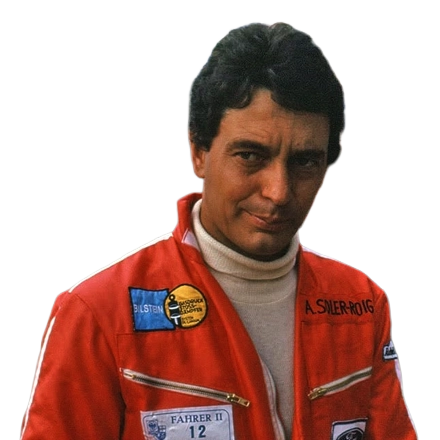
Alex Soler-Roig i Janer (born 29 October 1932) is a former Spanish racing driver from Barcelona who entered 10 and raced in six Formula One World Championship Grands Prix between 1970 and 1972. Although he did not score World Championship points, Soler-Roig enjoyed a varied international career that included success in rallying, endurance racing, touring cars and GT competition, becoming one of Spain’s leading drivers of his era.
Driver Bio
| Nationality | Spanish |
| Birthplace | Barcelona, Spain |
| Born | 29 October 1932 |
| First Grand Prix | 1970 Spanish Grand Prix |
| Last Grand Prix | 1972 Spanish Grand Prix |
| Years Active | 1970–1972 |
| Current/Last Team | BRM |
Early career
The son of Dr Soler-Roig, Alex began his competitive career on motorcycles before switching to four wheels, initially competing in rallies with Fiat and Porsche.
His first major successes came in 1958 when he won both the Nuvolari Trophy in Barcelona and the Rally Catalunya. Those victories helped secure sponsorship for an entry into the prestigious Monte Carlo Rally and opened the door to a wider international racing career.
During the 1960s, Soler-Roig became a regular competitor in endurance racing. He drove for Porsche at the 1968 24 Hours of Le Mans in a Porsche 907/6 Langheck before returning the following year to contest the 24 Hours of Daytona, where he led his class until co-driver Rudi Lins crashed the car. He also finished an impressive fourth overall at the 1969 12 Hours of Sebring in another Porsche 907.
Alongside his sports car commitments, Soler-Roig competed in Formula 2. Racing a Lola before switching to a Lotus entered by Roy Winkelmann Racing and managed by Bernie Ecclestone, he finished seventh in the 1969 Barcelona Grand Prix. He also shared victories with future Formula One World Champion Jochen Rindt, including success in the 6 Hours of Jarama, and claimed second place in the 1000 km of Buenos Aires.
Formula One career
Soler-Roig’s Formula One journey began in 1970 with a privately entered Lotus 49. His first attempt came at his home Spanish Grand Prix, where he narrowly missed qualifying after organisers restricted the grid to just 16 starters. Despite setting a lap time only one tenth of a second slower than Mario Andretti, he was excluded after officials decided not to allow additional starters, even though the non-qualifiers’ cars had briefly been placed on the grid before the decision was reversed.
Later that season he drove the Lotus 72 originally intended for Jochen Rindt at the Belgian Grand Prix. However, delays in preparing the car left him with only three laps in qualifying, preventing him from making the grid. Another failed qualification followed at the French Grand Prix.
Away from Formula One, 1970 proved far more rewarding as Soler-Roig captured the Spanish GT-Sport Championship.
For 1971, he joined the works March Formula One team while simultaneously contesting the Spanish and German Touring Car Championships in a Ford Capri. Although reliability problems prevented him from finishing a Formula One race, he successfully won the Spanish Touring Car Championship and finished fourth in the highly competitive German series.
Soler-Roig switched to the Marlboro-backed BRM team for the 1972 Formula One season. Once again, a combination of mechanical issues and an uncompetitive package prevented him from making an impact, and after only a handful of Grands Prix he turned his attention back to touring car racing.
Touring car success and retirement
After stepping away from Formula One in 1972, Soler-Roig enjoyed one of the finest seasons of his career in the European Touring Car Championship with Ford. He recorded victories in several major endurance events, including the 24 Hours of Spa, the 24 Hours of Paul Ricard, the 4 Hours of Zandvoort, the 4 Hours of Jarama and the 3 Hours of Montjuïc, confirming his reputation as one of Spain’s most accomplished touring car drivers.
Despite those successes, Soler-Roig chose to retire from competitive motorsport before his 41st birthday. He stepped away from racing at the end of the 1972 season to focus on his family’s business interests, bringing to a close a career that spanned rallying, Formula One, endurance racing and touring cars.
Grand Prix Stats
| Race Entries | 10 |
| Race Starts | 6 |
| Did Not Start | 0 |
| Best Race Start | 17th |
| Best Race Finish | n/a |
| Retirements | 6 |
| First-Lap Retirements | 0 |
| Not Classified | 0 |
| Disqualified | 0 |
| Did Not Qualify | 4 |
Qualifying
| Qualifying Sessions | 10 |
| Reached Q3 | 0 |
| Q2 Eliminations | 0 |
| Q1 Eliminations | 0 |
| Did Not Qualify | 4 |
Stats by Season
| Year | Constructor | Entries | Starts | Wins | Podiums | Poles | Fastest Laps | Front Rows | DNF | Best Start | Best Result | Pts Finishes | Points | Championship |
|---|---|---|---|---|---|---|---|---|---|---|---|---|---|---|
| 1970 | Lotus | 3 | 0 | 0 | 0 | 0 | 0 | 0 | 0 | – | – | 0 | 0 | NC |
| 1971 | March | 5 | 4 | 0 | 0 | 0 | 0 | 0 | 4 | 17 | – | 0 | 0 | NC |
| 1972 | BRM | 2 | 2 | 0 | 0 | 0 | 0 | 0 | 2 | 21 | – | 0 | 0 | NC |
Stats by Constructor
| Constructor | Years | Entries | Starts | Wins | Podiums | Poles | Fastest Laps | Front Rows | DNF | Best Start | Best Result | Pts Finishes | Points |
|---|---|---|---|---|---|---|---|---|---|---|---|---|---|
| Lotus | 1970 | 3 | 0 | 0 | 0 | 0 | 0 | 0 | 0 | – | – | 0 | 0 |
| March | 1971 | 5 | 4 | 0 | 0 | 0 | 0 | 0 | 4 | 17 | – | 0 | 0 |
| BRM | 1972 | 2 | 2 | 0 | 0 | 0 | 0 | 0 | 2 | 21 | – | 0 | 0 |
Teammates & Qualifying Head-to-Head
| Teammate | Years | Races | Qualifying H2H |
|---|---|---|---|
| Ronnie Peterson | 1971 | 5 | – |
| Andrea de Adamich | 1971 | 3 | – |
| Nanni Galli | 1971 | 3 | – |