







































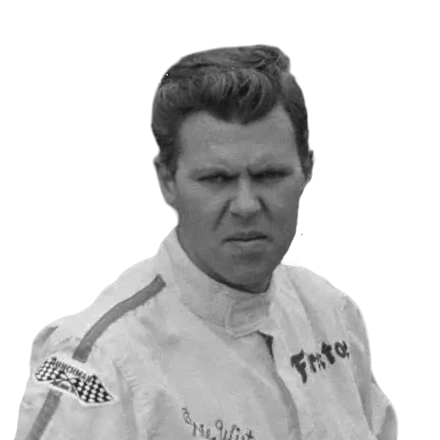
Egbert “Eppie” Wietzes was one of the pioneering figures in Canadian motorsport, a fiercely competitive driver whose career spanned Formula One, Formula 5000, Trans-Am racing, and some of North America’s toughest racing categories.
Driver Bio
| Nationality | Canadian |
| Birthplace | Assen, Netherlands |
| Born | 28 May 1938 |
| Died | 9 June 2020 |
| First Grand Prix | 1967 Canadian Grand Prix |
| Last Grand Prix | 1974 Canadian Grand Prix |
| Current/Last Team | Privateer: Brabham |
Born in Assen, the Netherlands, in 1938, Wietzes emigrated to Canada with his family at age 12, beginning a journey that would eventually make him one of the most respected racers in Canadian motorsport history. While he never became a full-time Formula One star, his influence on the sport — particularly in Canada — reached far beyond statistics.
Breaking Into Formula One
Wietzes made his Formula One World Championship debut on 27 August 1967 at the inaugural Canadian Grand Prix at Mosport Park, a landmark moment both for the country and for Canadian racing fans eager to see local talent compete on the world stage.
Driving a privately entered car, Wietzes showed determination and composure in difficult conditions during the race. However, his debut ended in frustration after he retired on lap 69 with electrical problems caused by wet conditions. Matters became even more disappointing when he was later disqualified for receiving outside assistance while attempting to continue.
Although the result did not go his way, simply earning a place on the Formula One grid during that era was a major achievement. The late 1960s were among the most dangerous and fiercely competitive periods in Grand Prix racing.
Return to the Grand Prix Stage
Seven years later, Wietzes returned to Formula One for the 1974 Canadian Grand Prix, this time driving a rented Brabham BT42. Once again competing on home soil, he battled mechanical issues throughout the event before eventually retiring with transmission trouble.
Like his first appearance, the race ended without points, leaving Wietzes with two Formula One starts and no championship finishes. Yet his brief Formula One career never fully defined him. In many ways, Wietzes represented the spirit of independent racing drivers of the era — determined racers willing to fight for opportunities at the highest level regardless of budget or factory backing.
Success Beyond Formula One
While Formula One brought only fleeting appearances, Wietzes found far greater success elsewhere in motorsport. He became a formidable competitor in Formula 5000, the thunderous open-wheel category famous for combining lightweight chassis with massive V8 power.
Wietzes also excelled in touring and sports car competition, building a reputation as a versatile and highly skilled driver capable of adapting to almost anything with four wheels. His biggest championship triumph came in 1981 when he won the prestigious Trans-Am Series, one of North America’s premier road-racing championships.
The title cemented his status as one of Canada’s elite racing drivers and proved that his talent extended well beyond the occasional Formula One appearance.
The First Formula One Safety Car Driver
Wietzes also occupies a unique place in F1 history for an entirely different reason: he became the driver of the sport’s very first official safety car.
During the 1973 Canadian Grand Prix, a collision involving François Cevert and Jody Scheckter forced officials to neutralise the race. Wietzes was called into action behind the wheel of a Porsche 914 course car, leading the field around the circuit in what became Formula One’s first-ever safety car deployment.
The moment has since become an important footnote in Grand Prix history. While the modern safety car is now a routine and essential part of Formula One, Wietzes was the man who unknowingly pioneered the role during that chaotic afternoon in Canada.
Hall of Fame Recognition and Legacy
In recognition of his contributions to the sport, Wietzes was inducted into the Canadian Motorsport Hall of Fame in 1993.
Throughout his career, he earned admiration not only for his speed but also for his professionalism, resilience, and dedication to Canadian racing. He competed during an era when drivers often raced multiple disciplines, handled their own deals, and faced enormous risks every time they entered the cockpit.
Eppie Wietzes passed away on 10 June 2020 at the age of 82.
Grand Prix Stats
| Race Entries | 2 |
| Race Starts | 2 |
| Did Not Start | 0 |
| Best Race Start | 17th |
| Best Race Finish | – |
| Retirements | 1 |
| First-Lap Retirements | 0 |
| Not Classified | 0 |
| Disqualified | 1 |
| Did Not Qualify | 0 |
Qualifying
| Qualifying Sessions | 2 |
| Reached Q3 | 0 |
| Q2 Eliminations | 0 |
| Q1 Eliminations | 0 |
| Did Not Qualify | 0 |
Stats by Season
| Year | Constructor | Entries | Starts | Wins | Podiums | Poles | Fastest Laps | Front Rows | DNF | Best Start | Best Result | Pts Finishes | Points | Championship |
|---|---|---|---|---|---|---|---|---|---|---|---|---|---|---|
| 1967 | Lotus | 1 | 1 | 0 | 0 | 0 | 0 | 0 | 0 | 17 | – | 0 | 0 | NC |
| 1974 | Privateer: Brabham | 1 | 1 | 0 | 0 | 0 | 0 | 0 | 1 | 26 | – | 0 | 0 | NC |
Stats by Constructor
| Constructor | Years | Entries | Starts | Wins | Podiums | Poles | Fastest Laps | Front Rows | DNF | Best Start | Best Result | Pts Finishes | Points |
|---|---|---|---|---|---|---|---|---|---|---|---|---|---|
| Privateer: Lotus | 1967 | 1 | 1 | 0 | 0 | 0 | 0 | 0 | 0 | 17 | – | 0 | 0 |
| Privateer: Brabham | 1974 | 1 | 1 | 0 | 0 | 0 | 0 | 0 | 1 | 26 | – | 0 | 0 |
Teammates & Qualifying Head-to-Head
| Teammate | Years | Races | Qualifying H2H |
|---|---|---|---|
| Jim Clark | 1967 | 1 | 0-1 |
| Graham Hill | 1967 | 1 | 0-1 |