

























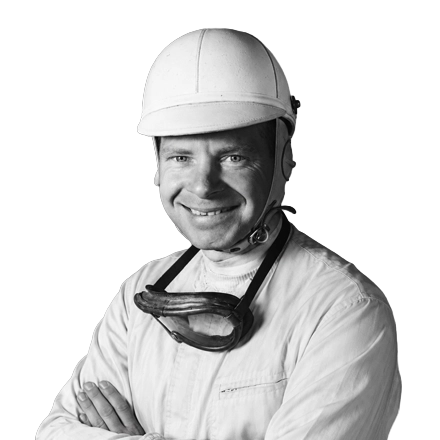
John Ashley “Johnny” Thomson (9 April 1922 – 24 September 1960) was an American racing driver whose speed across midgets, sprint cars, and Championship Cars earned him the nickname “The Flying Scot.” A multiple champion on America’s short tracks, Thomson progressed to what is now IndyCar, started the Indianapolis 500 eight times, and claimed pole position for the 1959 Indianapolis 500.
Driver Bio
| Nationality | American |
| Birthplace | Lowell, Massachusetts, USA |
| Born | 9 April 1922 |
| Died | 24 September 1960 |
| First Grand Prix | 1953 Indianapolis 500 |
| Last Grand Prix | 1960 Indianapolis 500 |
| Years Active | 1953–1960 |
| Current/Last Team | Lesovsky |
Born to William and Marion Ross Thomson, he grew up in Lowell, Massachusetts, graduating from Lowell High School and later the New England Aircraft School. Before motor racing became his profession, Thomson served during the Second World War between 1942 and 1945, working as a crew chief on a B-25 bomber in Corsica and Italy. His service earned him five service stars and the Distinguished Air Force Medal.
Racing had fascinated Thomson long before that. During 1937 and 1938 he watched events at a circuit across the street from his home, and in 1938 — against his parents’ wishes — began competing himself in a V8-powered car he had built. After returning from military service, he resumed racing with the Bay State Racing Association. His first victory came at Seekonk Speedway in 1946, followed by seven wins the next year.
By 1948, Thomson was becoming one of New England’s standout midget racers. He won an extraordinary 32 events on his way to the United Car Owners Association New England championship, then successfully defended the title in 1949. He also began appearing in American Racing Drivers Club competition, switching to the ARDC full-time in 1950. He finished fifth in points that season and improved to runner-up in 1951.
Another championship arrived in 1952. Victories at Williams Grove Speedway helped Thomson secure the AAA Eastern Division midget title, but by then he was already expanding into faster and more powerful machinery.
His first start in the cars then known simply as “Big Cars” — today’s sprint cars — came at the Vermont State Fairgrounds in September 1952. Racing primarily on the AAA Eastern circuit the following year, Thomson won at Altamont, New York, and finished ninth in the standings. In 1954 he became AAA Eastern Big Car champion, winning eight races during a dominant campaign.
When AAA withdrew from sanctioning racing after 1955 and USAC took over, Thomson remained a major force. Wins at Williams Grove, Trenton and Reading carried him to second in the 1956 Eastern standings behind Tommy Hinnershitz. He finished third in 1957 after victories at Reading and Allentown, then returned from injury in style in 1958. Thomson won the season-opening Eastern race at Williams Grove, added two victories at Reading and another at Allentown, and captured the USAC Eastern Sprint Car championship.
At the same time, Thomson was building an impressive career in AAA and USAC Championship Car racing. Between 1953 and 1960 he made 69 starts, finishing inside the top ten on 43 occasions and collecting seven victories. Most significantly, he qualified for the Indianapolis 500 every year from 1953 through 1960.
His first Championship Car victory came at the Milwaukee Mile in 1955, during a season in which Thomson finished third in the national standings despite missing races through injury. Those injuries had come in a violent end-over-end crash at Langhorne after he clipped Jerry Hoyt’s car while leading. Thomson suffered five broken ribs, damaged vertebrae and a shoulder broken in eight places.
It was the sort of accident that illustrated both the brutality of the era and Thomson’s toughness. He returned to win at Langhorne in 1957, collecting two pole positions during the season, although another crash at the California State Fairgrounds in October left him with internal injuries.
Once again, he bounced back. The 1958 Championship Car season became one of his strongest, with victories at the Springfield Mile, DuQuoin State Fairgrounds, California State Fairgrounds and Syracuse Mile. He took two poles from 13 starts and finished third in the championship.
Thomson also made history at Langhorne, becoming the first driver to complete a 100-mile dirt-track race in under an hour. His winning average of 100.174mph was a remarkable benchmark on one of American racing’s most intimidating circuits.
Then came Indianapolis in 1959. Thomson produced one of the defining performances of his career by winning pole position for the Indianapolis 500. He backed up his qualifying speed on race day, finishing third — the best Indy 500 result of his career. Roy Sherman, himself the first National Midget Champion, served as Thomson’s chief mechanic for several of his Indianapolis appearances.
Thomson remained a championship contender throughout 1959, winning again at Milwaukee and recording three fastest qualifying times on his way to another third place in the national standings. A sprint-car crash at Williams Grove in September brought his season to a premature end.
His achievements were particularly impressive because Thomson rarely confined himself to one discipline. Midgets, sprint cars and Championship Cars all demanded different skills, yet “The Flying Scot” was capable of winning in each. His record included major championships on the short tracks, seven Championship Car victories and an Indianapolis pole.
Away from racing, Thomson met Evelyn Peterson in 1951. During the mid-1950s he moved from the Springfield, Massachusetts area to a five-acre ranch he built near Boyertown, Pennsylvania. The couple had four sons: Dale, Dana, David and Darryl. Thomson even found his way onto television, appearing as a contestant on Bud Collyer’s Beat the Clock.
Tragically, his career and life were cut short during a USAC Sprint Car event at the Great Allentown Fair on 24 September 1960. Racing on a dry, heavily rutted track, Thomson’s car flipped, crashed through the backstretch fence and continued rolling into the infield. He was thrown from the car and trapped beneath it when it finally came to rest.
Thomson suffered a broken leg and other severe injuries and died several hours later at Allentown General Hospital. He was just 38 years old. His death deeply affected others; close friend and fellow competitor Tommy Hinnershitz announced his retirement shortly afterward.
Thomson’s standing in American motorsport was formally recognised decades later. He was inducted into the National Sprint Car Hall of Fame in 1996 and the National Midget Auto Racing Hall of Fame in 1997.
From a homemade V8 racer in Massachusetts to pole position at Indianapolis, Johnny Thomson packed an extraordinary amount into a career that ended far too soon. Champion in both midgets and sprint cars, a seven-time Championship Car winner and one of the fastest drivers of his generation on dirt, “The Flying Scot” earned his place among the outstanding American racers of the 1950s.
Grand Prix Stats
| Race Entries | 8 |
| Race Starts | 8 |
| Did Not Start | 0 |
| Best Race Start | 1st |
| Best Race Finish | 3rd |
| Retirements | 3 |
| First-Lap Retirements | 0 |
| Not Classified | 0 |
| Disqualified | 0 |
| Did Not Qualify | 0 |
Podiums
| Podiums | 1 |
| First Podium | 1959 Indianapolis 500 |
| Last Podium | 1959 Indianapolis 500 |
| 1st Place | 0 |
| 2nd Place | 0 |
| 3rd Place | 1 |
| Most Consecutive Podiums | 0 |
| Most Podiums in a Single Season | 1 (1959) |
| Seasons with Podiums | 1 |
Pole Positions
| Pole Positions | 1 |
| First Pole | 1959 Indianapolis 500 |
| Last Pole | 1959 Indianapolis 500 |
| Most Consecutive Poles | 0 |
| Most Poles in a Single Season | 1 |
| Seasons with Poles | 1 |
Qualifying
| Qualifying Sessions | 8 |
| Reached Q3 | 0 |
| Q2 Eliminations | 0 |
| Q1 Eliminations | 0 |
| Did Not Qualify | 0 |
Fastest Laps
| Fastest Laps | 1 |
| First Fastest Lap | 1959 Indianapolis 500 |
| Last Fastest Lap | 1959 Indianapolis 500 |
| Win + Fastest Lap | 0 |
| Most Consecutive Fastest Laps | 0 |
| Most Fastest Laps in a Season | 1 |
| Seasons with Fastest Laps | 1 |
Points
| Points Scored | 10 |
| Points Finishes | 3 |
| Most Points in a Single Season | 5 (1959) |
| Seasons with Points | 3 |
Front Row Starts
| Front Row Starts | 1 |
| Poles | 1 |
| 2nd on Grid | 0 |
| Most Front Row Starts in a Season | 1 |
| Seasons with Front Row Starts | 1 |
Stats by Season
| Year | Constructor | Entries | Starts | Wins | Podiums | Poles | Fastest Laps | Front Rows | DNF | Best Start | Best Result | Pts Finishes | Points | Championship |
|---|---|---|---|---|---|---|---|---|---|---|---|---|---|---|
| 1953 | Del Roy / Kurtis Kraft | 1 | 1 | 0 | 0 | 0 | 0 | 0 | 1 | – | – | 0 | 0 | NC |
| 1954 | Nichels | 1 | 1 | 0 | 0 | 0 | 0 | 0 | 0 | – | – | 0 | 0 | NC |
| 1955 | Kuzma | 1 | 1 | 0 | 0 | 0 | 0 | 0 | 0 | – | – | 1 | 3 | 13th |
| 1956 | Kuzma | 1 | 1 | 0 | 0 | 0 | 0 | 0 | 0 | – | – | 0 | 0 | NC |
| 1957 | Kuzma | 1 | 1 | 0 | 0 | 0 | 0 | 0 | 1 | – | – | 0 | 0 | NC |
| 1958 | Kurtis Kraft | 1 | 1 | 0 | 0 | 0 | 0 | 0 | 1 | – | – | 0 | 0 | NC |
| 1959 | Lesovsky | 1 | 1 | 0 | 1 | 1 | 1 | 1 | 0 | 1st | 3rd | 1 | 5 | 12th |
| 1960 | Lesovsky | 1 | 1 | 0 | 0 | 0 | 0 | 0 | 0 | – | – | 1 | 2 | 23rd |