



























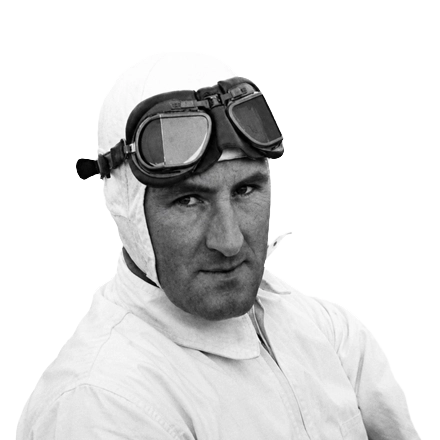
Leslie George Johnson was one of British motorsport’s great gentlemen adventurers — a gifted all-round racer and successful businessman whose career spanned rallies, hill climbs, endurance and Grand Prix racing during the golden years of post-war motorsport. Born on 22 March 1912 in Walthamstow, then one of London’s poorest districts, Johnson rose from modest beginnings to become a central figure in British racing.
Driver Bio
| Nationality | British |
| Birthplace | Walthamstow, London |
| Born | 22 March 1912 |
| Died | 8 June 1959 (aged 47) Foxcote, Gloucestershire |
| First Grand Prix | 1950 British Grand Prix |
| Last Grand Prix | 1950 British Grand Prix |
| Years Active | 1950 |
| Current/Last Team | ERA |
His early life was shaped by hardship and responsibility. After the death of his father, a cabinet maker who had only recently started his own business, the teenage Johnson found himself helping support his mother and younger brother while taking charge of the struggling family firm. Under his guidance, the business flourished. Employees responded to his famously compassionate and loyal management style with enormous dedication, helping Johnson build the successful furniture manufacturing empire that would later finance his racing career.
Despite becoming one of Britain’s most admired drivers, Johnson never treated motorsport as his sole profession. Business always remained his primary focus, and he balanced racing with an expanding commercial career throughout his life. He also battled serious health problems from an early age. Childhood nephritis and acromegaly had permanently damaged his heart and kidneys, conditions that increasingly affected him as he grew older. Yet even with deteriorating health, Johnson continued to compete at the highest levels of international motorsport.
When racing resumed after the Second World War, Johnson quickly established himself as a remarkably versatile competitor. He progressed from rallies and hill climbs into sports car racing and Grand Prix machinery, impressing leading contemporaries such as Raymond Sommer and Louis Chiron with his speed and composure behind the wheel.
Johnson became particularly renowned in endurance racing. Across the late 1940s and early 1950s, he competed in five 24 Hours of Le Mans, two Spa 24 Hours races and four Mille Miglias.
His achievements with British manufacturers were especially significant. Johnson delivered Aston Martin’s first major post-war international victory and also secured the first important competition successes for Jaguar’s revolutionary XK120, both in Britain and the United States. His close friendship with Jaguar founder William Lyons even saw him lend his own BMW 328 to Jaguar engineers for detailed study during the development of the XK120 — a small but fascinating contribution to one of Britain’s most iconic sports cars.
Johnson was equally influential away from the driver’s seat. Following the war, he acquired the famous British racing manufacturer English Racing Automobiles (ERA), helping preserve one of Britain’s most historic racing marques during a difficult period. He also played a key role in the commercial evolution of the sport by negotiating Stirling Moss’s first major sponsorship agreement with Shell — a groundbreaking move at the time.
Among Johnson’s many close friendships was Mercedes-Benz engineering mastermind Rudolf Uhlenhaut, and Johnson became known for his love of sophisticated German machinery, owning several Mercedes road cars including the legendary 300SL Gullwing.
As a single-seater racer, Johnson competed with Delage, Talbot-Lago and ERA machinery between 1946 and 1950. His first outing in a true Grand Prix car came in the 1946 Ulster Trophy at Ballyclare, driving an ageing but famous Delage previously raced by Earl Howe, Dick Seaman and Prince Bira. After a disastrous start caused by clutch failure left him hundreds of yards behind, Johnson fought his way through the field to fourth place before mechanical trouble forced his retirement — an early glimpse of both his skill and the chronic unreliability that often haunted his racing career.
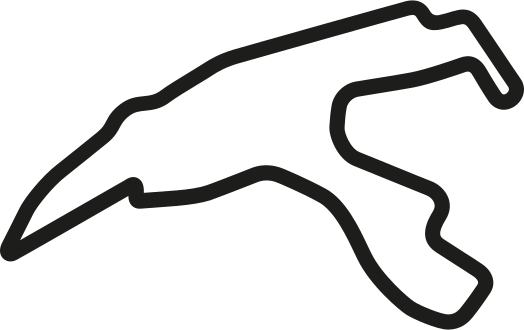
In 1947 he entered several Grands Prix with an ex-Louis Chiron Talbot-Lago T150C, ingeniously converting the same car between sports car and single-seater specification simply by removing the mudguards. His performances included sixth place in the Jersey International Road Race and seventh in the Belgian Grand Prix at Spa.
That same year, tragedy struck during the Swiss Grand Prix at Bern. Following the death of a spectator during practice involving Achille Varzi, Johnson himself lost control under braking during the race weekend, with his Talbot-Lago sliding into spectators and killing two people. Deeply affected by the accident, he withdrew from the event.
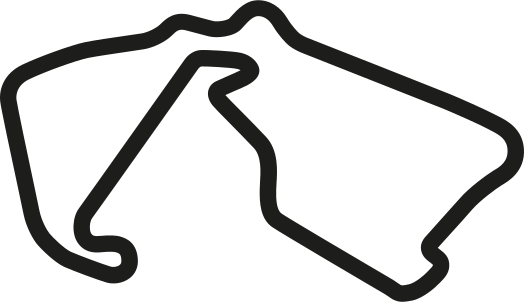
Johnson’s acquisition of ERA in late 1947 led to some of the most ambitious years of his racing career. Driving the powerful but fragile ERA E-Type, he regularly demonstrated front-running speed — taking pole position and a lap record at the Grand Prix du Salon at Montlhéry, as well as sharing fastest lap honours at the British Empire Trophy. Yet mechanical failures repeatedly denied him major results. At the 1948 British Grand Prix at Silverstone, he qualified near the front and briefly challenged Louis Chiron for the lead before a catastrophic driveshaft failure left the car trailing flames and smoke around the circuit.
He continued competing in Grand Prix events through Britain’s first World Championship years, recording podium finishes at Goodwood and the British Empire Trophy, but the ERA’s unreliability remained a constant frustration. The ambitious G-Type ERA project that followed ultimately failed to fulfil expectations, even later in the hands of Stirling Moss.
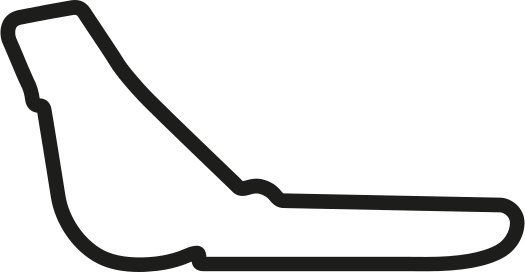
In 1951 Johnson was due to drive BRM’s fearsome 600-horsepower V16 machine at Monza, but missed an early-morning test session. Hans Stuck took over the drive instead, only for the car to suffer engine failure before the race itself.
By 1954 Johnson’s worsening heart condition forced him to retire permanently from competitive motorsport. He moved to a Gloucestershire farm with his family while continuing to oversee his engineering company, Prototype Engineering, which manufactured precision components for Britain’s developing nuclear industry. In later years he also developed a strong passion for horse racing and became an owner of several racehorses.
Those who knew Johnson remembered him not only as a talented racer, but as an exceptionally kind and principled man. Photographer Guy Griffiths famously described him as “quite the most charming, friendly, unassuming and courteous man in motor racing,” praising both his stoicism and the loyalty he showed to employees and friends alike. Even while suffering through severe illness late in life, Johnson reportedly never complained.
He was married to the widow of Anglo-French driver Pierre Maréchal and became stepfather to her son, Christian Maréchal, who later became known as an aviation pioneer and journalist.
Leslie Johnson died on 8 June 1959 at Foxcote House in Gloucestershire, aged just 46. Though often overlooked beside some of the bigger names of his era, he remains one of Britain’s most admired post-war racing figures — a brilliant all-round competitor whose integrity, generosity and understated courage earned him enormous respect throughout the motorsport world.
Grand Prix Stats
| Race Entries | 1 |
| Race Starts | 1 |
| Did Not Start | 0 |
| Best Race Start | Retired |
| Best Race Finish | Retired |
| Retirements | 1 |
| First-Lap Retirements | 0 |
| Not Classified | 0 |
| Disqualified | 0 |
| Did Not Qualify | 0 |