


























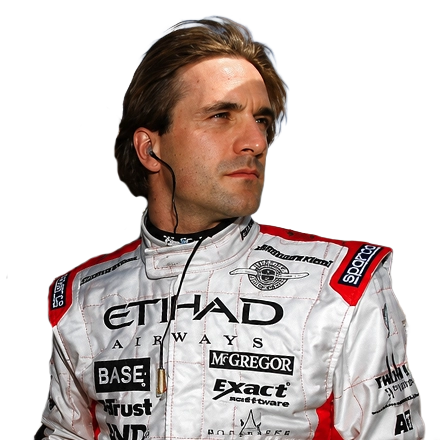
Born on 13 June 1980 in Stuttgart, Markus Winkelhock has built one of motorsport’s most fascinating and unconventional careers — a driver who turned a single unforgettable Formula One appearance into a lasting reputation across touring cars and endurance racing. The son of former Formula One racer Manfred Winkelhock and nephew of Grand Prix driver Joachim Winkelhock, motorsport was firmly embedded in the family DNA long before Markus ever climbed into a cockpit.
Driver Bio
| Nationality | German |
| Birthplace | Stuttgart, Germany |
| Born | 13 June 1980 |
| First Grand Prix | 2007 European Grand Prix |
| Last Grand Prix | 2007 European Grand Prix |
| Years Active | 2007 |
| Current/Last Team | Spyker |
Winkelhock’s rise through the junior ranks was rapid and impressive. Between 1998 and 2000, he collected victories across Formula König, German Formula Renault and the Formula Renault Eurocup, quickly establishing himself as one of Germany’s brightest young prospects.
In 2001, he stepped into the ultra-competitive German Formula 3 Championship, where he immediately made an impact by finishing fifth overall with three victories. He remained in the category as it evolved into the Formula 3 Euro Series, finishing seventh in 2002 with another win before delivering his strongest campaign in 2003, ending the year fourth overall after adding two more victories to his tally. Consistently quick and aggressive behind the wheel, Winkelhock developed a reputation for raw speed and racecraft.
His first move into touring cars came in 2004 with Mercedes in the DTM championship. Driving for the Persson team in an AMG-Mercedes CLK, however, proved frustrating. The season failed to produce a single point, and Winkelhock soon decided to return to single-seater racing in search of unfinished business.
That opportunity arrived in 2005 when he joined the World Series by Renault with Draco Racing. The season showcased both his talent and his fiery edge. Winkelhock claimed three victories and regularly fought at the front, although his campaign also included several dramatic moments — most notably crashing in Monaco during qualifying and again on the opening lap of the race itself. Even so, his pace was enough to attract the attention of Formula One.
In January 2006, Midland F1 signed Winkelhock as its test and reserve driver. Throughout the season, he appeared in Friday practice sessions at Bahrain, Australia, Germany and Hungary, gaining valuable Grand Prix experience while waiting for a full-time opportunity. When Midland transformed into Spyker F1 for 2007, Winkelhock retained his role with the team while also making a brief return to DTM competition.
Then came the race that would immortalise his name in Formula One folklore.
Formula One
After Spyker dropped Christijan Albers midway through the 2007 season, Winkelhock was handed a shock one-race call-up for the European Grand Prix at the Nürburgring. The agreement was temporary — Sakon Yamamoto was already lined up to take the seat afterwards — but Winkelhock suddenly had the chance to compete in his first Formula One Grand Prix.
What followed was chaos, brilliance and one of the strangest stories the sport has ever seen.
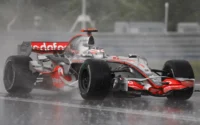
Starting last on the 22-car grid alongside teammate Adrian Sutil, Winkelhock and Spyker made a bold gamble before the start. As the rest of the field lined up on dry tyres, Spyker called him into the pits at the very last moment to fit full wet tyres, gambling on incoming rain. Moments later, the heavens opened.
As nearly the entire field scrambled into the pits at the end of lap one, Winkelhock surged into the lead. In scenes that stunned commentators and fans alike, the rookie Spyker driver — making his Formula One debut in one of the slowest cars on the grid — suddenly found himself leading a Grand Prix by nearly 20 seconds. At one stage, his advantage stretched to 33 seconds over Felipe Massa’s Ferrari. He even overtook Kimi Räikkönen on track while the Ferrari driver cautiously tiptoed toward the pit lane.
The worsening weather forced race officials to deploy the safety car before eventually red-flagging the event altogether after multiple crashes and spins at the opening corner. Thanks to the suspension and restart procedure, Winkelhock achieved one of Formula One’s strangest statistical feats: he became the only driver in history to start both last and first on the grid in the same Grand Prix. He also remains the only driver to lead his debut Formula One race after starting from the very back of the field.
When the race resumed on a drying circuit, Spyker gambled once more by keeping him on full wet tyres, hoping for another downpour. This time, the risk did not pay off. Faster cars quickly swept past, and on lap 15, Winkelhock retired with hydraulic failure that triggered a small fire in the car. His Formula One career lasted just a single race — but he had led six laps and created a moment still remembered as one of modern F1’s great underdog stories.
Despite the remarkable drive, Spyker opted not to retain him for the rest of the season, choosing Sakon Yamamoto instead.
Winkelhock returned to DTM in 2008 with Team Rosberg and remained a regular presence in the series through 2010, steadily rebuilding his career in touring cars. But it was endurance and GT racing where he truly found his long-term home.
In 2011, he joined All-Inkl.com Münnich Motorsport in the FIA GT1 World Championship alongside team owner Marc Basseng. Driving a Lamborghini initially, the pair became one of the championship’s strongest combinations. The following year, after the team switched to the Mercedes-Benz SLS AMG due to regulation changes, Winkelhock and Basseng captured the 2012 FIA GT1 World Championship title — one of the biggest successes of his professional career.
Although he was originally set to join Münnich Motorsport’s World Touring Car Championship programme in 2013, Winkelhock ultimately stepped away before the season began to focus fully on GT and endurance racing. It proved to be the right decision.
Over the following years, he became a familiar and respected figure in the Blancpain Endurance Series and international GT competition, cementing a reputation as a dependable, experienced and technically sharp endurance racer. One of the crowning moments of this phase of his career came in 2017 when he won the legendary 24 Hours of Nürburgring — one of the toughest endurance races in the world.
Grand Prix Stats
| Race Entries | 1 |
| Race Starts | 1 |
| Did Not Start | 0 |
| Best Race Start | – |
| Best Race Finish | – |
| Retirements | 1 |
| First-Lap Retirements | 0 |
| Not Classified | 0 |
| Disqualified | 0 |
| Did Not Qualify | 0 |
Qualifying
| Qualifying Sessions | 1 |
| Reached Q3 | 0 |
| Q2 Eliminations | 0 |
| Q1 Eliminations | 1 |
| Did Not Qualify | 0 |
Stats by Season
| Year | Constructor | Entries | Starts | Wins | Podiums | Poles | Fastest Laps | Front Rows | DNF | Best Start | Best Result | Pts Finishes | Points | Championship |
|---|---|---|---|---|---|---|---|---|---|---|---|---|---|---|
| 2006 | Midland* | 0 | 0 | 0 | 0 | 0 | 0 | 0 | 0 | – | – | 0 | 0 | NC |
| 2007 | Spyker | 1 | 1 | 0 | 0 | 0 | 0 | 0 | 1 | – | – | 0 | 0 | NC |
Stats by Constructor
| Constructor | Years | Entries | Starts | Wins | Podiums | Poles | Fastest Laps | Front Rows | DNF | Best Start | Best Result | Pts Finishes | Points |
|---|---|---|---|---|---|---|---|---|---|---|---|---|---|
| Midland* | 2006 | 0 | 0 | 0 | 0 | 0 | 0 | 0 | 0 | – | – | 0 | 0 |
| Spyker | 2007 | 1 | 1 | 0 | 0 | 0 | 0 | 0 | 1 | – | – | 0 | 0 |
Teammates & Qualifying Head-to-Head
| Teammate | Years | Races | Qualifying H2H |
|---|---|---|---|
| Adrian Sutil | 2007 | 1 | 0-1 |