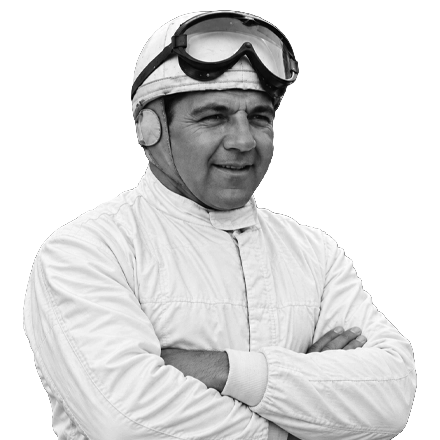
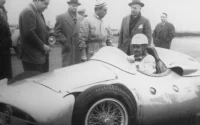
Paul Frank Russo, born on 10 April 1914, built his racing reputation in midgets before becoming a long-serving American championship-car driver. He began midget competition in 1934, raced in Hawaii during 1934–35 and won the AAA Eastern title in 1938.
Russo belonged to the group of Midwestern racers known as the Chicago Gang, alongside figures including Emil Andres, Tony Bettenhausen, Duke Nalon, Cowboy O’Rourke, Jimmy Snyder and Wally Zale. His first Nutley victory came in 1938, during the period when midget racing was supplying both experience and opportunities to ambitious American drivers.
His AAA and USAC championship career stretched across seasons from 1940 to 1962, interrupted by the war and later gaps in his programme. Across 81 starts, he recorded 49 top-ten finishes and victories at Springfield in 1950 and Detroit in 1951. He also won a non-championship race at Williams Grove in 1952.
Indianapolis supplied his best-known results. In 1955 he shared the second-placed car with Bettenhausen. His strongest finish without sharing came in 1957, when he brought a Novi home fourth. The powerful Novi machinery became an important part of his association with the Speedway.
Because the Indianapolis 500 counted towards the World Drivers’ Championship during that period, Russo also appears in the championship records. Eight such appearances brought one shared podium, a fastest lap and 8.5 points. These were Indianapolis results, rather than starts in conventional Formula One Grands Prix.
Racing extended through the family: his brother Joe Russo and nephew Eddie Russo also competed. Russo died on 13 February 1976 while off Clearwater, Florida, during a trip connected with the Daytona 500. He was buried at Crown Hill Cemetery in Indianapolis, the city most closely associated with the biggest races of his career. His record preserves a substantial contribution to American racing well beyond the championship points attributed to the 500.