






















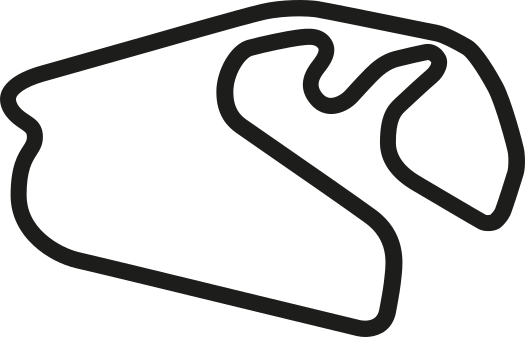







Located in the East Parklands beside Adelaide’s central business district, the Adelaide Street Circuit is one of Australia’s most iconic temporary racing venues.
Built on public roads around Victoria Park and the surrounding parklands, the circuit became famous for hosting the Formula One Australian Grand Prix during the final decade of the 20th century. Combining long straights, heavy braking zones and fast sweeping corners, Adelaide delivered dramatic season finales and some of the most memorable moments in Formula One history.
Today, the venue continues to play a major role in Australian motorsport, hosting the Adelaide 500 for the Supercars Championship and preparing to welcome MotoGP in the future.
See also…
Adelaide Street Circuit
| First Grand Prix | 1985 Australian Grand Prix |
| Number of Laps | 81 |
| Circuit Length | 3.780 km |
| Race Distance | 306.180 km |
| Lap Record | 1:15.381 Damon Hill (1993) |
Circuit
When was the Adelaide Street Circuit built?
The Adelaide Street Circuit was constructed in 1985 after the city secured the rights to host the Australian Grand Prix as part of the Formula One World Championship.
Located in the Adelaide Parklands surrounding Victoria Park Racecourse, the circuit used a network of public roads that were temporarily closed and transformed into a racing facility each year. The layout measured 3.780 km and featured 16 turns, blending tight street-style corners with high-speed sections.
All of the circuit infrastructure — including grandstands, barriers and pit facilities — was temporary and assembled specifically for race week before being dismantled afterwards.
The track was largely flat but included a mix of sweeping bends and long straights, producing fast lap times and multiple overtaking opportunities. During the turbo era of Formula One in the late 1980s, cars reached speeds exceeding 320 km/h (200 mph) on the long Dequetteville Terrace straight, making Adelaide one of the fastest street circuits of its time.
What are the key features of the circuit?
One of the most famous sections of the circuit is the Senna Chicane at the end of the pit straight, named in honour of Ayrton Senna after his death in 1994.
Beyond the chicane, drivers climbed slightly uphill along Wakefield Road before navigating a sequence of right-angled corners through the parklands. Another defining feature was the long Dequetteville Terrace straight — later known as Brabham Straight — which led to a heavy braking zone at the Britannia Roundabout hairpin.
Fast sweeping corners such as Brewery Bend and the flowing sections through the parklands rewarded commitment and precision, making Adelaide a demanding but popular track among drivers.
When was the first Australian Grand Prix at Adelaide?
The first Australian Grand Prix at the Adelaide Street Circuit took place in 1985, marking the race’s debut on the Formula One calendar.
For eleven seasons, from 1985 to 1995, Adelaide hosted the final race of the Formula One World Championship. The circuit quickly gained a reputation for dramatic title deciders and unpredictable races.
Several championships were decided at Adelaide, including Alain Prost’s 1986 title victory and Nigel Mansell’s famous tyre failure in the same race. The venue also hosted the controversial and rain-soaked 1994 championship finale, where Michael Schumacher and Damon Hill collided while battling for the title.
The final Formula One race at Adelaide was held in 1995, after which the Australian Grand Prix moved to Melbourne’s Albert Park Circuit beginning in 1996.
Adelaide Street Circuit lap record
The official Formula One race lap record at the Adelaide Street Circuit is 1:15.381, set by Damon Hill driving the Williams FW15C during the 1993 Australian Grand Prix.
Although Formula One no longer races in Adelaide, the circuit remains a central part of Australian motorsport. A shorter layout has been used for the Adelaide 500 touring car event since 1999, and a modified version of the track is scheduled to host the Australian Motorcycle Grand Prix from 2027, continuing the city’s long tradition of major international racing.