






















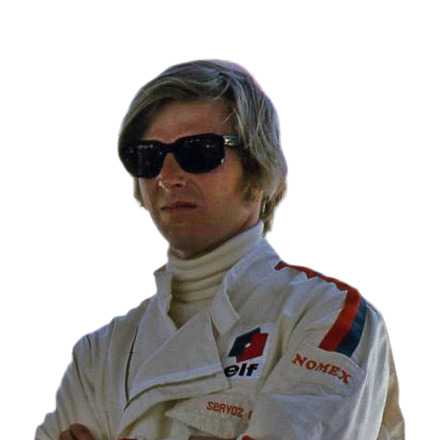
Georges-Francis “Johnny” Servoz-Gavin was one of the most intriguing and unconventional personalities of Formula One’s late-1960s era — a gifted French racer whose career burned brightly and briefly before he walked away from the sport at just 28 years old.
Driver Bio
| Nationality | French |
| Birthplace | Grenoble, France |
| Born | 18 January 1942 |
| Died | 29 May 2006 |
| First Grand Prix | 1967 Monaco Grand Prix |
| Last Grand Prix | 1970 Monaco Grand Prix |
| Years Active | 1967–1970 |
| Current/Last Team | Tyrrell |
Born in Grenoble, France, in the shadow of the Alps, Servoz-Gavin grew up surrounded by mountains and adventure. Before motorsport took over his life, he worked as a ski instructor during his teenage years, a period in which he picked up the nickname “Johnny” — a name that would stay with him throughout his racing career.
Tall, charismatic, stylish, and effortlessly cool, Servoz-Gavin quickly developed a reputation as one of racing’s great free spirits. But behind the glamour was a driver with genuine pace, sharp instincts, and a fearless edge that made him one of France’s brightest prospects during a golden age of motorsport.
From Rallying to Rising Star
Servoz-Gavin’s early motorsport work included helping Matra develop sports cars, giving him valuable engineering experience alongside his growing driving career.
Like many European drivers of the era, he initially competed in rallying before switching his focus to single-seater racing. He attended the famous racing school at Magny-Cours — although legend has it he was eventually “thrown out” — a story that only added to his rebellious image.
In 1965, he entered the French Formula Three Championship driving a privately run Brabham BT18. His raw speed soon attracted attention, and by the late 1960s he was regarded as one of France’s emerging stars alongside drivers such as Jacky Ickx and Jean-Pierre Beltoise.
In 1966, Servoz-Gavin became French Formula Three Champion driving the works Matra MS5, firmly establishing himself as one of Europe’s top young talents. Three years later, he added another major title to his résumé by winning the 1969 European Formula Two Championship — at the time considered the final proving ground before Formula One stardom.
Formula One Career
Servoz-Gavin’s Formula Three performances earned him a place with Matra in Formula One, where his blend of speed and flamboyance quickly made an impression.
Between 1967 and 1970, he entered 13 Formula One World Championship Grands Prix, qualifying for all but one and scoring a total of nine championship points. Much of his Formula One career came with the Tyrrell organisation, where he often partnered Jackie Stewart, one of the greatest drivers of the era.
His breakthrough season came in 1968. Driving for Matra, Servoz-Gavin delivered the strongest performances of his Formula One career and showed flashes of brilliance against elite competition.
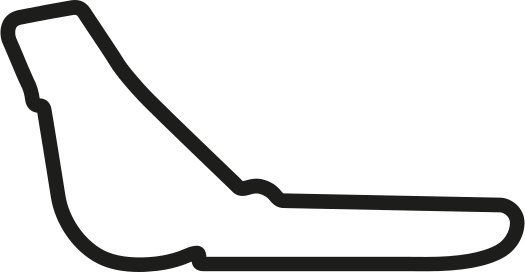
One of his standout drives came at the 1968 Italian Grand Prix at Monza, where he finished second to secure the only podium finish of his Formula One career. The result earned him six championship points and confirmed his reputation as a driver capable of competing at the front.
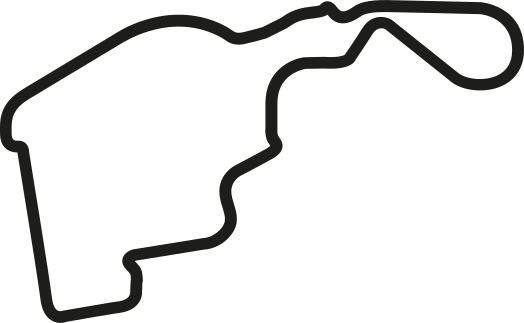
Earlier that same season, he had turned heads at the Monaco Grand Prix after stepping in as Jackie Stewart’s replacement. Against expectations, Servoz-Gavin qualified on the front row of the grid and launched brilliantly at the start, leading Graham Hill into the opening stages of the race.
However, Monaco’s unforgiving barriers would cut his race short. After clipping the wall, he broke a driveshaft in an accident eerily reminiscent of the crash that had killed Lorenzo Bandini at the circuit the previous year. It was another reminder of just how dangerous Formula One remained during the late 1960s.
The Driver Who Made Four-Wheel-Drive History
In 1969, Servoz-Gavin added one of the sport’s most unusual records to his name.
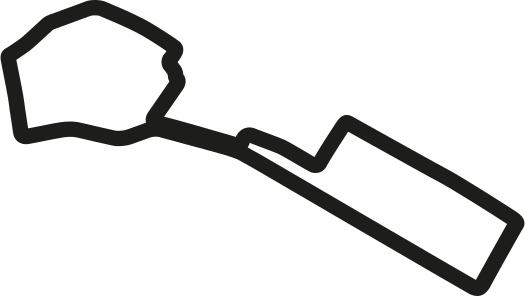
Driving the experimental four-wheel-drive Matra MS84 at the Canadian Grand Prix at Mosport Park, he finished sixth and scored a single championship point. That result made him the only driver in Formula One history ever to score a World Championship point in a four-wheel-drive Formula One car.
The achievement remains one of the quirkiest and most unique statistical footnotes in Grand Prix racing history.
Alongside his Formula One commitments, Servoz-Gavin also competed in endurance racing for Matra during 1969, partnering with Mexican star Pedro Rodríguez in sports car events.
A Sudden Retirement
By the end of the 1969 season, Servoz-Gavin’s career appeared to be heading upward. But away from the racetrack, concerns were beginning to grow.
During the winter of 1969–70, he suffered an eye injury while competing in an off-road event. Although the damage was not catastrophic, Servoz-Gavin became increasingly worried that his vision had been affected — a terrifying prospect for a Formula One driver competing at extreme speeds.
In 1970, now driving a March 701 for Tyrrell, he managed to finish fifth at the Spanish Grand Prix at Jarama, although he was also the final classified finisher in the race.
Soon afterwards, another crash at Monaco proved decisive. After hitting the barriers again and failing to qualify for the 1970 Monaco Grand Prix, Servoz-Gavin made the shocking decision to retire from Formula One entirely at the age of just 28.
He later explained that the dangers of Formula One no longer felt worthwhile. While concerns about his eyesight likely influenced the choice, there was also a growing sense that he no longer wished to gamble his life in a sport where fatalities had become tragically common.
In an era when many drivers continued despite immense risks, Servoz-Gavin’s decision to walk away voluntarily was highly unusual — and perhaps remarkably wise.
Life Beyond Racing
Even after leaving motorsport, Servoz-Gavin remained a fascinating figure within racing circles. Handsome, sophisticated, and deeply connected to Europe’s high-society lifestyle, he became part of Formula One folklore in unexpected ways.
For years, rumours circulated that he was the mystery driver featured in Claude Lelouch’s legendary 1977 short film C’était un rendez-vous — the infamous high-speed drive through the streets of Paris filmed at dawn. Lelouch always claimed he drove the car himself, but speculation surrounding Servoz-Gavin’s involvement persisted for decades.
Following his racing career, he adopted a quieter and more unconventional lifestyle, living aboard a houseboat. In 1982, tragedy struck again when a gas bottle exploded onboard, leaving him with serious burns.
Final Years and Death
In later life, Servoz-Gavin largely stayed away from the spotlight as his health declined. He died on 29 May 2006 from a pulmonary embolism following a period of illness. He was 64 years old.
Grand Prix Stats
| Race Entries | 12 |
| Race Starts | 11 |
| Did Not Start | 0 |
| Best Race Start | 2nd |
| Best Race Finish | 2nd |
| Retirements | 6 |
| First-Lap Retirements | 0 |
| Not Classified | 1 |
| Disqualified | 0 |
| Did Not Qualify | 1 |
Podiums
| Podiums | 1 |
| First Podium | 1968 Italian Grand Prix |
| Last Podium | 1968 Italian Grand Prix |
| 1st Place | 0 |
| 2nd Place | 1 |
| 3rd Place | 0 |
| Most Consecutive Podiums | 0 |
| Most Podiums in a Single Season | 1 (1968) |
| Seasons with Podiums | 1 |
Qualifying
| Qualifying Sessions | 12 |
| Reached Q3 | – |
| Q2 Eliminations | – |
| Q1 Eliminations | – |
| Did Not Qualify | 1 |
Points
| Points Scored | 9 |
| Points Finishes | 3 |
| Most Points in a Single Season | 6 (1968) |
| Seasons with Points | 3 |
Front Row Starts
| Front Row Starts | 1 |
| Poles | 0 |
| 2nd on Grid | – |
| Most Front Row Starts in a Season | 1 |
| Seasons with Front Row Starts | 1 |
Stats by Season
| Year | Constructor | Entries | Starts | Wins | Podiums | Poles | Fastest Laps | Front Rows | DNF | Best Start | Best Result | Pts Finishes | Points | Championship |
|---|---|---|---|---|---|---|---|---|---|---|---|---|---|---|
| 1967 | Matra | 1 | 1 | 0 | 0 | 0 | 0 | 0 | 1 | 11 | – | 0 | 0 | NC |
| 1968 | Matra / Cooper | 5 | 5 | 0 | 1 | 0 | 0 | 1 | 4 | 2 | 2 | 1 | 6 | 13th |
| 1969 | Matra | 3 | 3 | 0 | 0 | 0 | 0 | 0 | 0 | 14 | 6 | 1 | 1 | 16th |
| 1970 | Tyrrell | 3 | 2 | 0 | 0 | 0 | 0 | 0 | 1 | 14 | 5 | 1 | 2 | 19th |
Stats by Constructor
| Constructor | Years | Entries | Starts | Wins | Podiums | Poles | Fastest Laps | Front Rows | DNF | Best Start | Best Result | Pts Finishes | Points |
|---|---|---|---|---|---|---|---|---|---|---|---|---|---|
| Matra | 1967 | 1 | 1 | 0 | 0 | 0 | 0 | 0 | 1 | 11 | – | 0 | 0 |
| Matra | 1968–1969 | 7 | 7 | 0 | 1 | 0 | 0 | 1 | 3 | 2 | 2 | 2 | 7 |
| Cooper | 1968 | 1 | 1 | 0 | 0 | 0 | 0 | 0 | 1 | 15 | – | 0 | 0 |
| Tyrrell | 1970 | 3 | 2 | 0 | 0 | 0 | 0 | 0 | 1 | 14 | 5 | 1 | 2 |
Teammates & Qualifying Head-to-Head
| Teammate | Years | Races | Qualifying H2H |
|---|---|---|---|
| Jean-Pierre Beltoise | 1967, 1969 | 5 | – |
| Vic Elford | 1968 | 1 | – |
| Jackie Stewart | 1968, 1970 | 10 | – |