























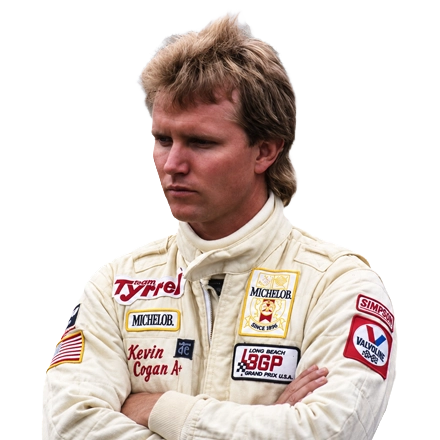
Kevin Cogan came close to winning the Indianapolis 500, won a CART race and twice finished sixth in the championship. Yet his name became disproportionately associated with the accident before the start of the 1982 Indianapolis race. His career contains much more than that controversial moment, including rapid early progress, serious injuries and a succession of difficult comebacks.
Driver Bio
| Nationality | American |
| Birthplace | Culver City, California, USA |
| Born | 31 March 1956 |
| First Grand Prix | 1980 Canadian Grand Prix |
| Last Grand Prix | 1981 United States Grand Prix West |
| Years Active | 1980–1981 |
| Current/Last Team | Tyrrell |
Born in Culver City, California, on 31 March 1956, Cogan graduated from West Torrance High School in 1974. His early ambitions included Formula One. He attempted to qualify a RAM-entered Williams for the 1980 Canadian Grand Prix and a Tyrrell at Long Beach in 1981, but neither attempt produced a start. His lasting opportunities would come in American single-seaters.
Indianapolis in 1981 provided an immediate breakthrough. Driving Jerry O’Connell’s Sugaripe-sponsored Phoenix PR01 with Cosworth power, Cogan qualified twelfth and finished fourth, completing 197 laps. Josele Garza received Rookie of the Year honours, but Cogan had delivered an excellent result on his first appearance in the race.
His CART debut at Milwaukee was similarly encouraging: seventh in qualifying and second in the race. Further points finishes followed, although a limited programme left him 23rd in the championship. The separate USAC standings were complicated by a licence issue that prevented him receiving Indianapolis points that year. Whatever the administrative position, his performances had attracted the attention of a leading team and created the opportunity for a much more complete championship campaign.
Roger Penske hired Cogan for Team Penske in 1982. Driving a Norton-sponsored PC10, he finished third at Phoenix and later second at Pocono, while pole positions at Cleveland and Riverside demonstrated his outright speed. He ended the season sixth in the championship, with team-mate Rick Mears taking the title. It was a strong year on paper, but one event came to dominate how it was remembered.
At Indianapolis, Cogan qualified in the centre of the front row. His best lap was 204.638mph and his four-lap average 204.082mph, beaten only by Mears. A. J. Foyt completed the front row. Cogan had arrived at the start with a genuine opportunity to contend in the most important race of the American season.
As the field approached the green flag, his car moved across and struck Foyt’s, then became involved with Mario Andretti. The chain reaction eliminated several cars, including those of Dale Whittington and Roger Mears, and brought out the red flag. Bobby Rahal was also caught in the incident but escaped serious damage. Foyt’s crew repaired his car so he could take the restart.
The immediate response was fierce. Foyt and Andretti criticised Cogan, and the young driver found himself at the centre of an unusually public dispute. Penske supported him, with a possible driveline failure among the explanations discussed. The precise cause was never conclusively established, and later accounts offered differing interpretations of what had happened in the compressed field.
Gordon Johncock, Johnny Rutherford and Bobby Unser were among those who discussed the pace and positioning of the cars before the start. The slow approach, the relationship between the rows and the behaviour of the leading cars all became part of the debate. A failed constant-velocity joint was suggested, as were other mechanical or handling explanations. None should be treated as a settled finding.
Rodger Ward, commentating for the Speedway’s radio network, initially suspected that the rear brakes had locked. Drivers in turbocharged cars sometimes used the brakes during warm-up while keeping engine speed up, so it was a technically different explanation from a broken joint. Television analyst Sam Posey was also unable to identify a definite cause. His description of how suddenly the car changed direction added to the immediate uncertainty, rather than providing evidence that the movement had been deliberate. Cogan himself examined the rear of the car after getting out, consistent with his concern that a component might have failed.
For Cogan, the practical consequence was that an entire career became linked to a few seconds of film. His subsequent results in 1982 showed that he remained competitive, but Penske replaced him with Al Unser for 1983.
There was another layer to the reaction: Penske and Patrick Racing had already been central to the controversy surrounding the 1981 Indianapolis result. With Andretti involved again, the new accident reopened arguments between people who had disputed the previous year’s outcome. Cogan was caught in a much larger and already heated paddock story. The accident did not end his racing career; it did, however, follow him through the opportunities that came afterwards.
He joined Bignotti-Cotter for 1983, driving a March 83C alongside Tom Sneva. Fifth at Indianapolis was his best result of the year, while Sneva won the race.
The March carried Master Mechanic and Caesars Palace sponsorship, normally using number 6 but appearing as number 16 at Indianapolis. Bignotti-Cotter’s subsequent development work centred on the Theodore 83, replacing attention that might otherwise have gone into the proven March. For a driver trying to consolidate his place after losing a leading seat, that change created another variable in an already difficult year. Development work involving Theodore machinery complicated the programme, and Cogan finished 15th in the CART standings and sixth in USAC’s championship. When George Bignotti sold his interest to Dan Cotter, Cogan was not retained.
The 1984 season involved several teams and cars. With Curb Racing, he qualified a Ligier LC02 21st at Long Beach but was classified 28th. An Eagle 84SB with Pontiac power brought eighth at Phoenix in an All American Racers entry. The shifting combinations made it difficult to build a settled campaign.
Indianapolis presented another change. The Ligier proved uncompetitive, and Cogan faced the possibility of failing to qualify. After Ligier and Curb parted company, and Michael Chandler suffered serious injuries in the Eagle, a route into the other car opened. Mike Curb and Dan Gurney combined their efforts as Curb-All American Racers, allowing Cogan to attempt qualification in the Eagle.
He qualified 27th, setting a new Indianapolis speed record for stock-block engines. The race ended after 137 laps when a wheel froze, leaving him 20th. The episode neatly illustrated the instability of his season: substantial effort and a notable qualifying achievement had produced neither a settled programme nor a strong finish.
After Cleveland, he left Curb-All American Racers and joined Forsythe Racing in a March 84C. The initial results were promising. At Michigan he qualified fifth and finished eighth, then took tenth at Road America. Before the improvement could develop into a sustained run, a heavy practice accident at Pocono ended his season.
The frontal impact in turn two caused extensive injuries to both feet, including broken heels, a torn left Achilles tendon and a shattered talus bone on the right. Recovery replaced racing as his immediate task. He finished 24th in the championship, with the promising first races for Forsythe followed by another enforced interruption.
Kraco Racing provided his return in 1985, using a March 85C. Indianapolis qualification was difficult, and he made the field only in 32nd place, but climbed to eleventh in the race. Fourth at Michigan and fifth at Portland supplied further points, leaving him 14th in the final standings. It was a recovery season rather than a return to the front, but he was competing regularly again.
The Kraco Car Stereo and Wolff Systems-backed car carried number 18. His best finish came in Michigan’s Detroit News 200, while the Portland result was achieved in the Stroh’s/G.I. Joe’s 200. Those points finishes mattered because Indianapolis had begun with such a narrow escape from failing to qualify; his race recovery there was part of a wider return to regular competition after the Pocono injuries.
The move to Patrick Racing in 1986 changed that. In the 7-Eleven March 86C, Cogan won the opening Phoenix race, finishing a lap ahead of Sneva. It was his first CART victory and put him at the head of the championship for the first time. Four years after joining Penske as a major prospect, he finally had a race win in the leading American single-seater series.
Indianapolis then offered the biggest opportunity of all. With thirteen laps remaining, Mears and Rahal were delayed by Randy Lanier’s slower car. Cogan took advantage, passing both in less than a lap to seize the lead. Although his car was visibly oversteering through the corners, he pulled roughly three seconds clear.
The advantage disappeared when Arie Luyendyk crashed in turn four on lap 195 and the caution came out. Racing resumed on lap 198, but Cogan did not get away cleanly enough to protect the lead. Rahal passed him and went on to win. Cogan finished second, having come within a late restart of an Indianapolis victory.
It was still an excellent result and kept him at the top of the championship after the 500. The remainder of the season, however, brought seven retirements in fourteen races. The lost finishes steadily eroded his position, and he ended sixth overall, matching his best previous championship result from 1982.
Patrick retained him for 1987, the first time in his CART career that he continued with the same team for a second consecutive season. The equipment changed to a Marlboro-sponsored March 87C powered by the Ilmor-built Chevrolet engine. Results did not match the previous year’s promise: fifth places at Mid-Ohio and Nazareth were the highlights, and he finished 16th in the championship.
For 1988, Cogan joined Machinists Union Racing in a Cosworth-powered March 88C. Third at Long Beach showed that podium speed was still available. After seven races he was eleventh in the points, but an injury at Toronto caused him to miss four events. He returned to take fourth at Miami and finished 13th in the final standings.
The Miami result came at Tamiami Park, while the Toronto accident had occurred on the Exhibition Place circuit. Machinists Union’s cars carried Schaefer Beer and Playboy Fashions backing, and although the newer March 88C was the principal car, an older 87C was used at Milwaukee. Even within a single season, Cogan’s programme continued to involve changes of chassis and interrupted running.
He stayed with the team in 1989, continuing with the March 88C. Eighth at Laguna Seca was his best result and he finished 14th in the championship. At Indianapolis, a violent third-lap accident at the exit of turn four and the pit entrance broke the car apart. Cogan escaped serious injury, but the images added another dramatic crash to the public memory of his career.
A smaller programme followed in 1990. He drove a Buick-powered Penske PC18 for Granatelli at Indianapolis, qualifying 15th and finishing ninth. A further appearance at Michigan in a Stoops Racing Lola brought 13th on the grid and 20th in the result, leaving him 23rd in the championship standings.
In 1991 he joined Team Menard for Indianapolis in a Buick-powered Lola T91/00. Rain disrupted qualifying, and his second-day time placed him 16th even though the speed would have been competitive with the top ten on the earlier day. Once again, the qualifying schedule and the car’s actual pace told slightly different stories.
His race ended on lap 25 in an accident involving Roberto Guerrero. Cogan suffered severe injuries to his femur, arm and shoulder and underwent an operation lasting about seven and a half hours. The recovery was lengthy, and he did not race in 1992. The physical consequences of repeated major accidents were becoming an increasingly important part of his life.
Responsibility for the collision was disputed. Cogan believed Guerrero had moved down towards him, while later amateur footage gave a different perspective from the inconclusive television pictures. The available accounts did not establish a simple, universally accepted explanation.
The severity of the damage to his right leg was particularly significant: the femur had broken into four lengthwise sections near the hip. The injuries were not limited to a single limb, with the right forearm and shoulder also affected. Returning to Indianapolis two years later therefore meant recovering from several major injuries together, rather than simply waiting for one fracture to heal. As with the earlier Indianapolis controversy, describing the injury and outcome is more secure than assigning definitive blame from conflicting interpretations of the incident.
Cogan returned to Indianapolis in 1993 with Galles-Kraco Racing, driving a Lola T93/00. In a difficult qualifying meeting that left defending CART champion Rahal outside the field, Cogan secured 14th on the grid. He led four laps during the pit-stop sequence and finished 14th, completing one last Indianapolis comeback.
Three further CART appearances followed that season. His best finish was 13th at Cleveland, and he scored no championship points. He retired at the end of the year.
That final Galles-Kraco programme used Conseco sponsorship and the Ilmor-built Chevrolet engine. The combination brought him back into the Indianapolis field after a year away, but it did not become a full-season return. His last four appearances were therefore the closing stage of a comeback rather than the beginning of another sustained championship campaign. The final record included the Phoenix victory, a near-win at Indianapolis, two sixth places in the CART championship and several seasons in which injuries or unstable equipment interrupted his progress.
Away from racing, Cogan moved into property work in the Los Angeles area, including Palos Verdes Estates. He became less involved in the motorsport world, particularly after the death of Scott Brayton during Indianapolis practice in 1996. Requests for anniversary interviews about the Speedway were often declined, reflecting his preference for a quieter life outside the paddock.
A rare interview with journalist Curt Cavin in 2015 revisited both his career and the lasting effects of his accidents. Cogan described continuing physical difficulties, including problems with balance. The distance between his racing years and later life did not mean that the injuries had ceased to matter.
His family life also continued away from the sport’s regular attention. He had married Tracy, with whom he had a son, before their divorce in 2004, and later had a daughter and another son. The public career was only one part of a life that increasingly centred on family and work beyond racing.
Cogan’s best performances deserve to stand alongside the incidents that became so widely replayed. Fourth on his Indianapolis debut, two pole positions for Penske, a convincing Phoenix victory and second in the 1986 500 are substantial achievements. The unresolved arguments over 1982 should not be allowed to erase them, or to turn a disputed accident into a complete assessment of a driver.
Grand Prix Stats
| Race Entries | 2 |
| Race Starts | 0 |
| Did Not Start | 0 |
| Best Race Start | – |
| Best Race Finish | Never classified |
| Retirements | 0 |
| First-Lap Retirements | 0 |
| Not Classified | 0 |
| Disqualified | 0 |
| Did Not Qualify | 2 |
Qualifying
| Qualifying Sessions | 2 |
| Reached Q3 | 0 |
| Q2 Eliminations | 0 |
| Q1 Eliminations | 0 |
| Did Not Qualify | 2 |
Stats by Season
| Year | Constructor | Entries | Starts | Wins | Podiums | Poles | Fastest Laps | Front Rows | DNF | Best Start | Best Result | Pts Finishes | Points | Championship |
|---|---|---|---|---|---|---|---|---|---|---|---|---|---|---|
| 1980 | RAM Racing | 1 | 0 | 0 | 0 | 0 | 0 | 0 | 0 | DNQ | DNQ | 0 | 0 | Not Classified |
| 1981 | Tyrrell | 1 | 0 | 0 | 0 | 0 | 0 | 0 | 0 | DNQ | DNQ | 0 | 0 | Not Classified |
Teammates & Qualifying Head-to-Head
| Teammate | Years | Races | Qualifying H2H |
|---|---|---|---|
| Eddie Cheever | 1981 | 1 | 0-1 |