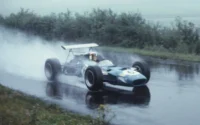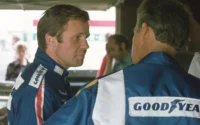



























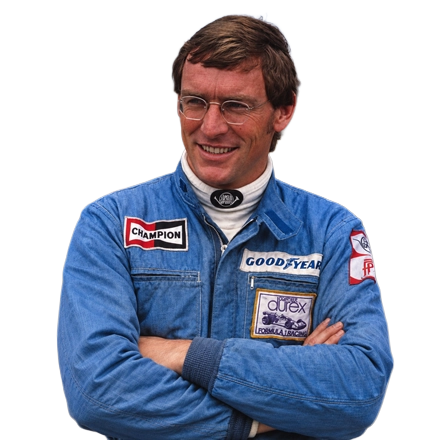
Larry Perkins combined the instincts of a racing driver with the practical understanding of an engineer. Formula One formed an early part of his international career, but six Bathurst victories and a long association with Holden made him one of Australian touring-car racing’s defining figures.
Driver Bio
| Nationality | Australian |
| Birthplace | Murrayville, Australia |
| Born | 18 March 1950 |
| First Grand Prix | 1974 German Grand Prix |
| Last Grand Prix | 1977 French Grand Prix |
| Years Active | 1974, 1976–1977 |
| Current/Last Team | Surtees |
Born in Cowangie, in Victoria’s Mallee region, on 18 March 1950, Larry Clifton Perkins grew up on a farm where mechanical skills were part of everyday life. His father Eddie had competed in the 1956 Redex Trial, and his maternal uncle George Reynolds was a Bathurst winner.
That family background connected two distinct parts of Australian competition: the long-distance demands of road trials and the emerging importance of touring-car endurance racing. Perkins’s own career would add European single-seaters, but his eventual return to Bathurst also brought him back to an event already present in the family story. Motorsport was therefore familiar well before Larry began building his own record.
In 1970 he joined Harry Firth’s Holden Dealer Team as a mechanic and driver. His activities included rallycross alongside Peter Brock and work on the V8-powered LJ Torana XU-1 project, which was abandoned during the 1972 controversy over high-performance road cars. Perkins was learning how to make racing machinery work as well as how to drive it.
Single-seaters took him abroad. He won Australia’s Formula Ford Driver to Europe award in 1971 and the Australian Formula Two Championship in 1972, using an Elfin 600. In Europe, his strongest junior result was the 1975 European Formula Three title, establishing him as a serious contender for an F1 opportunity.
His first World Championship entry had come at the 1974 German Grand Prix. Chris Amon‘s sinus problems opened a chance to drive the Amon AF101, but Perkins had little running before an accident in the second practice session ended his qualifying hopes. The ambitious but troubled car offered a difficult introduction to the category.
A more sustained opportunity arrived with Boro in 1976. Perkins finished 13th in Spain and eighth in Belgium, but failed to qualify at Monaco and retired in Sweden. Further retirements in the Netherlands and Italy preceded the end of the team’s programme. Resources were limited, and the Belgian result remained the high point.
For the final three races of 1976, Perkins replaced Carlos Reutemann at Brabham. He finished 17th in Canada, then retired in the United States and Japan. The change had brought him into a better-known team, but not the results required to establish a permanent place on the grid.
He began 1977 with BRM, whose new car was not ready for the opening race. In Brazil, Perkins qualified more than twelve seconds off the leading pace and retired after one lap. Fifteenth in South Africa, five laps down, was followed by his replacement by Conny Andersson. It was another difficult spell with a struggling operation.
Surtees offered a final series of opportunities. Perkins finished twelfth in Belgium, failed to qualify in Sweden and began practice in France before Patrick Tambay took over. His F1 career ended without points, leaving the European F3 title as a clearer indication of what he could achieve in competitive single-seater machinery.
Returning to Australia, he finished third at Bathurst in 1977 with Peter Janson in a Torana. He also drove Garrie Cooper’s factory Elfin MR8 in the 1979 Rothmans series and won an Australian rallycross championship in a Volkswagen. The range of machinery suited a driver who had never limited his interests to one form of racing.
His engineering work extended beyond conventional motorsport. In 1982 and 1983, he helped build and drive the Quiet Achiever solar car on its transcontinental Australian journey. It was a very different technical challenge from an F1 car or a Bathurst racer, but one that drew on the same practical approach to machinery and problem-solving.
Bathurst supplied his most famous sporting achievements. Perkins won with Brock in 1982, 1983 and 1984, with John Harvey also sharing the winning car in 1983. Within the Holden Dealer Team, Brock’s driving and public profile were complemented by Perkins’s substantial engineering contribution.
Three further wins came in his own era as a leading team figure: with Gregg Hansford in 1993 and Russell Ingall in 1995 and 1997, all in Holden Commodores. The 1995 race was especially memorable. A puncture on the opening lap left Perkins and Ingall at the back, but they recovered through the field and won after Glenn Seton’s engine failed with fewer than ten laps remaining.
For all his Bathurst success, Perkins never won the Australian Touring Car Championship. His best championship placing was fourth, achieved three times. That distinction matters: he was a six-time winner of Australia’s great endurance race, rather than a touring-car title winner whose record happened to include Bathurst.
International endurance racing also remained part of his story. He finished fourth at Le Mans with TWR in 1988, adding another notable result to a career that had moved repeatedly between single-seaters and sports or touring cars. He retired from driving in 2003, aged 53, and entered the V8 Supercars Hall of Fame in 2008.
Known variously as LP, Lightning Larry and Larrikin Larry, Perkins remained strongly associated with engineering and engine preparation. His son Jack also became a winning racing driver.
The engineering reputation was built through years of preparing the cars he drove, rather than added afterwards as a separate occupation. That continuity linked his early Holden Dealer Team work with the later Commodores and engine programmes carrying his own name. On 7 December 2017, the Larry Perkins Trophy was announced for the leading points scorer across the Supercars races at the Australian Grand Prix meeting.
Other pursuits retained the same practical and exploratory character. In 2018, Larry and his brother Peter located equipment abandoned during the 1904 Barclay–MacPherson expedition in the Simpson Desert, including camel water tanks and scientific items. Perkins was appointed a Member of the Order of Australia in 2021, recognition extending beyond the results sheets of a long and varied racing career.
Grand Prix Stats
| Race Entries | 15 |
| Race Starts | 11 |
| Did Not Start | 0 |
| Best Race Start | 13th |
| Best Race Finish | 8th |
| Retirements | 6 |
| First-Lap Retirements | 0 |
| Not Classified | 0 |
| Disqualified | 0 |
| Did Not Qualify | 4 |
Qualifying
| Qualifying Sessions | 15 |
| Reached Q3 | 0 |
| Q2 Eliminations | 0 |
| Q1 Eliminations | 4 |
| Did Not Qualify | 4 |
Stats by Season
| Constructor | Years | Entries | Starts | Wins | Podiums | Poles | Fastest Laps | Front Rows | DNF | Best Start | Best Result | Pts Finishes | Points |
|---|---|---|---|---|---|---|---|---|---|---|---|---|---|
| Amon | 1974 | 1 | 0 | 0 | 0 | 0 | 0 | 0 | 0 | – | – | 0 | 0 |
| Boro | 1976 | 6 | 5 | 0 | 0 | 0 | 0 | 0 | 3 | 13 | 8 | 0 | 0 |
| Brabham | 1976 | 3 | 3 | 0 | 0 | 0 | 0 | 0 | 2 | 13 | 17 | 0 | 0 |
| BRM | 1977 | 2 | 2 | 0 | 0 | 0 | 0 | 0 | 1 | 22 | 15 | 0 | 0 |
| Surtees | 1977 | 3 | 1 | 0 | 0 | 0 | 0 | 0 | 0 | 23 | 12 | 0 | 0 |
Teammates & Qualifying Head-to-Head
| Teammate | Years | Races | Qualifying H2H |
|---|---|---|---|
| Chris Amon | 1974 | 1 | – |
| Carlos Pace | 1976 | 3 | – |
| Patrick Tambay | 1977 | 1 | – |