




























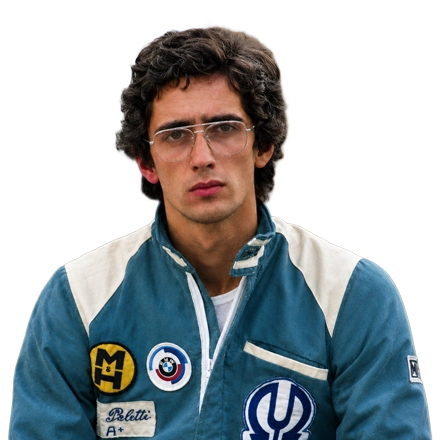
Born in Milan on 15 June 1958, Riccardo Paletti was one of Italian motorsport’s great “what if” stories — a talented young driver whose Formula One dream ended in tragedy just days before his 24th birthday.
Driver Bio
| Nationality | Italian |
| Birthplace | Milan, Italy |
| Born | 15 June 1958 |
| Died | 13 June 1982 |
| First Grand Prix | 1982 South African Grand Prix |
| Last Grand Prix | 1982 Canadian Grand Prix |
| Years Active | 1982 |
| Current/Last Team | Osella |
The son of the successful Milanese businessman Arietto Paletti and Gianna Paletti, Riccardo grew up in a wealthy, ambitious environment. His father had built a fortune in property development and also handled the Italian import business for Pioneer audio equipment — a brand that would later become closely linked to Riccardo’s racing career. But motorsport was not his only sporting talent. As a teenager, Paletti became Italy’s junior karate champion at just thirteen years old and was also talented enough on the slopes to contend for a place on the Italian national youth alpine skiing team.
His switch to racing came relatively late compared to many of his contemporaries, but he progressed quickly. In 1978, Paletti entered Formula Super Ford and immediately showed promise by leading for 18 laps in his very first race. Although he did not score a victory that season, he consistently impressed, collecting two second-place finishes and finishing third in the championship standings. Before the season was over, he had already stepped into Formula 3 machinery, making his debut in the Italian championship driving a March-Toyota.
A full Formula 3 campaign followed in 1979. Results were modest — his best finishes were a pair of fifth places — but Paletti continued to gain experience and build a reputation as a committed and technically thoughtful driver. Later that same year, he also sampled Formula 2 for the first time with Mike Earle’s team, recording an encouraging eighth-place finish at Misano.
The breakthrough came in 1981. Mike Earle ended his partnership with March and launched the new Onyx Formula 2 project, with Paletti heavily involved in winter testing and development work. The hard work paid off immediately. At the opening round at Silverstone, Paletti qualified tenth and stormed to second place behind rising New Zealander Mike Thackwell. At Hockenheim, he retired but set the fastest lap of the race, underlining his raw pace, and he followed that with another podium at Thruxton, finishing third behind Roberto Guerrero. Early in the season, he sat joint second in the championship alongside Stefan Johansson, just three points behind Thackwell.
While the second half of the campaign proved more difficult and he eventually slipped to tenth in the standings, Paletti had shown enough speed and potential to attract attention. Despite still being relatively inexperienced, he made the bold decision to step up to Formula One with Osella for 1982.
Formula One
It was a daunting move. Osella was among the smallest and least competitive teams on the grid, and Paletti openly admitted that Formula One intimidated him. Nevertheless, pressure from sponsors — particularly Pioneer — combined with the rarity of such an opportunity, convinced him to take the chance. He partnered with veteran French driver Jean-Pierre Jarier and immediately stood out for his meticulous preparation. At a time when many drivers relied almost entirely on instinct, Paletti travelled with a personal medical adviser who monitored his heart rate and blood pressure during testing and practice sessions through sensors attached to his body. Even his diet was continually adjusted based on the results — an approach that was years ahead of its time.
The reality of Formula One, however, proved brutal.
Paletti’s first attempt to qualify came at the 1982 South African Grand Prix. Jarier managed to drag the Osella onto the back row of the grid, but Paletti was nearly two seconds slower and failed to qualify. Similar frustration followed in Brazil after a suspension failure caused a wheel to detach during prequalifying, again preventing him from making the race. At Long Beach, Jarier remarkably pushed the Osella into the top ten on the grid, while Paletti missed qualification by more than three seconds.
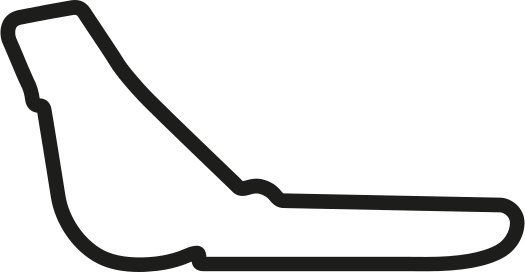
At Imola, amid the bitter FISA–FOCA political conflict that reduced the field to just 14 starters, Paletti finally made a Grand Prix start. Even then, little went smoothly. His Osella failed to fire for the warm-up lap, forcing him to start from the pits nearly 50 seconds behind the field. After circulating alone at the back, another suspension failure ended his race after only seven laps.
The struggles continued at Zolder and Monaco, where prequalifying defeats became increasingly demoralising. Osella promised improvements with a new chassis and suspension package, but the team’s resources were stretched thin. By Detroit, Paletti was finally much closer to Jarier’s pace and successfully qualified just behind his teammate. Yet more bad luck followed when he lost a wheel during warm-up. Mechanics rushed to repair the car, only for Jarier to crash his own machine and commandeer the repaired Osella, leaving Paletti sidelined once again.
Then came Montreal.
Death
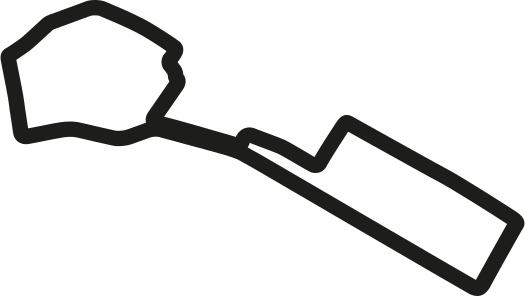
On 13 June 1982, at the Canadian Grand Prix, Paletti finally achieved what he had worked toward all season: qualification for a full Formula One grid. It would be his second Grand Prix start — and tragically, his last.
At the start, pole-sitter Didier Pironi stalled his Ferrari as the lights were unusually delayed before turning green. Drivers behind scattered desperately to avoid the stationary car. Several clipped Pironi but escaped major damage. Paletti, however, approaching at around 180 km/h, had nowhere to go. His Osella slammed violently into the rear of the Ferrari, launching it forward into the path of Geoff Lees. The front of Paletti’s car was destroyed instantly.
The impact caused catastrophic chest injuries, leaving Paletti unconscious and trapped in the wreckage. FIA medical chief Sid Watkins reached the scene quickly, but moments later, fuel ignited around the shattered Osella, engulfing the car in flames. Rescue crews eventually extinguished the fire, but extraction was agonisingly slow because cutting equipment risked reigniting fuel still spread across the circuit. After 25 minutes, Paletti was finally airlifted to Montreal’s Royal Victoria Hospital, where he died shortly after arrival. He had suffered a torn aorta along with severe leg fractures. Doctors later confirmed the injuries were unsurvivable.
Adding to the heartbreak, his mother had been watching from the grandstands. The family had planned to celebrate his 24th birthday later that week.
Paletti became the second Formula One driver killed during the dark 1982 season, following Gilles Villeneuve and his fatal accident at Zolder just weeks earlier. His death was the last time a driver died during a Formula One race until the tragic Imola weekend of 1994, when Roland Ratzenberger and Ayrton Senna lost their lives.
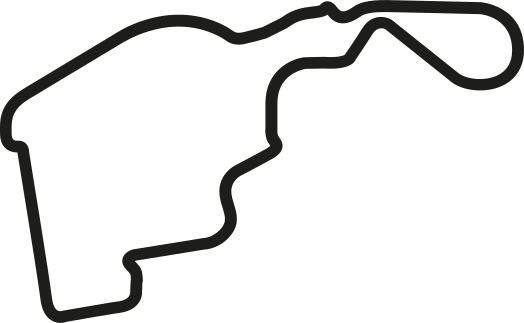
Despite his short career, Paletti’s memory remains deeply woven into Italian motorsport history. The circuit at Varano de’ Melegari was renamed the Autodromo Riccardo Paletti in his honour, while Monza’s Church of Santa Maria al Carrobiolo features a memorial chapel dedicated to him. He is buried at Milan’s Cimitero Maggiore.
Only weeks after his death, Italy’s national football team paid tribute following their 1982 World Cup victory. Players held a banner dedicated to both Villeneuve and Paletti that read: “Villeneuve, Paletti… Corriamo insieme, il terzo titolo è nostro!” — “Villeneuve, Paletti… We race together, the third title is ours.”
Grand Prix Stats
| Race Entries | 8 |
| Race Starts | 2 |
| Did Not Start | 1 |
| Best Race Start | 23rd |
| Best Race Finish | – |
| Retirements | 2 |
| First-Lap Retirements | 1 |
| Not Classified | 0 |
| Disqualified | 0 |
| Did Not Qualify | 2 |
Qualifying
| Qualifying Sessions | 8 |
| Reached Q3 | 0 |
| Q2 Eliminations | 0 |
| Q1 Eliminations | 0 |
| Did Not Qualify | 2 |
Stats by Season
| Year | Constructor | Entries | Starts | Wins | Podiums | Poles | Fastest Laps | Front Rows | DNF | Best Start | Best Result | Pts Finishes | Points | Championship |
|---|---|---|---|---|---|---|---|---|---|---|---|---|---|---|
| 1982 | Osella | 8 | 2 | 0 | 0 | 0 | 0 | 0 | 2 | 23 | n/a | 0 | 0 | NC |
Stats by Constructor
| Constructor | Years | Entries | Starts | Wins | Podiums | Poles | Fastest Laps | Front Rows | DNF | Best Start | Best Result | Pts Finishes | Points |
|---|---|---|---|---|---|---|---|---|---|---|---|---|---|
| Osella | 1982 | 8 | 2 | 0 | 0 | 0 | 0 | 0 | 2 | 23 | n/a | 0 | 0 |
Teammates & Qualifying Head-to-Head
| Teammate | Years | Races | Qualifying H2H |
|---|---|---|---|
| Jean-Pierre Jarier | 1982 | 8 | 0-8 |