



















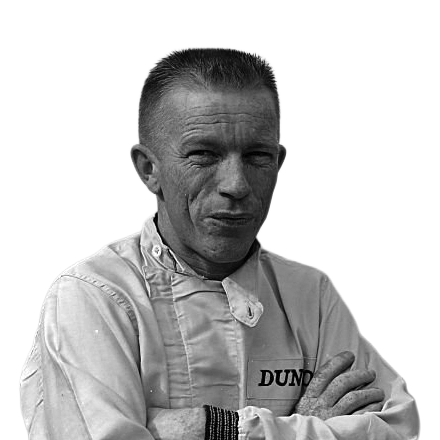
Richie Ginthe was one of American motor racing’s most respected international figures, a driver whose intelligence, mechanical sympathy, and quiet speed earned him the trust of some of the sport’s most important teams. Competing in Formula One from 1960 to 1967, Ginther achieved a place in F1 history by delivering the first Grand Prix victory for both Honda and Goodyear, at the 1965 Mexican Grand Prix.
| Nationality | American |
|---|---|
| Born | Paul Richard Ginther 5 August 1930 Los Angeles, California, U.S. |
| Died | 20 September 1989 (aged 59) Touzac, Charente, France |
Across eight Formula One seasons, Ginther raced for Ferrari, Scarab, BRM, Honda, Cooper, and Eagle, making 52 starts from 54 entries. He scored a single win, 14 podium finishes, three fastest laps, and accumulated 107 World Championship points. His most successful championship campaign came in 1963, when he finished third overall with BRM. In recognition of his achievements, Ginther was inducted into the Motorsports Hall of Fame of America in 2008.
Early Life and Racing Beginnings
Richie Ginther was born in Hollywood, California, on 5 August 1930. His childhood was split between California and Ohio, following his father’s work, before the family ultimately settled in Santa Monica. That move proved pivotal. Santa Monica was also home to Phil Hill, a future Formula One World Champion, and through Hill, who was a friend of Ginther’s older brother George, Richie found his way into racing.
After finishing school in 1948, Ginther joined Douglas Aircraft, working in the tool-and-die shop. Racing, however, soon filled his spare time. He assisted Hill with the preparation, maintenance, and competition of Hill’s collection of old sports cars and hot rods, learning both driving technique and mechanical fundamentals. Ginther made his competitive debut in 1951 at Pebble Beach, driving a Ford-powered MG T-type sports car.
His momentum was interrupted by two years of national service during the Korean War. While away from racing, Ginther received extensive training in aircraft and engine mechanics—skills that would later define his reputation as one of the most technically astute drivers in the paddock.
After returning from military service, Ginther rejoined Hill for the 1953 Carrera Panamericana, acting primarily as riding mechanic in a privately entered 4.1-litre Ferrari. The pair were running strongly before Hill crashed and destroyed the car. Both escaped injury and returned in 1954, finishing second overall, beaten only by Umberto Maglioli in a works Ferrari.
Sports Cars and Rising Reputation
By 1954, Ginther was racing regularly again, primarily in a self-prepared Austin-Healey. His performances caught the attention of prominent West Coast Volkswagen and Porsche dealer John von Neumann, who hired him to drive Porsches in domestic competition in 1955. When von Neumann began importing Ferraris the following year, Ginther naturally graduated into Ferrari machinery as well.
Ginther balanced racing with full-time work at von Neumann’s dealership, including trips to the Ferrari factory in Italy to resolve customer issues. On track, he was building a formidable reputation. His success and his loyalty to Ferrari equipment attracted the attention of Luigi Chinetti, Ferrari’s East Coast distributor and a three-time Le Mans winner. Chinetti’s North American Racing Team (NART) would soon become Ferrari’s official North American competition arm.
Ginther first raced for Chinetti in 1957, stepping onto the international stage at the 12 Hours of Sebring and later at Le Mans, driving a Ferrari 500 TR. That same year, he also drove Aston Martin machinery for Joe Lubin. Over the next several seasons, Ginther became a fixture in top-level American sports car racing, competing extensively in both Ferrari and Aston Martin cars.
Victories followed quickly. In June 1957, he won a 15-lap GT race at the newly opened Lime Rock Park and claimed victory in the opening race of the national championship in his Ferrari. Early in 1958, he won at Pomona, averaging 83.8 mph, and later took another GT victory in a qualifying race for the SCCA Pacific Coast Championship. By the end of the season, Ginther had secured the Pacific Coast Sports Car Championship outright.
He continued his winning form into 1959, dominating the season opener at Pomona in a 4.1-litre Ferrari and winning the inaugural Hourglass road races in San Diego in a Ferrari TR. Throughout this period, Ginther remained employed at von Neumann’s dealership, a workload that by late 1959 was becoming physically and mentally demanding.
Formula One: Ferrari Years
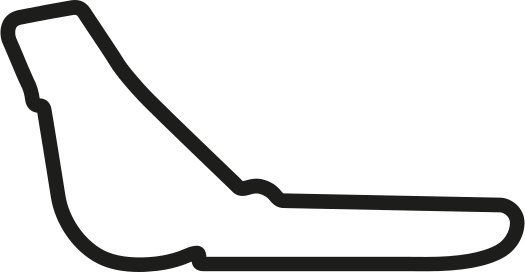
Ginther made his Formula One debut at the 1960 Monaco Grand Prix with Ferrari. Later that season, he delivered a standout performance at Monza, finishing second in the Italian Grand Prix behind Phil Hill after leading the race until lap 25.
Ferrari entered a transitional period in 1961, adopting the new 1.5-litre rear-engine regulations. Ginther became the team’s third driver behind Wolfgang von Trips and Hill, with Giancarlo Baghetti appearing occasionally. Despite Ferrari’s late switch to rear-engined cars, the new V6 machine proved competitive.
At the 1961 Monaco Grand Prix, Ginther finished second to Stirling Moss by just 3.6 seconds, driving a new Ferrari with a 120-degree V6 engine that featured a lower center of gravity. He qualified second, ahead of Hill, briefly setting a new lap record before Moss claimed pole.
That season was overshadowed by tragedy. At the Italian Grand Prix, Ginther qualified third. During the race, von Trips was killed in a catastrophic accident that also claimed the lives of eleven spectators, later rising to fifteen. Ferrari withdrew from competition for the remainder of the year as a mark of respect.
BRM and Championship Contention
In 1962, Ginther joined BRM, partnering with Graham Hill. His finest season came in 1963, when he finished equal-second in the World Championship with Hill, officially classified third due to the rule limiting drivers to their six best results. Over the full season, Ginther actually scored more points than his teammate.
At BRM, Ginther cemented his reputation as a dependable team player and an outstanding development driver—qualities that would soon define the most famous chapter of his career.
Honda and a Historic Victory
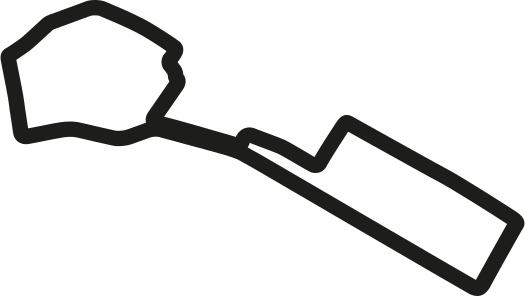
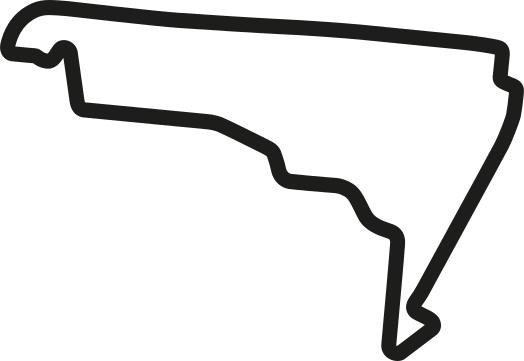
Those strengths earned Ginther a place with Honda’s fledgling Formula One team in 1965. At the Mexican Grand Prix, he delivered a landmark victory, giving Honda its first Formula One win and marking the first Grand Prix triumph for Goodyear tyres.
Ginther averaged 151.7 km/h over the 65-lap race, breaking the circuit’s lap record in the process. It was Honda’s first appearance at the Mexican Grand Prix and a defining moment for the manufacturer’s international ambitions.
Honda’s return to Europe in 1966 proved more challenging. At the Italian Grand Prix, Ginther led the race before crashing into a retaining wall, breaking his collarbone. The team was still grappling with the development of its more powerful engines.
Final Racing Years and Retirement
Ginther joined Dan Gurney’s Eagle team in 1967 and competed in the Race of Champions. His final Formula One entry came at the Monaco Grand Prix, where he failed to qualify.
That same year, while attempting to qualify for the Indianapolis 500 in an American Eagle, Ginther suffered a fuel-line failure that sprayed ethanol and gasoline across his back. Combined with the recent fiery death of close friend Lorenzo Bandini, the incident deeply affected him and contributed to his sudden decision to retire from professional racing.
Beyond Formula One
Ginther remained involved in motorsport after retirement. He appeared in an uncredited role in the 1966 film Grand Prix, portraying driver John Hogarth of the fictional Japanese-backed Yamura team, and also served as a technical advisor on the film.
In June 1969, he participated in a charity rally from Los Angeles to Huntington Beach, alongside 65 competitors including actor James Garner, raising funds for the Braille Institute. In 1971, Ginther managed a Porsche 911S entry at the 24 Hours of Le Mans.
Death
Richie Ginther died of a heart attack on 20 September 1989 while vacationing with his family in Touzac, near Bordeaux, France. He was 59 years old.
Richie Ginther Formula One World Championship career
| F1 Career | 1960–1967 |
|---|---|
| Teams | Ferrari, Scarab, BRM, Honda, Cooper, Eagle |
| Entries | 54 (52 starts) |
| Championships | 0 |
| Wins | 1 |
| Podiums | 14 |
| Career points | 102 |
| Pole positions | 0 |
| Fastest laps | 3 |
| First entry | 1960 Monaco Grand Prix |
| First win | 1965 Mexican Grand Prix |
| Last win | 1965 Mexican Grand Prix |
| Last entry | 1967 Monaco Grand Prix |
Richie Ginther Teammates
| 16 drivers | Involvement | First Year | Last Year |
|---|---|---|---|
| Phil Hill | 11 | 1960 | 1961 |
| Cliff Allison | 1 | 1960 | |
| Wolfgang von Trips | 10 | 1960 | 1961 |
| Chuck Daigh | 1 | 1960 | |
| Willy Mairesse | 2 | 1960 | 1961 |
| Olivier Gendebien | 1 | 1961 | |
| Ricardo Rodriguez | 1 | 1961 | |
| Pedro Rodriguez | 1 | 1961 | |
| Graham Hill | 29 | 1962 | 1964 |
| Tony Marsh | 3 | 1962 | |
| Gerry Ashmore | 1 | 1962 | |
| Richard Attwood | 2 | 1964 | |
| AJ Foyt | 2 | 1964 | |
| Ronnie Bucknum | 10 | 1965 | 1966 |
| Jochen Rindt | 2 | 1966 | |
| Dan Gurney | 2 | 1967 |
Richie Ginther Wins
| Win No. | Grand Prix |
|---|---|
| 1 | 1965 Mexican Grand Prix |
Richie Ginther Complete Formula One Results
| Year | Entrant | Chassis | Engine | 1 | 2 | 3 | 4 | 5 | 6 | 7 | 8 | 9 | 10 | 11 | WDC | Pts |
|---|---|---|---|---|---|---|---|---|---|---|---|---|---|---|---|---|
| 1960 | Scuderia Ferrari | Ferrari 246P | Ferrari | ARG | MON 6 | 500 | 9th | 8 | ||||||||
| Ferrari Dino 246 | Ferrari | NED 6 | BEL | ITA 2 | USA | |||||||||||
| Reventlow Automobiles Inc | Scarab F1 | Scarab | FRA DNS | GBR | POR | |||||||||||
| 1961 | Scuderia Ferrari | Ferrari 156 | Ferrari | MON 2 | NED 5 | BEL 3 | FRA Ret | GBR 3 | GER 8 | ITA Ret | USA DNA | 5th | 16 | |||
| 1962 | Owen Racing Organisation | BRM P48/57 | BRM | NED Ret | MON Ret | 8th | 10 | |||||||||
| BRM P57 | BRM | BEL 13 | FRA 3 | GBR 13 | GER 8 | ITA 2 | USA Ret | RSA 7 | ||||||||
| 1963 | Owen Racing Organisation | BRM P57 | BRM | MON 2 | BEL 4 | NED 5 | FRA Ret | GBR 4 | GER 3 | ITA 2 | USA 2 | MEX 3 | RSA Ret | 3rd | 29 (34) | |
| 1964 | Owen Racing Organisation | BRM P261 | BRM | MON 2 | NED 11 | BEL 4 | FRA 5 | GBR 8 | GER 7 | AUT 2 | ITA 4 | USA 4 | MEX 8 | 5th | 23 | |
| 1965 | Honda R&D Co | Honda RA272 | Honda | RSA | MON Ret | BEL 6 | FRA Ret | GBR Ret | NED 6 | GER | ITA Ret | USA 7 | MEX 1 | 7th | 11 | |
| 1966 | Cooper Car Company | Cooper T81 | Maserati | MON Ret | BEL 5 | FRA | GBR | NED | GER | 11th | 5 | |||||
| Honda R&D Co | Honda RA273 | Honda | ITA Ret | USA NC | MEX 4 | |||||||||||
| 1967 | Anglo American Racers | Eagle Mk1 | Weslake | RSA | MON DNQ | NC | 0 | |||||||||
| Advance Muffler/ Bruce Bromme | Eagle Mk1 | Weslake | NED DNA | BEL | FRA | GBR | GER | CAN | ITA | USA | MEX | NC |