























Fondmetal S.p.A. is a proud Italian alloy wheel manufacturer, established in 1972 by racing enthusiast and industrialist Gabriele Rumi. What began as a specialist engineering venture would grow into a globally respected name in wheel design—while also leaving a bold, if turbulent, footprint in Formula One.
Alongside the manufacturing business, Rumi also launched a Formula One team under the Fondmetal name. The outfit competed in the 1991 and 1992 seasons, ultimately without scoring championship points, but its story is one of ambition, persistence, and pure racing passion. Beyond its own team, Fondmetal played a significant role in the sport for nearly two decades, supplying wheels and sponsorship to multiple constructors from the mid-1980s through to the early 2000s.
In 2014, the brand expanded across the Atlantic as Fondmetal USA, bringing Italian-made wheels to a new market. Despite the international growth, production has remained firmly rooted in Italy, with all wheels carrying TÜV approval—a mark of quality and safety that reflects the company’s engineering heritage.
Origins
The Fondmetal story really begins in 1961, when Gabriele Rumi took control of his grandfather’s iron foundry in Brescia. But this wasn’t just a business move—it was the foundation of a lifelong motorsport journey. Rumi, already deeply passionate about racing, used the opportunity to compete in hillclimbs and the Formula Monza category throughout the 1960s.
At the same time, the company was becoming a serious player in automotive manufacturing. Operating out of Palosco, it produced a wide range of engine and mechanical components, including induction manifolds, water conduits, clutch bellhousings, oil pumps, cylinder heads, and complete engine blocks. Its client list reads like a who’s who of Italian industry, including the Maserati Biturbo program, as well as Fiat, Iveco, OM, and Magneti Marelli.
Yet Rumi wanted more control over his destiny. The oil crisis exposed how vulnerable the business was to external demand, and he decided it was time to create something of his own. In 1972, Fondmetal was born, focusing on alloy wheels—a natural extension of his engineering expertise and racing passion.
From that moment on, Fondmetal established itself as a leader in Italy for both cast and forged wheel design, engineering, and production.
Into Formula One
Fondmetal first entered the Formula One world in 1983, backing Italian driver Piercarlo Ghinzani. By the mid-1980s, the company was supplying wheels to teams such as Williams, Tyrrell, and Ligier, while continuing its sponsorship of Ghinzani and, later, the Osella team.
By 1989, Fondmetal had become the main sponsor of Osella, and within a year, Rumi had taken a controlling stake. At the end of 1990, he made the decisive move: full ownership, full responsibility—and a full leap into Formula One as a constructor.
Team Fondmetal
Relocating operations from Volpiano to Bergamo, Rumi set about running his own team. Initially, he retained Osella driver Olivier Grouillard, but frustrations with performance and attitude led to a switch to Gabriele Tarquini.
Despite the changes, the team struggled to escape the back of the grid, often battling with fellow underfunded teams like Coloni and AGS.
1991 Season
The rebranded Fondmetal Corse entered the 1991 season with the FA1M-E—a car that was essentially a carryover from previous Osella designs dating back to 1989. Painted in blue and grey, it was immediately outclassed.
Even with Cosworth engines prepared by Brian Hart, performance lagged behind rivals. Pre-qualifying—a brutal hurdle of the era—proved almost insurmountable.
Hope arrived with a new car, the Fomet-1, introduced at the San Marino Grand Prix. Designed by a UK-based think tank, Fomet, and led by Tino Belli, it featured improved aerodynamics and suspension. While it represented progress, it still carried the DNA of its Osella roots and couldn’t transform the team’s fortunes.
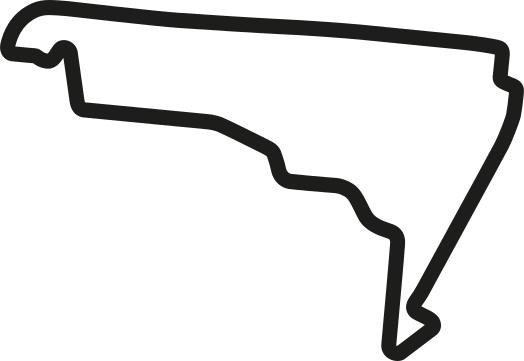
Grouillard did manage a standout moment by qualifying 10th at the Mexican Grand Prix, but consistency remained elusive. Later in the season, Tarquini replaced him and completed two races, yet the team finished the year without points.
1992 Season
The 1992 campaign began with setbacks. Fondmetal had lost access to a new car design after selling its British subsidiary, forcing the team to start the season with an updated version of the old chassis.
A new Ford HB V8 engine—previously used by Benetton—replaced earlier engine options, but the pairing proved problematic. Cooling issues and poor reliability plagued the car.
The driver lineup featured Tarquini alongside Swiss rookie Andrea Chiesa. While Tarquini showed flashes of speed, mechanical failures frequently cut races short.
Relief came with the introduction of the GR02 chassis, designed by Sergio Rinland. A far more modern design, it was unrelated to earlier Osella-based cars and drew from concepts originally intended for Brabham.
The GR02 was a clear improvement, but limited funding meant minimal testing and slow development. Even when the cars qualified well, small issues often ended races prematurely.
Tarquini delivered the team’s best qualifying result—11th place at the Belgian Grand Prix—while Chiesa struggled for consistency and was eventually replaced by Eric van de Poele.
In Hungary, van de Poele showed promise but spun out early, effectively ending Fondmetal’s best chance at a points finish. Meanwhile, Tarquini was caught in first-lap chaos.
By September 1992, following the Italian Grand Prix, the team withdrew from Formula One due to financial pressures. Despite occasional flashes of competitiveness, it ended its run with no points and mounting debt, exacerbated by the global recession.
Rumi briefly considered hiring Giuseppe Bugatti as a pay driver to continue, but ultimately chose to close the team.
Post-Formula One
Although the team folded, its technical legacy lived on. Designs developed by Rinland would later resurface in the Forti team’s FG01 chassis in 1995, showing clear lineage from the Fondmetal GR02.
Rumi himself returned to Formula One in a quieter role. Fondmetal became a sponsor and technical partner to Tyrrell in 1994 and later supported Minardi in 1996. The company’s wind tunnel in Northern Italy became a valuable resource, leased to multiple teams.
Rumi deepened his involvement with Minardi, eventually becoming co-owner and chairman. In 2000, he even rebadged Ford Zetec-R engines under the Fondmetal name—an echo of his earlier ambitions.
However, illness forced him to step back. Diagnosed with cancer, Rumi withdrew from the sport later that year as Minardi was sold to Paul Stoddart. He passed away in May 2001.
Fondmetal Formula One World Championship Records
| First entry | 1991 United States Grand Prix |
|---|---|
| Races entered | 29 (19 starts) |
| Engines | Ford |
| Constructors’ Championships | 0 |
| Drivers’ Championships | 0 |
| Race victories | 0 |
| Pole positions | 0 |
| Fastest laps | 0 |
| Final entry | 1992 Italian Grand Prix |
Fondmetal Constructors’ Championship Results
| Year | Chassis | Engine | Tyres | Drivers | 1 | 2 | 3 | 4 | 5 | 6 | 7 | 8 | 9 | 10 | 11 | 12 | 13 | 14 | 15 | 16 | Points | WCC |
|---|---|---|---|---|---|---|---|---|---|---|---|---|---|---|---|---|---|---|---|---|---|---|
| 1991 | Fondmetal FA1M-E Fomet-1 | Ford Cosworth DFR 3.5 V8 | G | USA | BRA | SMR | MON | CAN | MEX | FRA | GBR | GER | HUN | BEL | ITA | POR | ESP | JPN | AUS | 0 | NC | |
| G | Olivier Grouillard | DNPQ | DNPQ | DNPQ | DNPQ | DNPQ | Ret | Ret | DNPQ | DNPQ | DNQ | 10 | Ret | DNPQ | 0 | NC | ||||||
| G | Gabriele Tarquini | 12 | 11 | DNPQ | 0 | NC | ||||||||||||||||
| 1992 | Fondmetal GR01 Fondmetal GR02 | Ford HBA5 3.5 V8 | G | RSA | MEX | BRA | ESP | SMR | MON | CAN | FRA | GBR | GER | HUN | BEL | ITA | POR | JPN | AUS | 0 | NC | |
| G | Gabriele Tarquini | Ret | Ret | Ret | Ret | Ret | Ret | Ret | Ret | 14 | Ret | Ret | Ret | Ret | 0 | NC | ||||||
| G | Andrea Chiesa | DNQ | Ret | DNQ | Ret | DNQ | DNQ | DNQ | Ret | DNQ | DNQ | 0 | NC | |||||||||
| G | Eric van de Poele | Ret | 10 | Ret | 0 | NC |
As An engine supplier
| Year | Entrant | Chassis | Engine | Tyres | Drivers | 1 | 2 | 3 | 4 | 5 | 6 | 7 | 8 | 9 | 10 | 11 | 12 | 13 | 14 | 15 | 16 | 17 | Points | WCC |
|---|---|---|---|---|---|---|---|---|---|---|---|---|---|---|---|---|---|---|---|---|---|---|---|---|
| 2000 | Telefónica Minardi Fondmetal | Minardi M02 | Fondmetal RV10 3.0 V10 | B | AUS | BRA | SMR | GBR | ESP | EUR | MON | CAN | FRA | AUT | GER | HUN | BEL | ITA | USA | JPN | MAL | 0 | NC | |
| Fondmetal RV10 3.0 V10 | B | Marc Gené | 8 | Ret | Ret | 14 | 14 | Ret | Ret | 16 † | 15 | 8 | Ret | 15 | 14 | 9 | 12 | Ret | Ret | 0 | NC | |||
| Fondmetal RV10 3.0 V10 | B | Gastón Mazzacane | Ret | 10 | 13 | 15 | 15 | 8 | Ret | 12 | Ret | 12 | 11 | Ret | 17 | 10 | Ret | 15 | 13 † | 0 | NC |