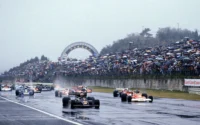


















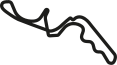


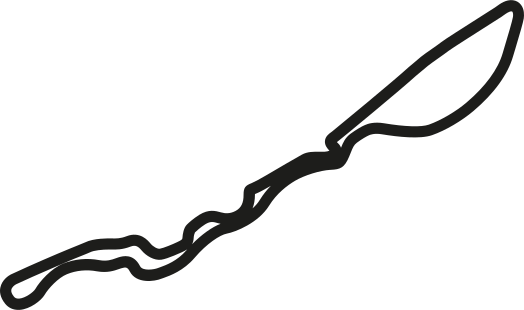

The 1976 German Grand Prix took place on 1 August 1976 at the legendary Nürburgring Nordschleife. It was the tenth round of the 1976 Formula One season, and the final time Formula One would race on the daunting 22.8 km (14.2 mile) Nordschleife configuration.
| Season | 1976 F1 World Championship | ||
|---|---|---|---|
| Date | 1 August 1976 | ||
| Location | Nürburgring, Nürburg, West Germany | ||
| Course | Permanent racing facility | ||
| Course length | 22.835 km (14.19 miles) | ||
| Distance | 14 laps, 319.690 km (198.65 miles) | ||
| Weather | Rain at start, later drying | ||
The race is remembered above all for the near-fatal accident of reigning world champion Niki Lauda, an event that changed Formula One safety forever. The race itself was won by James Hunt, but the result was overshadowed by the dramatic events unfolding in the Eifel mountains.
“The Green Hell”
Few circuits in motorsport history have commanded as much respect—or fear—as the Nürburgring Nordschleife. Stretching over 14 miles through forests and hills, it featured over 300 metres of elevation change, unpredictable weather, and a relentless sequence of corners.
Three-time world champion Jackie Stewart famously dubbed it “The Green Hell”, and by 1976, many drivers believed the nickname was no exaggeration.
Despite minor updates in 1971, the track remained dangerously outdated. It was narrow, bumpy, and lined with minimal run-off areas. Sections like Flugplatz and Pflanzgarten could send cars airborne. Even more concerning was the sheer scale of the circuit, making it almost impossible to provide adequate medical coverage or marshal response times. Weather conditions could vary dramatically from one part of the lap to another, complicating tyre choices.
A fatal accident during a support race just weeks earlier had only reinforced concerns. It had already been decided before the event that this would be the last German Grand Prix held on the Nordschleife.
Tension Before the Start
Lauda, leading the championship and known for his analytical approach, was deeply concerned about safety. He attempted to organise a driver boycott, citing insufficient medical support and the risk posed by the circuit—especially with rain forecast.
The vote among drivers was narrowly against him. By a margin of just one vote, the race would go ahead.
The weekend also saw several unusual developments. Jacky Ickx lost his seat at Wolf Racing and was replaced by Arturo Merzario. A new entrant, Scuderia Rondini, appeared with an older Tyrrell chassis. Meanwhile, legal complications led to cars being impounded midweekend, forcing last-minute driver reshuffles—including Rolf Stommelen switching teams. Lella Lombardi, caught up in the disruption, was left without a drive.
1976 German Grand Prix Qualifying
Wet conditions on Saturday meant that Friday’s qualifying times determined the grid. Lap times hovered around 7 minutes 6 seconds, comparable to earlier years despite regulation changes.
Hunt secured pole position, with Lauda alongside him. Patrick Depailler lined up third in the distinctive six-wheeled Tyrrell, followed by Hans-Joachim Stuck. Clay Regazzoni, Jacques Laffite, Carlos Pace, Jody Scheckter, Jochen Mass, and Carlos Reutemann completed the top ten.
1976 German Grand Prix Race Results
The race start was delayed due to changing conditions. Rain had fallen on parts of the circuit, leading most drivers to choose wet tyres, while Mass gambled on slicks, anticipating a drying track.
At the start, Regazzoni surged into the lead, with Hunt and Lauda dropping back. But conditions evolved rapidly. By the end of the first lap, the circuit was drying, prompting most drivers to pit for slick tyres.
Then, on lap two, came one of the most infamous moments in F1 history.
Lauda, pushing hard after his tyre stop, approached the fast left-hand kink before Bergwerk. Suddenly, his Ferrari snapped sideways, crashing into the barriers before rebounding onto the track and erupting into flames.
What followed was an extraordinary act of bravery. Guy Edwards narrowly avoided the wreck, while Brett Lunger and Harald Ertl collided in the aftermath. Several drivers—most notably Merzario—stopped and rushed into the fire to pull Lauda from the burning car.
Severely burned and suffering from smoke inhalation, Lauda was airlifted to the hospital, beginning a fight for his life that would become one of the most remarkable recovery stories in sport.
The race was immediately stopped.
Restart and Conclusion
After a lengthy delay, the race restarted with a reduced field. The weather had improved, and conditions were now dry.
Hunt seized control, overtaking Regazzoni and steadily building a lead he would not relinquish. Behind him, the race remained unpredictable. Ronnie Peterson crashed heavily at Flugplatz, Regazzoni spun multiple times, and Depailler ran off the circuit.
Attrition continued as mechanical failures and mistakes took their toll. Mass climbed through the order, eventually reaching third, while Pace and others shuffled positions behind the leaders.
Hunt drove cleanly and decisively to take victory—one of the most important wins of his career in what would become a legendary championship battle.
Aftermath
Lauda’s accident confirmed what many had feared: the Nordschleife was no longer suitable for modern Formula One.
The scale of the circuit meant emergency response times were far too slow—Lauda’s rescue depended almost entirely on fellow drivers rather than marshals. With only one helicopter stationed far from the crash site, it took crucial minutes to reach him—time that could easily have proved fatal.
The race marked the end of Formula One at the old Nürburgring. When the sport returned to the venue years later, it would be on a much shorter, modernised circuit.
In the immediate aftermath, the shock rippled through the paddock. Chris Amon was so affected that he briefly retired from Formula One, though he would return later that season.
Lauda’s survival—and astonishing return to racing just weeks later—would become one of the defining stories of Formula One history. But the events of this race ensured that safety would never again be treated as secondary.
1976 Post-Race F1 Championship Standings
Drivers
| Pos. | Driver | Points |
|---|---|---|
| 1 | Niki Lauda | 58 |
| 2 | James Hunt | 44 |
| 3 | Jody Scheckter | 34 |
| 4 | Patrick Depailler | 26 |
| 5 | Clay Regazzoni | 16 |
Teams
| Pos. | Constructor | Points |
|---|---|---|
| 1 | Ferrari | 61 |
| 2 | McLaren | 49 (50) |
| 3 | Tyrrell | 47 |
| 4 | Ligier | 10 |
| 5 | Penske | 9 |
Seen in: