























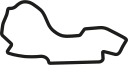

Nestled in the Eifel mountains near Nürburg, Germany, the Nürburgring is one of the most famous and feared circuits in motorsport history. Known around the world as “The Green Hell,” the venue combines a modern Grand Prix circuit with the legendary Nordschleife, a vast ribbon of tarmac that winds through forests, climbs hills, and drops through valleys with relentless intensity. Few tracks in motorsport carry the same aura, and even fewer have shaped Formula One history so profoundly.
Originally opened in 1927, the Nürburgring was built as a showcase for German engineering and quickly became one of Europe’s premier racing venues. Its most iconic configuration, the Nordschleife, gained legendary status for its extraordinary length, huge elevation changes, and seemingly endless sequence of corners. For decades, it stood as the ultimate test of speed, bravery, and endurance, demanding complete concentration from every driver who dared to tackle it.
Over time, the venue evolved. The original start-finish complex and older layouts were eventually replaced by a modern Grand Prix circuit, which first opened in 1984 and was later revised in 2002. While the new track brought the Nürburgring in line with contemporary safety standards, the old Nordschleife remained in use for endurance racing, testing, and public driving sessions, preserving the circuit’s mythical reputation.
The Nürburgring has hosted Formula One Grands Prix under several names, including the German Grand Prix, European Grand Prix, Luxembourg Grand Prix, and most recently the Eifel Grand Prix. Across both the old and new eras, it has produced some of the sport’s most unforgettable races, legendary performances, and defining moments.
See also…

Nurburgring
| First Grand Prix | 1951 German Grand Prix |
| Number of Laps | 60 |
| Circuit Length | 5.148 km (current GP-Strecke) |
| Race Distance | 308.617 km |
| Lap Record | 1:28.139 Max Verstappen (2020) |
Circuit
When was the Nürburgring built?
Construction of the Nürburgring began in September 1925, and the circuit was completed in the spring of 1927. It was created in the hills around the medieval Nürburg Castle as a major national project designed to showcase German automotive engineering and to provide a world-class venue for motorsport. From the outset, it was unlike any circuit in the world.
The original Nürburgring complex featured multiple layouts, including the fearsome Nordschleife, the Südschleife, and the combined Gesamtstrecke. The Nordschleife soon became the most famous of them all. Measuring over 22 kilometres in its historic form, it twisted through forests and mountainous terrain with more than 300 metres of elevation change, creating a challenge that no conventional circuit could match.
In its early decades, the Nürburgring became synonymous with long-distance endurance and driver skill. The track’s enormous length, ever-changing weather, blind crests, plunging descents, and hundreds of corners made it the ultimate test for drivers. Scottish world champion Jackie Stewart famously gave it the nickname “The Green Hell,” a description that has remained inseparable from the circuit ever since.
By the late 1960s and early 1970s, however, Formula One’s increasing speeds exposed the limits of what the old Nordschleife could safely accommodate. A series of safety modifications were introduced, including barriers, resurfacing, and changes to certain corners, but the sheer scale of the track made it increasingly difficult to marshal, televise, and make it fully safe for modern Grand Prix racing.
Following Niki Lauda’s near-fatal accident during the 1976 German Grand Prix, Formula One never raced on the old Nordschleife again. The German Grand Prix moved away, and work eventually began on a shorter, modern circuit built near the old pit area.
That new Grand Prix circuit opened in 1984, giving the Nürburgring a contemporary Formula One-standard venue while allowing the shortened Nordschleife to survive alongside it. In 2002, the GP circuit was revised again, adding the Mercedes Arena section and extending the lap to its current 5.148-kilometre configuration.
Today, the Nürburgring is not a single track but a motorsport complex with multiple layouts. The modern GP circuit hosts major racing events, while the Nordschleife remains one of the most famous and intimidating circuits in the world, still used for endurance races, manufacturer testing, and public laps.
When was the first German Grand Prix at the Nürburgring?
The Nürburgring hosted the German Grand Prix long before Formula One existed, staging pre-war editions of the race from 1927 to 1939. In the Formula One World Championship era, it first hosted the championship German Grand Prix in 1951, beginning one of the most important relationships between a circuit and a Grand Prix in the sport’s history.
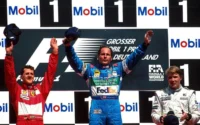
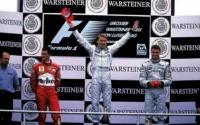
Across the decades, the Nürburgring became the stage for many of Formula One’s greatest drivers. Champions such as Juan Manuel Fangio, Jim Clark, Jackie Stewart, Niki Lauda, Alain Prost, and Michael Schumacher all left their mark on the venue. Schumacher became the most successful Formula One driver at the Nürburgring, winning five times between 1995 and 2006.
The circuit’s Formula One story is split into two distinct eras. The first belonged to the old Nordschleife, which hosted the German Grand Prix until 1976 and became legendary for its difficulty and danger. The second began with the opening of the modern GP circuit in 1984, which allowed Formula One to return under various Grand Prix titles.
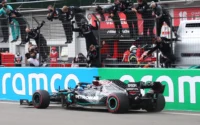
After its comeback, the Nürburgring hosted races not only as the German Grand Prix, but also as the European Grand Prix, the Luxembourg Grand Prix, and later the Eifel Grand Prix in 2020. That 2020 race was won by Lewis Hamilton, who equalled Michael Schumacher’s then-record number of Formula One victories.
The Nürburgring’s place in F1 history is also tied to some of the sport’s most defining moments. None is more famous than Lauda’s 1976 crash on the Nordschleife, an accident that highlighted the circuit’s risks and accelerated the end of Formula One’s time on the old layout. Even so, the Nürburgring’s prestige has endured, and it remains one of the sport’s most revered names.
Nürburgring lap record
The official Formula One lap record for the current GP-Strecke is 1:28.139, set by Max Verstappen in a Red Bull RB16 during the 2020 Eifel Grand Prix.
On the older Grand Prix circuit configuration used between 1995 and 2001, the Formula One lap record was 1:18.354, set by Juan Pablo Montoya during the 2001 European Grand Prix.
For the historic Nordschleife, the official Formula One race lap record remains 7:06.4, set by Clay Regazzoni in a Ferrari 312T during the 1975 German Grand Prix. That figure stands as one of the most iconic lap records in Formula One history, reflecting the scale and difficulty of the old Nürburgring.