


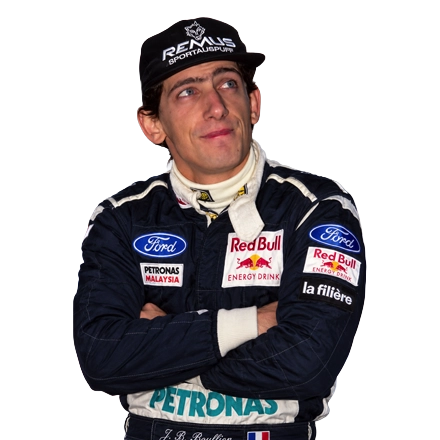
Jean-Christophe Boullion made his reputation by winning the International Formula 3000 title, reached Formula One with Sauber and then built his most sustained success in endurance racing. Two Le Mans Series championships and two overall podiums at the Le Mans 24 Hours would give his career considerably more depth than an eleven-race Grand Prix spell might suggest.
Driver Bio
| Nationality | French |
| Birthplace | St Brieuc, France |
| Born | 27 December 1969 |
| First Grand Prix | 1995 Monaco Grand Prix |
| Last Grand Prix | 1995 Pacific Grand Prix |
| Years Active | 1995 |
| Current/Last Team | Sauber |
Born in Saint-Brieuc on 27 December 1969, Jean-Christophe Joël Louis Boullion became widely known as “Jules”. He began karting in 1982 and, after attending a racing school near Paris, moved into cars in 1988. Third in French Formula Ford 1600 in 1989 was followed by a dominant title-winning campaign the next year.
French Formula Three came next. Boullion finished sixth in 1991, then fourth with three victories in 1992. He joined Apomatox for International F3000 in 1993 and ended an eighth-place championship season with two runner-up finishes. That late improvement offered a useful hint of what was to come.
Switching to DAMS in 1994 transformed promise into a championship. His campaign began slowly, but four consecutive podiums at the end of the season, including victories in the final three races, carried him past Franck Lagorce and Gil de Ferran in the title battle. It was a finish timed to perfection.
The championship had demanded a recovery rather than a season-long procession. Boullion entered the closing rounds needing results, then produced the three consecutive victories that changed the final order. That sequence made the title particularly persuasive evidence of his readiness for a bigger opportunity.
Williams recruited him as a test driver for 1995. Soon, however, Sauber needed a replacement for Karl Wendlinger, whose return following his serious Monaco accident had proved difficult. Williams loaned Boullion to the Swiss team, and his race debut came at Monaco itself.
It was an eventful introduction. Accidents at the Nouvelle Chicane in practice and Massenet in qualifying were followed by a race in which he was classified eighth despite spinning out with two laps remaining. Canada brought another spin, France a gearbox failure and Britain tenth place. The learning curve was steep, with little time to settle into the job.
At Hockenheim, retirements ahead helped Boullion secure fifth and his first championship points. Another point followed at Monza, where he passed Max Papis on the final lap to finish sixth. His last two appearances ended early: contact with Mika Salo at the Nürburgring and a spin in the Pacific Grand Prix, which Boullion attributed to Pedro Lamy moving across ahead of him.
Sauber chose Johnny Herbert for 1996, and Boullion returned to Williams testing rather than receiving a full-time race seat. He tested for Jordan at the end of that year, continued with Williams in 1997 and became Tyrrell‘s test driver in 1998. His Grand Prix racing career was over, but his work in F1 continued beyond those eleven starts.
Competition opportunities ran alongside the testing. He finished fourth in the 1997 Renault Spider Eurocup with two wins. His first Le Mans appearance had come in 1994; a return with DAMS in GT1 in 1997 also ended in retirement. A JB Racing prototype failed with gearbox trouble in the 1998 race.
For 1999 he switched to the British Touring Car Championship, driving a Williams-run Renault Laguna. A Silverstone podium was the standout result in a season that left him tenth overall. The following year, a Le Mans outing with Racing Organisation Course helped move his attention towards prototypes, where he would find a much more lasting home.
Joining Pescarolo Sport in 2001 brought a first FIA Sportscar Championship victory at Magny-Cours. With Sébastien Bourdais in 2002, he won the opening and closing rounds, although missing Brno proved costly in a championship won by Racing for Holland. Two appearances in 2003 included another win at Estoril. The series’ subsequent disappearance contributed to a season on the sidelines in 2004.
Boullion returned in 2005 alongside Emmanuel Collard in the Le Mans Endurance Series. Two victories helped the Pescarolo pair beat Zytek Motorsport to the title by just two points. They also shared second place at Le Mans with Érik Comas, turning a successful championship year into a memorable endurance campaign.
Their 2006 title defence was even stronger. Boullion and Collard won all five Le Mans Series races, an emphatic clean sweep, although Boullion did not contest that year’s 24 Hours. Consistency had become something more formidable: wherever the championship went, the same pairing kept winning.
Factory opposition changed the balance in 2007. Peugeot’s arrival made life harder for the independent Pescarolo team, but four podiums from six races kept Boullion in contention until the final round. He finished runner-up in the championship and took third at Le Mans, behind the works Audi and Peugeot entries.
Audi joined the Le Mans Series with two cars in 2008, increasing the pressure on the privateers. Boullion managed one podium and sixth in the standings. With Christophe Tinseau in 2009, he opened with two second places and later won at the Algarve, but retirement at the Nürburgring swung the title fight towards Aston Martin Racing. Another championship runner-up finish was the outcome.
A move to Rebellion Racing in 2010 paired him with Andrea Belicchi and produced one podium. They stayed together in 2011, adding two more and finishing second in the championship, only three points behind the title-winning Pescarolo entry. Boullion returned to Pescarolo for the opening World Endurance Championship round at Sebring in 2012. A planned Le Mans appearance ended before race day when a practice accident injured his ribs.
From a dramatic F3000 title run to years of prototype success, Boullion’s career repeatedly demonstrated the value of looking beyond a short F1 record. His finest sustained results came in the long races, with Pescarolo providing the setting for his most productive partnership.
Grand Prix Stats
| Race Entries | 11 |
| Race Starts | 11 |
| Did Not Start | 0 |
| Best Race Start | 13th |
| Best Race Finish | 5th |
| Retirements | 5 |
| First-Lap Retirements | 0 |
| Not Classified | 0 |
| Disqualified | 0 |
| Did Not Qualify | 0 |
Qualifying
| Qualifying Sessions | 11 |
| Reached Q3 | 0 |
| Q2 Eliminations | 0 |
| Q1 Eliminations | 0 |
| Did Not Qualify | 0 |
Points
| Points Scored | 3 |
| Points Finishes | 2 |
| Most Points in a Single Season | 3 (1995) |
| Seasons with Points | 1 |
Stats by Season
| Year | Constructor | Entries | Starts | Wins | Podiums | Poles | Fastest Laps | Front Rows | DNF | Best Start | Best Result | Pts Finishes | Points | Championship |
|---|---|---|---|---|---|---|---|---|---|---|---|---|---|---|
| 1995 | Sauber | 11 | 11 | 0 | 0 | 0 | 0 | 0 | 5 | 13 | 5 | 2 | 3 | 16th |
Teammates & Qualifying Head-to-Head
| Teammate | Years | Races | Qualifying H2H |
|---|---|---|---|
| Heinz-Harald Frentzen | 1995 | 11 | 0-11 |


