





























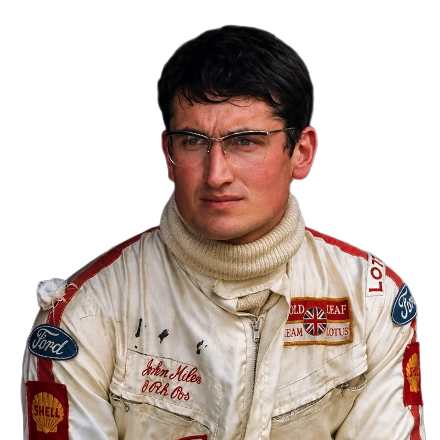
John Miles was one of the most intelligent, technically gifted and underrated British racing drivers of his era — a driver whose Formula One career placed him at the centre of Team Lotus during one of the sport’s most revolutionary and dangerous periods. Born in England on 14 June 1943, Miles competed in 15 Formula One World Championship Grands Prix between 1969 and 1970, scoring two championship points with a gritty fifth-place finish at the 1970 South African Grand Prix. But statistics alone barely tell the story of a driver who became deeply intertwined with the development of some of Colin Chapman’s boldest — and most feared — creations.
Driver Bio
| Nationality | British |
| Birthplace | Paddington, England, UK |
| Born | 14 June 1943 |
| Died | 8 April 2018 |
| First Grand Prix | 1969 French Grand Prix |
| Last Grand Prix | 1970 Austrian Grand Prix |
| Years Active | 1969–1970 |
| Current/Last Team | Lotus |
Known throughout the paddock as “Diva” Miles, to distinguish him from fellow racer John “Turner” Miles, he built his reputation long before Formula One through sheer versatility and speed in British sports car racing. In 1963 and 1964, he emerged as a major talent in the Redex Sports Car Championship, taking the overall title in a front-engined Diva GT. A second successful campaign followed, with backing from John Willment, one of Britain’s best-known racing team owners of the era.
By 1966, Miles had become virtually unstoppable in national GT racing. Driving a Willment-supported Lotus Elan 26R, he dominated the Autosport Championship with 15 outright victories from 17 races. The car itself became legendary — unbeaten until the arrival of newer mid-engined challengers such as Chevron. That same winter, at Brands Hatch on Boxing Day 1966, Miles debuted the radical new Lotus 47GT before stepping into the Lotus works programme full-time.
Over the next two seasons, he raced Formula 3 Lotus machinery — including the Lotus 41, 41X and 47GT — for the factory team, developing both his racecraft and his technical understanding. In 1968, he won four international Formula 3 races and firmly established himself as one of Britain’s most promising drivers outside Formula One.
That promise earned him a call from Colin Chapman in 1969 — though the opportunity came with enormous risk attached.
Formula One
Miles was handed the difficult task of developing the Lotus 63, Chapman’s ambitious but deeply flawed four-wheel-drive Formula One car. The project had already alarmed established stars Graham Hill and Jochen Rindt, both of whom reportedly refused to drive it, viewing the machine as dangerously unpredictable. Miles, however, became the man tasked with taming it.
The Lotus 63 proved nightmarishly difficult to drive. In five Grands Prix, Miles finished only once, taking tenth place, while even Mario Andretti failed to tame the car in his own outings. Yet Miles’ willingness to wrestle with the 63 demonstrated both his bravery and his value to Lotus as a development driver. At circuits such as Mosport in Canada, where fast sweeping corners suited the four-wheel-drive concept better than tighter tracks, he showed flashes of competitiveness from the midfield.
When Graham Hill left Team Lotus after suffering severe leg injuries late in 1969, Miles was promoted to the role of number two driver alongside Jochen Rindt for the 1970 Formula One season. It should have been the breakthrough moment of his career. Instead, it became one of the most emotionally and mechanically turbulent periods in Formula One history.
At the opening race of the season in South Africa, Miles finished fifth in the dependable Lotus 49, scoring the only championship points of his Formula One career despite driving much of the race soaked in leaking fuel. Even then, Colin Chapman reportedly criticised him afterward for not overtaking Jean-Pierre Beltoise for fourth place.
The season quickly became consumed by the arrival of the revolutionary Lotus 72 — a car that would eventually dominate Formula One but initially terrified many of the drivers tasked with racing it. The wedge-shaped design introduced radical anti-dive and anti-squat suspension concepts, enormous braking potential and aerodynamic ideas years ahead of their time. But early versions were unstable and unpredictable.
While Rindt gradually unlocked the car’s brilliance, Miles often found himself driving more experimental versions that retained many of Chapman’s harsher setup philosophies. The result was a machine that could be breathtakingly quick one moment and deeply intimidating the next.
At Zandvoort, where Rindt took pole position and victory, Miles delivered one of the finest drives of his career. Battling in the midfield against established stars including Jean-Pierre Beltoise, John Surtees and Piers Courage, he used the Lotus 72’s phenomenal braking ability to defend aggressively for much of the race. For lap after lap, he held off far more experienced rivals in a spectacular scrap before eventually slipping to seventh after his brakes faded late in the race.
Yet despite moments of obvious talent, Miles increasingly found himself overshadowed by Rindt, who went on to win five races and ultimately secure the 1970 World Championship posthumously. Miles later described feeling undervalued within Team Lotus, claiming Chapman treated him “like a grease monkey” and paid him only £300 per race — from which he still had to cover his own travel expenses.
As the season progressed, the pressure and danger intensified. Mechanical failures repeatedly hampered Miles’ races, including persistent brake and water system issues. At Hockenheim, he spent practice sessions towing young Emerson Fittipaldi to help the Brazilian qualify, even as his own Lotus continued suffering reliability problems. Rindt, meanwhile, famously told Miles that he could not understand why his teammate was two seconds slower, remarking that driving slower in the Lotus 72 “was no safer anyway.”
Then came Monza.
For the 1970 Italian Grand Prix, Chapman instructed both drivers to run wingless Lotus 72s in pursuit of maximum straight-line speed. Miles was deeply uncomfortable with the car’s stability in that configuration and openly concerned about its behaviour at high speed. During practice, Jochen Rindt suffered a catastrophic brake shaft failure approaching the Parabolica. His Lotus slammed into the barriers, and the Austrian was killed instantly.
The tragedy shattered Miles. Already regarded within the paddock as thoughtful, cerebral and unusually sensitive for a Formula One driver of that era, he could no longer continue under those circumstances. Soon after Rindt’s death, Miles walked away from Team Lotus and effectively ended his Formula One career.
In 1971, he joined BRM primarily as a development and test driver, although he also competed in several non-championship events. Away from Formula One, he continued to demonstrate his talent by winning the British Sports Car Championship in a Chevron B19, defeating a highly competitive field that included Chris Craft and Wilson Fittipaldi.
Beyond Racing
Outside racing, Miles’ engineering mind became central to his later success. A qualified mechanical engineer, he worked extensively with Lotus Cars on the road car side of the business and became a respected motoring journalist. His long-running Autocar column, Miles Behind The Wheel, earned praise for its insight, honesty and technical depth, particularly when reviewing performance cars.
Miles also maintained strong creative interests beyond motorsport. In 1985, he co-founded the jazz label Miles Music alongside Peter Watts. One of the company’s most acclaimed releases, Tamburello by Peter King, won the BT Jazz CD of the Year award in 1996. The album was inspired by the death of Ayrton Senna at Imola — another reminder of how deeply motorsport’s triumphs and tragedies shaped Miles throughout his life.
Death
The son of celebrated actors Bernard Miles and Josephine Wilson, John Miles lived a life that combined racing, engineering, writing and music in equal measure. He died on 8 April 2018 following complications from a stroke, leaving behind a legacy that extends far beyond his Formula One statistics.
To many, he remains one of the sport’s great nearly-men — a gifted driver whose intelligence and honesty perhaps made him too reflective for Formula One’s brutal golden age, but whose contribution to Lotus and motorsport history remains enormously significant.
Grand Prix Stats
| Race Entries | 15 |
| Race Starts | 12 |
| Did Not Start | 1 |
| Best Race Start | 7th |
| Best Race Finish | 5th |
| Retirements | 8 |
| First-Lap Retirements | 0 |
| Not Classified | 0 |
| Disqualified | 0 |
| Did Not Qualify | 2 |
Qualifying
| Qualifying Sessions | 15 |
| Reached Q3 | – |
| Q2 Eliminations | – |
| Q1 Eliminations | – |
| Did Not Qualify | 2 |
Points
| Points Scored | 2 |
| Points Finishes | 1 |
| Most Points in a Single Season | 2 (1970) |
| Seasons with Points | 1 |
Stats by Season
| Year | Constructor | Entries | Starts | Wins | Podiums | Poles | Fastest Laps | Front Rows | DNF | Best Start | Best Result | Pts Finishes | Points | Championship |
|---|---|---|---|---|---|---|---|---|---|---|---|---|---|---|
| 1969 | Lotus | 5 | 5 | 0 | 0 | 0 | 0 | 0 | 4 | 11 | 10 | 0 | 0 | NC |
| 1970 | Lotus | 10 | 7 | 0 | 0 | 0 | 0 | 0 | 4 | 7 | 5 | 1 | 2 | 19th |
Stats by Constructor
| Constructor | Years | Entries | Starts | Wins | Podiums | Poles | Fastest Laps | Front Rows | DNF | Best Start | Best Result | Pts Finishes | Points |
|---|---|---|---|---|---|---|---|---|---|---|---|---|---|
| Lotus | 1969–1970 | 15 | 12 | 0 | 0 | 0 | 0 | 0 | 8 | 7 | 5 | 1 | 2 |
Teammates & Qualifying Head-to-Head
| Teammate | Years | Races | Qualifying H2H |
|---|---|---|---|
| Jochen Rindt | 1969–1970 | 15 | – |
| Graham Hill | 1969 | 4 | – |
| Emerson Fittipaldi | 1970 | 4 | – |