






















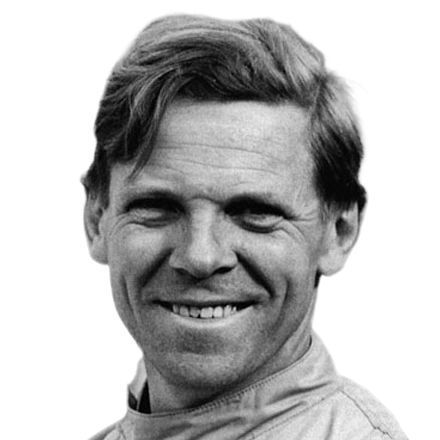
Paul Frère was one of Belgium’s most accomplished and influential figures in motor racing, uniquely combining success as a racing driver with lasting authority as a journalist and technical analyst of the sport. His career bridged the formative years of Formula One, the golden age of sports-car racing, and the modern era of performance road cars.
| Nationality | Belgian |
|---|---|
| Born | 30 January 1917 Le Havre, France |
| Died | 23 February 2008 (aged 91) Saint-Paul-de-Vence, France |
Frère competed in 11 Formula One World Championship Grand Prix, making his debut on 22 June 1952. Across his championship appearances, he scored one podium finish and accumulated 11 championship points. In addition to his World Championship outings, he was a frequent and successful competitor in non-Championship Formula One races, winning the 1952 Grand Prix des Frontières and the VI South African Grand Prix in 1960.
His greatest on-track achievement came in endurance racing. In 1960, Frère won the 24 Hours of Le Mans, driving a Ferrari alongside fellow Belgian Olivier Gendebien—a landmark victory that cemented his place in motorsport history.
Frère also drove for the Ferrari works team, including racing alongside Peter Collins, placing him at the heart of one of the sport’s most prestigious line-ups during a highly competitive era.
Journalism, engineering insight and influence
After retiring from front-line competition in 1960, Frère moved into a second career that would arguably prove even more influential. He became a highly respected automotive journalist, serving as European Editor for Road & Track magazine and working closely with car manufacturers as a consultant.
Known for his technical curiosity and deep mechanical sympathy, Frère developed close relationships with vehicle design engineers—particularly in Japan, where he worked extensively with Honda and Mazda. His journalistic work allowed him to test and evaluate an extraordinary range of road and racing cars over several decades.
One of the most remarkable moments of his later life came during the 2003 24 Hours of Le Mans. At 86 years old, Frère tested and demonstrated the Audi R8 during a break on Test Day, making him the oldest racing driver ever to drive a then-current top-level sports prototype.
Writing and legacy as a teacher of driving
Alongside Piero Taruffi and Denis Jenkinson, Frère was among the first writers to treat motor racing as a discipline that could be systematically analysed, explained, and taught. His influential 1963 book, Sports Car and Competition Driving, became—and remains—a foundational text in performance driving. The book played a key role in shaping the philosophy behind modern competition driving schools, including those founded by Jim Russell, Bob Bondurant, and others.
Porsche authority
Frère was widely regarded as one of the world’s foremost experts on Porsche, particularly the Porsche 911. His book The Porsche 911 Story is considered the definitive history of the model. Over many years he maintained a close relationship with Porsche and was frequently consulted for his insight.
His reputation extended beyond the factory: Alois Ruf, head of Ruf Automobile, regarded Frère as an advisor and authority on the 911 and consulted him during the development of the Ruf RGT8.
Film appearance and later years
In 1967, Frère made a cameo appearance in The Departure, a Belgian film centred on a car-obsessed young man determined to acquire a Porsche 911 for a race—an appearance that neatly reflected Frère’s real-world standing in automotive culture.
Just weeks before his 90th birthday in January 2007, Frère was seriously injured in an accident near the Nürburgring and spent 14 days in intensive care.
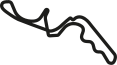
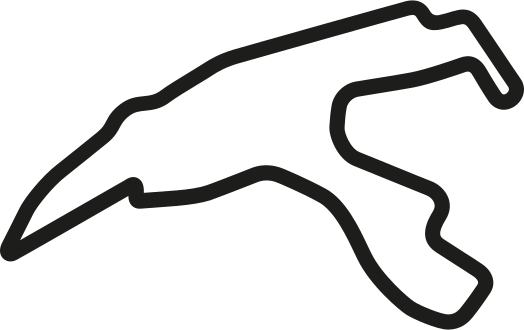
He died on 23 February 2008 in Saint-Paul-de-Vence, France. In recognition of his enduring impact on the sport, Turn 15 at the Circuit de Spa-Francorchamps, formerly part of the Stavelot corner, was renamed in his honour.
Rowing achievements
Beyond motorsport, Frère was also a highly accomplished rower. He won three Belgian national rowing championships: claiming titles in 1946 and 1947 in the coxless four, and also winning the coxed four championship in 1946—a testament to his athleticism well beyond the racetrack.
Paul Frere Formula One World Championship career
| F1 Career | 1952–1956 |
|---|---|
| Teams | HWM, Gordini, Ferrari |
| Entries | 11 |
| Championships | 0 |
| Wins | 0 |
| Podiums | 1 |
| Career points | 11 |
| Pole positions | 0 |
| Fastest laps | 0 |
| First entry | 1952 Belgian Grand Prix |
| Last entry | 1956 Belgian Grand Prix |
Paul Frere Teammates
| 16 drivers | Involvement | First Year | Last Year |
|---|---|---|---|
| Roger Laurent | 1 | 1952 | |
| Lance Macklin | 3 | 1952 | 1953 |
| Peter Collins | 4 | 1952 | 1956 |
| Johnny Claes | 2 | 1952 | |
| Albert Scherrer | 1 | 1953 | |
| André Simon | 1 | 1954 | |
| Jean Behra | 3 | 1954 | |
| André Pilette | 3 | 1954 | 1956 |
| Jacques Pollet | 1 | 1954 | |
| Clemar Bucci | 1 | 1954 | |
| Maurice Trintignant | 2 | 1955 | |
| Harry Schell | 1 | 1955 | |
| Piero Taruffi | 2 | 1955 | |
| Giuseppe Farina | 2 | 1955 | |
| Eugenio Castellotti | 1 | 1956 | |
| Juan Manuel Fangio | 1 | 1956 |
Paul Frere Complete Formula One Results
| Year | Team | Chassis | Engine | 1 | 2 | 3 | 4 | 5 | 6 | 7 | 8 | 9 | WDC | Pts |
|---|---|---|---|---|---|---|---|---|---|---|---|---|---|---|
| 1952 | HW Motors Ltd | HWM 52 | Alta 2.0 L4 | SUI | 500 | BEL 5 | FRA | GBR | GER Ret | 16th | 2 | |||
| Ecurie Belge | Simca – Gordini T15 | Gordini 1.5 L4 | NED Ret | ITA | 16th | |||||||||
| 1953 | HW Motors Ltd | HWM 53 | Alta 2.0 L4 | ARG | 500 | NED | BEL 10 | FRA | GBR | GER | SUI Ret | ITA | NC | 0 |
| 1954 | Equipe Gordini | Gordini T16 | Gordini 2.0 L6 | ARG | 500 | BEL Ret | FRA Ret | GBR | GER Ret | SUI | ITA | ESP | NC | 0 |
| 1955 | Scuderia Ferrari | Ferrari 555 | Ferrari 106 2.5 L4 | ARG | MON 8 | 500 | BEL 4 | NED | GBR | ITA | 15th | 3 | ||
| 1956 | Scuderia Ferrari | Lancia Ferrari D50 | Lancia Ferrari DS50 2.5 V8 | ARG | MON | 500 | BEL 2 | FRA | GBR | GER | ITA | 7th | 6 |