




















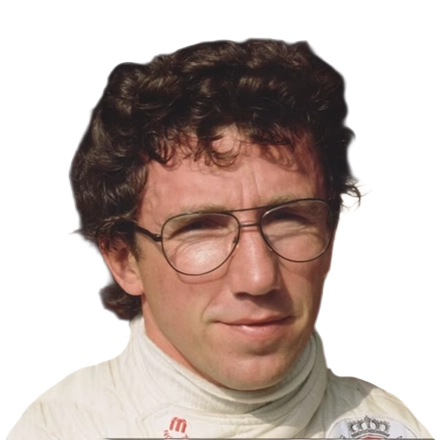
Rolf Johann Stommelen was one of Germany’s most fearless and versatile racing drivers, a man whose career stretched across Formula One, endurance racing, touring cars, and prototypes. Best known for his speed, bravery, and technical feel behind the wheel, Stommelen competed in Formula One from 1969 to 1978 and forged a formidable reputation in sports car racing. Across an era packed with legends, he became one of endurance racing’s true specialists—most notably winning the 24 Hours of Daytona four times with Porsche.
Driver Bio
| Nationality | German |
| Birthplace | Siegen, Germany |
| Born | 11 July 1943 |
| Died | 24 April 1983 |
| First Grand Prix | 1970 South African Grand Prix |
| Last Grand Prix | 1978 Canadian Grand Prix |
| Years Active | 1970–1976, 1978 |
| Current/Last Team | Arrows |
In Formula One, Stommelen entered 63 World Championship Grands Prix, scoring one podium finish and 14 championship points. While he never had the machinery to consistently challenge the sport’s biggest stars, he earned widespread respect as a quick, dependable and courageous driver who could adapt to almost anything on four wheels. He also competed in several non-championship Formula One events during a time when such races still carried prestige.
Born in Siegen on 11 July 1943, Stommelen came of age in post-war Germany and rose through the country’s rapidly rebuilding motorsport scene. By the mid-1960s, he was already making his mark in sports cars, where his blend of precision and bravery made him a natural fit for long-distance racing. In 1967, he claimed victory in the legendary Targa Florio driving for Porsche—an early sign that he belonged among Europe’s elite endurance racers.
24 Hours of Le Mans
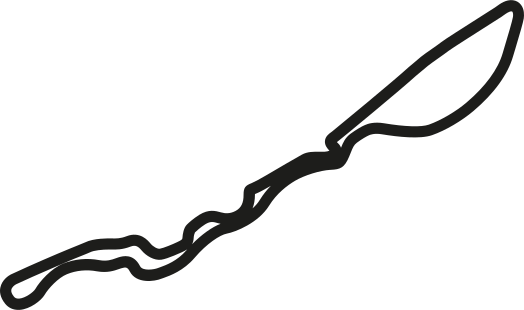
His reputation soared further at the 24 Hours of Le Mans. In 1968, he finished third in a Porsche 908, and in 1969, he claimed pole position in the mighty Porsche 917. During that event, he became the first driver recorded at over 350 km/h (217 mph) on Le Mans’ famous Mulsanne Straight, underlining both his nerve and the astonishing pace of the new-generation prototypes.
Formula One
In 1970, Stommelen stepped into Formula One with Brabham, backed by sponsorship arranged through the German publication Auto, Motor und Sport. Throughout the decade, he balanced Grand Prix racing with an extensive programme in sports cars, often racing for factory-backed Porsche efforts as well as other teams. It was a demanding dual career, but one that suited his relentless competitiveness.
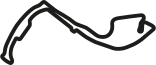
One of the darkest moments of his Formula One years came at the 1975 Spanish Grand Prix at Montjuïc Park Circuit. When the rear wing of his Embassy Hill car failed, the machine was launched into the crowd, tragically killing five spectators and seriously injuring Stommelen. The accident effectively ended Formula One’s association with the circuit and remains one of the sport’s most sobering incidents.
Beyond FOrmula One
Remarkably, Stommelen returned to racing after recovering from those injuries. If anything, his determination only strengthened his standing in endurance racing. He went on to score wins for Alfa Romeo and added three more victories at Daytona, bringing his total to four: 1968, 1978, 1980 and 1982. Few drivers of his generation matched that level of sustained success over such a long period.
In 1976, he was chosen to debut the new Porsche 936 at the 300 km Nürburgring. The car’s sinister all-black appearance earned it the nickname “Black Widow.” In treacherous wet conditions, Stommelen produced one of the drives for which he is still fondly remembered. After seizing the lead, he later suffered a stuck throttle cable—yet somehow continued by switching the master electrical system off in corners to slow the car, then back on to accelerate on the straights. Against all logic, he still finished second. The feat became part of Nürburgring folklore and reinforced his reputation as a master of the Nordschleife.
Two years later, Porsche entrusted him with the spectacular Porsche 935/78 ‘Moby Dick’ at Le Mans. Wearing Martini colours and powered by an 845-horsepower turbocharged engine, the machine was among the fastest cars of its era. Stommelen reached 365 km/h (235 mph) on the Mulsanne Straight, making him the fastest driver there that year—even quicker than several prototype rivals. Fuel consumption ultimately prevented a serious challenge for victory, but the speed was unforgettable.
At Le Mans again in 1979, he came agonisingly close to a famous win in a Porsche 935 alongside Dick Barbour and Paul Newman. Their challenge was ruined by a lengthy pit stop caused by a stubborn wheel nut, costing precious time and likely the chance of overall victory.
Back in Germany, Stommelen also excelled in the Deutsche Rennsport Meisterschaft, winning the 1977 title for Gelo Racing Team in a Porsche 935. He was especially formidable at the Nürburgring, where his local knowledge and fearless commitment made him a regular winner.
Even into the 1980s, Stommelen remained in demand as a prototype ace, driving machines such as the Kremer CK5, Lancia LC1 and Porsche 956. Age had not dulled his speed, and teams still trusted him with their most serious programmes.
Death
Tragically, his life ended on 24 April 1983 during the Los Angeles Times Grand Prix IMSA event at Riverside International Raceway. Driving a Porsche 935 entered by John Fitzpatrick and shared with Derek Bell, Stommelen had just taken over the car and was running second when the rear wing failed at around 190 mph (306 km/h). The car crashed heavily into a concrete wall, overturned, and caught fire. He was killed instantly from the impact injuries.
Grand Prix Stats
| Race Entries | 62 |
| Race Starts | 53 |
| Did Not Start | 2 |
| Best Race Start | 7th |
| Best Race Finish | 3rd |
| Retirements | 16 |
| First-Lap Retirements | 0 |
| Not Classified | 1 |
| Disqualified | 2 |
| Did Not Qualify | 4 |
Podiums
| Podiums | 1 |
| First Podium | 1970 Austrian Grand Prix |
| Last Podium | 1970 Austrian Grand Prix |
| 1st Place | 0 |
| 2nd Place | 0 |
| 3rd Place | 1 |
| Most Consecutive Podiums | 0 |
| Most Podiums in a Single Season | 1 (1970) |
| Seasons with Podiums | 1 |
Qualifying
| Qualifying Sessions | 62 |
| Reached Q3 | 0 |
| Q2 Eliminations | 0 |
| Q1 Eliminations | 0 |
| Did Not Qualify | 4 |
Points
| Points Scored | 14 |
| Points Finishes | 7 |
| Most Points in a Single Season | 10 (1970) |
| Seasons with Points | 3 |
Stats by Season
| Year | Constructor | Entries | Starts | Wins | Podiums | Poles | Fastest Laps | Front Rows | DNF | Best Start | Best Result | Pts Finishes | Points | Championship |
|---|---|---|---|---|---|---|---|---|---|---|---|---|---|---|
| 1970 | Brabham | 13 | 10 | 0 | 1 | 0 | 0 | 0 | 4 | 7 | 3 | 4 | 10 | 11th |
| 1971 | Surtees | 10 | 9 | 0 | 0 | 0 | 0 | 0 | 2 | 10 | 5 | 2 | 3 | 18th |
| 1972 | Eifelland | 8 | 8 | 0 | 0 | 0 | 0 | 0 | 2 | 14 | 10 | 0 | 0 | NC |
| 1973 | Brabham | 4 | 4 | 0 | 0 | 0 | 0 | 0 | 1 | 9 | 11 | 0 | 0 | NC |
| 1974 | Hill | 4 | 4 | 0 | 0 | 0 | 0 | 0 | 2 | 11 | 11 | 0 | 0 | NC |
| 1975 | Hill | 6 | 6 | 0 | 0 | 0 | 0 | 0 | 2 | 9 | 7 | 0 | 0 | NC |
| 1976 | RAM, Brabham, Hesketh | 3 | 3 | 0 | 0 | 0 | 0 | 0 | 1 | 15 | 6 | 1 | 1 | 19th |
| 1978 | Arrows | 14 | 9 | 0 | 0 | 0 | 0 | 0 | 2 | 17 | 9 | 0 | 0 | NC |
Stats by Constructor
| Constructor | Years | Entries | Starts | Wins | Podiums | Poles | Fastest Laps | Front Rows | DNF | Best Start | Best Result | Pts Finishes | Points |
|---|---|---|---|---|---|---|---|---|---|---|---|---|---|
| Brabham | 1970, 1973, 1976 | 19 | 16 | 0 | 1 | 0 | 0 | 0 | 6 | 7 | 3 | 5 | 11 |
| Surtees | 1971 | 10 | 9 | 0 | 0 | 0 | 0 | 0 | 2 | 10 | 5 | 2 | 3 |
| Eifelland | 1972 | 8 | 8 | 0 | 0 | 0 | 0 | 0 | 2 | 14 | 10 | 0 | 0 |
| Hill | 1974–1975 | 7 | 7 | 0 | 0 | 0 | 0 | 0 | 2 | 11 | 7 | 0 | 0 |
| Hill | 1975 | 3 | 3 | 0 | 0 | 0 | 0 | 0 | 2 | 9 | 16 | 0 | 0 |
| Hesketh | 1976 | 1 | 1 | 0 | 0 | 0 | 0 | 0 | 0 | 25 | 12 | 0 | 0 |
| Arrows | 1978 | 14 | 9 | 0 | 0 | 0 | 0 | 0 | 2 | 17 | 9 | 0 | 0 |
Teammates & Qualifying Head-to-Head
| Teammate | Years | Races | Qualifying H2H |
|---|---|---|---|
| Graham Hill | 1974, 1975 | 7 | 4-3 |
| Tony Brise | 1975 | 2 | 1-1 |
| Carlos Pace | 1976 | 2 | 1-1 |
| Carlos Reutemann | 1976 | 1 | 0-1 |
| Riccardo Patrese | 1978 | 13 | 2-11 |