




























Life was an Italian Formula One constructor based in Modena that competed during the 1990 Formula One World Championship. Founded by Ernesto Vita—whose surname translates to “Life” in English—the team became famous for one of the most unconventional projects in Formula One history: a unique W12 engine designed by former Ferrari engineer Franco Rocchi.
The ambitious concept promised innovation but delivered one of the least competitive cars ever to attempt a Formula One season. Life failed to qualify for all 14 Grands Prix it entered in 1990, with the team frequently several seconds slower than the rest of the field.
| Nationality | Italian |
| Base | Formigine, Italy |
| Years Active | 1990 |
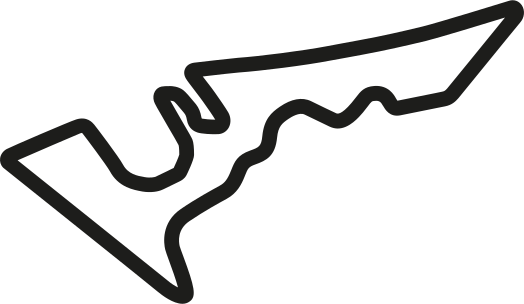
| First Race | 1990 United States Grand Prix |
| Last Race | 1990 Spanish Grand Prix |
| Race Entries | 14 |
| Race Starts | 0 |
| Podiums | 0 |
| Pole Positions | 0 |
| Fastest Laps | 0 |
| Points | 0 |
| Constructors’ Championships | 0 |
| Drivers’ Championships | 0 |
| Best Start | Never qualified |
| Best Finish | Never classified (constructor), Never classified (driver) |
| Did Not Start | 0 |
| Did Not Qualify | 0 |
| Retirements | 0 |
The W12 Engine
Life’s Formula One project centred around Franco Rocchi’s unusual W12 engine, sometimes described as a “broad arrow” configuration. Rocchi had previously worked at Ferrari, where he contributed to several successful engine programmes, including the company’s 3.0-litre V8 used in the Ferrari 308 GTB and GTS road cars.
The origins of the design stretched back to the late 1960s, when Rocchi developed a small W3 prototype as part of an ambitious proposal for a Ferrari W18 racing engine. After leaving Ferrari in 1980, he continued refining the concept independently before Ernesto Vita persuaded him to complete a Formula One version.
The resulting naturally aspirated 3.5-litre engine featured three banks of four double overhead camshaft cylinders. The layout made it significantly shorter than a conventional V12 while being taller than a V8, giving it a distinctive appearance reminiscent of the historic Napier Lion aircraft engine.
The timing initially appeared promising. Formula One had recently outlawed turbocharged engines, creating opportunities for new manufacturers. Companies such as Judd, Ilmor and Yamaha entered the sport with fresh designs, while Ferrari and Lamborghini continued with V12 engines and Renault and Honda pioneered increasingly successful V10 concepts.
Vita hoped to sell the W12 to an established Formula One team, but after failing to find a customer during 1989, he made the bold decision to enter Formula One himself.
Birth of the Team
Ernesto Vita established Life Team to showcase the W12 engine. The operation was initially split between technical offices in Reggio Emilia and production facilities in Formigine before being consolidated into a single base near Modena.
Although modest by Formula One standards, the workshop included an engine dynamometer, development equipment and the machinery needed to manufacture and maintain the W12 power unit.
Without the resources to build an entirely new car, Life purchased the unused Formula One chassis originally developed by FIRST Racing. Designed by Richard Divila for Lamberto Leoni’s aborted Formula One project, the chassis was extensively modified by former Ferrari engineer Gianni Marelli to accommodate Rocchi’s unconventional engine.
Renamed the Life L190, the completed car made its first test outings at Vallelunga and Monza ahead of the 1990 season.
The 1990 Formula One Season
From the outset, the Life project struggled against overwhelming technical limitations. The W12 engine proved to be the weakest power unit on the Formula One grid. Officially, it was reported to produce around 470 bhp, while rival engines delivered between 600 and 700 bhp. Later accounts suggested the true figure may have been little more than 300 bhp.
The problems extended well beyond the engine. The adapted FIRST chassis was among the heaviest in Formula One, while poor handling and chronic reliability issues meant the L190 was often slower than contemporary Formula Three machinery and hopelessly uncompetitive against the rest of the Formula One field.
Several established drivers were approached before the season, including Gabriele Tarquini, Pierluigi Martini, Roberto Moreno and Gianni Morbidelli. Ultimately, Gary Brabham, the youngest son of three-time World Champion Sir Jack Brabham, was signed as the team’s race driver, with Franco Scapini serving as test driver and Sergio Barbasio appointed team manager.
Brabham’s time with the team was brief. After failing to pre-qualify for the opening two Grands Prix, he walked away from the project, later describing numerous operational shortcomings, including a non-functioning tachometer and the team having to borrow a tyre pressure gauge from rivals EuroBrun. He also urged Vita to abandon the W12 in favour of a conventional Judd V8 engine, but the proposal was rejected. Around the same time, chief designer Gianni Marelli also departed following disagreements with Vita.
Life explored several replacements, including Bernd Schneider, who declined the offer, while Scapini was unable to secure the FIA Super Licence required to race. New Zealander Rob Wilson was also contacted before veteran Italian Bruno Giacomelli accepted the drive.
Giacomelli brought valuable recent Formula One experience from his testing role with Leyton House. However, even his experience could do little to improve the fortunes of the team. At the San Marino Grand Prix, the Life’s lack of pace became painfully apparent, with Giacomelli later admitting he feared being struck by faster cars. During pre-qualifying, his engine failed before completing an out lap, but because the car’s timing transponder remained active while it was being towed back to the pits, he was officially recorded with a lap time almost six minutes slower than the next competitor.
Recognising the W12’s shortcomings, Life finally abandoned the project before the Portuguese Grand Prix and installed a Judd CV V8 engine instead. The conversion was completed in less than three weeks despite the team’s tiny workforce and limited budget. Although the modified L190 successfully left the pit lane for pre-qualifying at Estoril, its first flying lap ended almost immediately when the engine cover detached and flew off the car.
Life’s final Formula One appearance came at the Spanish Grand Prix at Jerez. After another failure to qualify, the team withdrew before the final two races of the season, bringing its Formula One adventure to an end.
Throughout the campaign, the entire race operation typically consisted of only nine people, underlining just how small and underfunded the project had been compared with its rivals.
Legacy
Although the Life project is often remembered as one of Formula One’s least successful constructors, it has also become one of the sport’s most fascinating engineering curiosities. Its ambitious W12 engine remains one of the most unusual power unit concepts ever to appear in Grand Prix racing.
In 2009, the original Life L190 was fully restored by former chief mechanic Oliver Piazzi and returned to action at the Goodwood Festival of Speed with its original W12 engine reinstalled. Driven by Arturo Merzario and then-owner Lorenzo Prandina, the car successfully completed the famous hill climb, giving one of Formula One’s most infamous machines a fitting second life.
Life Stats by Season
| Year | Engine | Drivers | Entries | Starts | Wins | Podiums | Poles | Fastest Laps | Front Rows | DNF | Best Start | Best Result | Points | Championship |
|---|---|---|---|---|---|---|---|---|---|---|---|---|---|---|
| 1990 | Life W12, Judd V8 | Gary Brabham, Bruno Giacomelli | 14 | 0 | 0 | 0 | 0 | 0 | 0 | 0 | DNQ | DNQ | 0 | NC |

