

























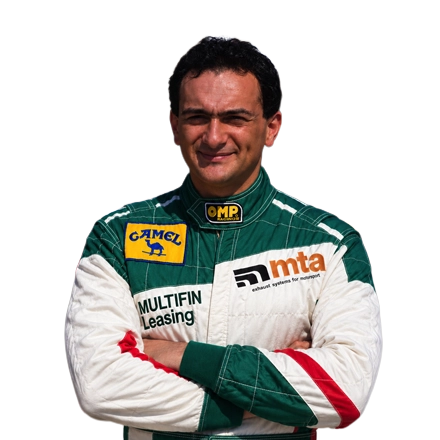
Gabriele Tarquini (born 2 March 1962) is an Italian former racing driver and motorsport executive whose career stretched from Formula One’s pre-qualifying era to the modern age of TCR competition. He raced in Formula One between 1987 and 1995, then established himself as one of touring-car racing’s defining drivers.
Driver Bio
| Nationality | Italian |
|---|---|
| Born | 2 March 1962 Giulianova, Italy |
| Active years | 1987–1992, 1995 |
| Teams | Osella, Coloni, First, AGS, Fondmetal, Tyrrell |
| Entries | 78 (38 starts) |
| Championships | 0 |
| Wins | 0 |
| Podiums | 0 |
| Career points | 1 |
| Pole positions | 0 |
| Fastest laps | 0 |
| First entry | 1987 San Marino Grand Prix |
| Last entry | 1995 European Grand Prix |
Tarquini won the British Touring Car Championship with Alfa Romeo in 1994, the European Touring Car Championship in 2003 and the World Touring Car Championship with SEAT in 2009. At 47 years and 266 days, that WTCC success made him the oldest FIA World Champion. Nine years later, aged 56, he added the 2018 World Touring Car Cup.
Born in Giulianova, Tarquini began karting at 14. He entered 78 Formula One Grands Prix for Osella, Coloni, First, AGS, Fondmetal, and Tyrrell, scoring one championship point. His record 40 unsuccessful qualifying attempts—25 of them in pre-qualifying—says rather more about the machinery he drove than the talent behind the wheel.
After retiring from competition in 2021, Tarquini moved into management. In 2026, he became sporting director of Genesis Magma Racing for its FIA World Endurance Championship programme.
Formula One
Tarquini entered competitive karting in 1976 and reached Formula 3000 in 1985. Three seasons with underfunded teams brought limited rewards, although he finished second at Imola in 1987.
By then, he had already made his Formula One debut through a one-off appearance for Osella at the 1987 San Marino Grand Prix.
Coloni and First
Tarquini joined Coloni for the 1988 Formula One season, having previously raced for the team in Formula 3000. With 31 cars chasing only 30 places in regular qualifying, the championship introduced a preliminary Friday session for its least-established entrants.
Coloni was among the teams required to participate, alongside Rial, Dallara and EuroBrun. Tarquini repeatedly found himself eliminated despite setting faster times than several drivers whose teams were exempt from the session.
Even so, his performances attracted favourable attention. He started eight Grands Prix—more than any other Coloni driver managed—and finished eighth in Canada, which remained the team’s best Formula One result.
For 1989, Tarquini signed with another former Formula 3000 employer, First Racing. He represented the team at the Formula One Indoor Trophy, but its Grand Prix car failed the mandatory crash tests, leaving him without a seat when the World Championship began.
AGS
An opportunity emerged after Philippe Streiff suffered career-ending injuries in a pre-season testing accident. From the second round onwards, Tarquini joined Joachim Winkelhock at AGS.
His arrival transformed the atmosphere around the small French team. At Imola, Tarquini finished eighth on the road before the exclusions of Thierry Boutsen and Alex Caffi elevated him to sixth. That result initially earned him a championship point.
At Monaco, he threatened to qualify among the leading six before securing 13th on the grid. During the race he climbed as high as fourth, only for an electrical fault to end one of the strongest drives of his Formula One career.
Tarquini crossed the line sixth again at the following Mexican Grand Prix. By then, however, Williams and Scuderia Italia had successfully appealed against their Imola exclusions, removing the point he had briefly held. Mexico therefore became his official first—and ultimately only—World Championship score.
More frustration followed in Phoenix, where he maintained sixth despite technical trouble before Boutsen passed him on the final lap. In a wet Canadian Grand Prix, Tarquini was again running competitively until René Arnoux pushed him off the circuit.
The season then moved onto faster tracks that exposed the AGS car’s limitations. Results elsewhere also stripped the entry of the exemption earned through Streiff’s 1988 performances, placing Tarquini into pre-qualifying for the second half of the year.
By then, pre-qualifying had become a brutal one-hour contest involving drivers and teams such as Michele Alboreto and Philippe Alliot at Larrousse, Roberto Moreno at Coloni, the two Osellas and the Onyx pairing of Stefan Johansson and Bertrand Gachot. Only four cars progressed. Tarquini and new teammate Yannick Dalmas struggled, and neither reached another race that season.
AGS attempted to expand for 1990, but insufficient funding and the delayed JH25 left the team trapped near the foot of the field. Tarquini qualified four times and reached the finish only once, placing 13th in Hungary.
The financial situation deteriorated further in 1991. Initially spared pre-qualifying, Tarquini started three early-season races and finished a creditable eighth in Phoenix. After Monaco, however, AGS failed to qualify again.
Fondmetal
Near the end of 1991, the cash-starved AGS operation sold Tarquini’s contract to Gabriele Rumi’s more ambitious Fondmetal team. He joined in time for the Spanish Grand Prix and quickly developed a strong relationship with the organisation.
Retained for 1992, Tarquini showed flashes of speed in the tidy but insufficiently developed Fondmetal GR02. He even qualified ahead of Ivan Capelli in a Ferrari in Belgium. Reliability was disastrous, however, and his only finish was 14th at Silverstone after clutch trouble.
Fondmetal’s funding disappeared after the Italian Grand Prix, forcing the team to close and leaving Tarquini without a Formula One seat.
Tyrrell
By 1995, Tarquini was 33 and firmly established as a touring-car star. Fondmetal’s sponsorship connection nevertheless helped him secure a position as Tyrrell’s test driver.
When Ukyo Katayama was injured in a start-line accident, Tarquini replaced him at the European Grand Prix. With little recent single-seater experience and minimal testing because of Tyrrell’s limited budget, he finished 14th, six laps behind winner Michael Schumacher.
It was Tarquini’s final Grand Prix and remains the last Formula One appearance by a reigning British Touring Car Champion.
Although his 40 failures to qualify remain a record, Tarquini spent much of his Formula One career wrestling cars that were barely capable of reaching the grid. Like his contemporary Roberto Moreno, he became regarded as a talented driver whose statistics were shaped by chronically uncompetitive equipment.
Touring-car career
Alfa Romeo and the BTCC
Tarquini found a much better showcase for his aggression and technical ability in touring cars. He became Alfa Romeo’s leading driver in the 1993 Italian Superturismo Championship, finishing third behind Roberto Ravaglia and Fabrizio Giovanardi.
He moved to Britain in 1994 and immediately conquered the British Touring Car Championship. Driving Alfa Romeo’s aerodynamically adventurous 155, Tarquini won the title at his first attempt and became one of the defining figures of the Super Touring era.
Alfa initially returned him to the Italian championship for 1995. After recording two victories, four third places and six retirements, he switched back to Britain to help Prodrive improve the manufacturer’s BTCC programme.
Tarquini remained with Alfa Romeo for the 1996 International Touring Car Championship, winning once and taking one runner-up finish in the spectacular Class 1 machinery.
Honda years
When Class 1 collapsed, Tarquini signed a five-year agreement with Honda. His first season brought another BTCC campaign with Prodrive in 1997. He finished sixth in the standings after collecting one victory, one second place and three thirds.
He spent 1998 and 1999 in Germany’s STW Cup with JAS Motorsport, earning two wins and several podium finishes, before returning to the BTCC for a third campaign in 2000.
Tarquini’s final Honda season came in the 2001 European Super Touring Championship. He won nine races and finished third behind Alfa Romeo drivers Giovanardi and Nicola Larini.
European champion
After sitting out 2002, Tarquini reunited with Alfa Romeo and Nordauto for the 2003 European Touring Car Championship. Just as he had done in Britain nine years earlier, he won the title in his first season back.
He remained Alfa’s strongest performer in the final ETCC season of 2004, placing third behind BMW drivers Andy Priaulx and Dirk Müller.
World Touring Car Championship
Alfa Romeo and SEAT
The ETCC became the World Touring Car Championship in 2005. Tarquini stayed with Alfa Romeo, winning twice and finishing seventh overall.
He joined SEAT Sport for 2006 as part of the manufacturer’s six-driver line-up. One victory helped him to fifth in his first season, while another single win accompanied eighth place in 2007.
The programme clicked in 2008. Tarquini won three races and finished runner-up to teammate Yvan Muller. He returned even stronger in 2009, sealing the World Championship at the Macau finale and becoming the oldest FIA World Champion.
SUNRED and Lukoil
SEAT withdrew its factory team for 2010 but supported the semi-works SR-Sport operation. Tarquini won five times—including a Belgian victory inherited after Jordi Gené’s exclusion—and fought to retain his title. A crash in the second Japanese race effectively ended the challenge, leaving him runner-up to Muller.
Driving for Lukoil-SUNRED alongside Aleksei Dudukalo in 2011, Tarquini began with SEAT’s two-litre diesel before switching to SUNRED’s 1.6-litre turbo engine at Brno. Chevrolet dominated the season, and Tarquini finished fifth with one victory.
He remained with Lukoil for 2012, now using a SEAT León equipped with the manufacturer’s new turbocharged engine. Tarquini claimed pole at the opening Italian round and finished third in its first race. Contact with Rob Huff later contributed to a damaged and distant finish in Portugal, although neither driver was penalised.
Honda and Lada
Honda selected Tarquini and Tiago Monteiro to lead its factory-supported JAS Motorsport programme in 2013. Tarquini gave the returning manufacturer its first WTCC pole position in Morocco and regularly placed the Civic near the front.
He remained with Honda through 2015 before joining Lada for the final WTCC season of his career in 2016. Despite the car’s limited competitiveness, Tarquini still delivered two victories.
World Touring Car Cup
Tarquini spent 2017 developing Hyundai’s new i30 N TCR, then joined BRC Racing for the inaugural World Touring Car Cup following the merger of the WTCC and TCR International Series.
Far from easing towards retirement, he became a title contender immediately. After a season-long fight with Yvan Muller, Tarquini secured the 2018 crown at the age of 56—his fourth major touring-car championship after the BTCC, ETCC and WTCC titles.
He continued racing Hyundai machinery through 2021 and announced his retirement at that year’s Race of Italy, ending a top-level career that had begun more than four decades earlier.
A 2005 Motor Sport magazine poll ranked Tarquini as the 11th-greatest touring-car driver of all time.
Management career
Tarquini later became sporting director of Genesis Magma Racing. The organisation entered the 2026 FIA World Endurance Championship with its GMR-001 prototype, returning Tarquini to international competition in a senior management role.
Complete Formula One results
| Year | Entrant | Chassis | Engine | 1 | 2 | 3 | 4 | 5 | 6 | 7 | 8 | 9 | 10 | 11 | 12 | 13 | 14 | 15 | 16 | 17 | WDC | Pts |
|---|---|---|---|---|---|---|---|---|---|---|---|---|---|---|---|---|---|---|---|---|---|---|
| 1987 | Osella Squadra Corse | Osella FA1G | Alfa Romeo 890T 1.5 V8 t | BRA | SMR Ret | BEL | MON | DET | FRA | GBR | GER | HUN | AUT | ITA | POR | ESP | MEX | JPN | AUS | NC | 0 | |
| 1988 | Coloni SpA | Coloni FC188 | Ford Cosworth DFZ 3.5 V8 | BRA Ret | SMR Ret | MON Ret | MEX 14 | CAN 8 | DET DNPQ | FRA DNPQ | GBR DNPQ | GER DNPQ | HUN 13 | BEL NC | NC | 0 | ||||||
| Coloni FC188B | ITA DNQ | POR 11 | ESP DNPQ | JPN DNPQ | AUS DNQ | |||||||||||||||||
| 1989 | FIRST Racing | First F189 | Judd CV 3.5 V8 | BRA DNA | 26th | 1 | ||||||||||||||||
| Automobiles Gonfaronnaises Sportives | AGS JH23B | Ford Cosworth DFR 3.5 V8 | SMR 8 | MON Ret | MEX 6 | USA 7† | CAN Ret | FRA Ret | GER DNPQ | |||||||||||||
| AGS JH24 | GBR DNQ | HUN DNPQ | BEL DNPQ | ITA DNPQ | POR DNPQ | ESP DNPQ | JPN DNPQ | AUS DNPQ | ||||||||||||||
| 1990 | Automobiles Gonfaronnaises Sportives | AGS JH24 | Ford Cosworth DFR 3.5 V8 | USA DNPQ | BRA DNPQ | NC | 0 | |||||||||||||||
| AGS JH25 | SMR DNPQ | MON DNPQ | CAN DNPQ | MEX DNPQ | FRA DNQ | GBR Ret | GER DNPQ | HUN 13 | BEL DNQ | ITA DNQ | POR DNQ | ESP Ret | JPN DNQ | AUS Ret | ||||||||
| 1991 | Automobiles Gonfaronnaises Sportives | AGS JH25 | Ford Cosworth DFR 3.5 V8 | USA 8 | BRA Ret | SMR DNQ | MON Ret | CAN DNQ | MEX DNQ | NC | 0 | |||||||||||
| AGS JH25B | FRA DNQ | GBR DNQ | GER DNQ | HUN DNPQ | BEL DNPQ | |||||||||||||||||
| AGS JH27 | ITA DNPQ | POR DNQ | ||||||||||||||||||||
| Fondmetal F1 SpA | Fomet F1 | ESP 12 | JPN 11 | AUS DNPQ | ||||||||||||||||||
| 1992 | Fondmetal F1 SpA | Fondmetal GR01 | Ford HBA5 3.5 V8 | RSA Ret | MEX Ret | BRA Ret | ESP Ret | SMR Ret | MON Ret | NC | 0 | |||||||||||
| Fondmetal GR02 | CAN Ret | FRA Ret | GBR 14 | GER Ret | HUN Ret | BEL Ret | ITA Ret | POR | JPN | AUS | ||||||||||||
| 1995 | Nokia Tyrrell Yamaha | Tyrrell 023 | Yamaha OX10C 3.0 V10 | BRA | ARG | SMR | ESP | MON | CAN | FRA | GBR | GER | HUN | BEL | ITA | POR | EUR 14 | PAC | JPN | AUS | NC | 0 |
Teammates & Qualifying Head-to-Head
| Teammate | Years | Races | Qualifying H2H |
|---|---|---|---|
| Alex Caffi | 1987 | 1 | 0-1 |
| Joachim Winkelhock | 1989 | 6 | 6-0 |
| Yannick Dalmas | 1989, 1990 | 23 | 14-9 |
| Stefan Johansson | 1991 | 2 | 2-0 |
| Fabrizio Barbazza | 1991 | 11 | 7-4 |
| Andrea Chiesa | 1992 | 10 | 10-0 |
| Eric van de Poele | 1992 | 3 | 3-0 |
| Mika Salo | 1995 | 1 | 0-1 |